Naukri Scraper for India Job Market Data

Naukri prints experience in years and required skills as separate fields on every posting, so the India job market can be cut by seniority and skill rather than by job title alone.

Plans from €169/month · Free project assessment · Reply within 1 business day

Naukri Scraper
Solutions

Naukri.com Scraper Services

Naukri assembles its pages in the browser, so the first markup is an empty shell, and automated requests meet a CAPTCHA challenge rather than a job record. Running a Naukri scraper at volume needs a rendered browser and a way through the edge protection. Anti-bot handling, proxy rotation and CAPTCHA solving are part of the service, not a surcharge.

You name the roles, skills, cities and cadence. We build the crawler, run it, repair it when the markup moves, and deliver CSV, JSON or an API endpoint on your schedule. These are scheduled crawls, not a live stream, and we state the expected lag.

What We Capture on Naukri

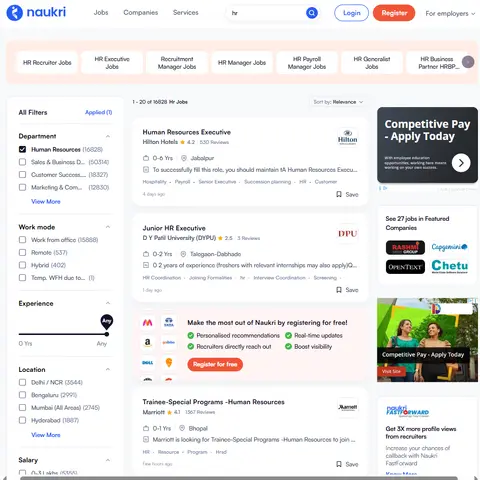
Two fields carry most of the value here and are the reason to scrape Naukri rather than a global aggregator. Experience is published as a band in years, not as a vague word like senior, and required skills sit in a list of their own rather than in prose. Both are readable before the posting opens: the job URL itself ends with the experience band and a numeric job id.

  • Job title as the employer wrote it, plus the designation Naukri files it under.
  • Experience range as printed and split into minimum and maximum years, so a 0 to 2 fresher opening and an 11 to 13 lead role never share a bucket.
  • Key skills as an array, with preferred skills in a second column.
  • Company name, the numeric company id and the employer page it links to.
  • Locations as a list, not one string: postings routinely name several cities at once, and metro groupings such as Delhi NCR and Mumbai All Areas are values in themselves.
  • Salary kept twice, as the printed string and as a parsed band. Indian pay is quoted in lakhs per annum: a lakh is one hundred thousand rupees, so 9-18 Lacs P.A. means nine to eighteen lakh rupees a year.
  • Work mode - work from office, hybrid or remote - and the employment type.
  • Role, role category, department or functional area, and industry type.
  • Education split into undergraduate and postgraduate requirements.
  • Openings, applicants and views where the posting publishes them.
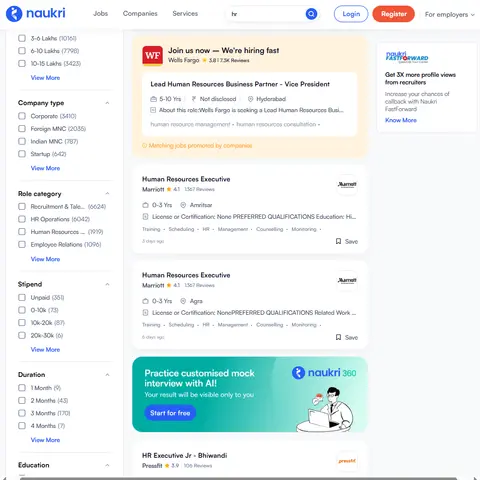
  • Employer type - placed by the company itself or by a hiring consultancy, a distinction Naukri marks and filters on.
  • Posted date, the freshness label, the job id and the canonical URL.

Salary is the field to be candid about. A large share of postings read Not Disclosed, and that column stays blank rather than carrying a modelled estimate. The Naukri salary data you get is real but partial, so plan around the rows that state a band.

What We Capture on Naukri
Employers, Closed Jobs and Crawl Boundaries

Employers, Closed Jobs and Crawl Boundaries

Company pages are a separate object. A Naukri employer lives at its own address ending in a numeric company id, with an overview and a jobs-by-location view indexed apart from the job list. We collect employer records alongside postings and join them on that id, but they move on different clocks and run as separate jobs.

Ratings come from AmbitionBox. The star rating and review count on a job card are supplied by AmbitionBox, a separate site in the Info Edge group with its own address and protection. Rating and count travel with the posting as printed on the card. Full review text sits on that other site and is scoped as its own project, not bundled into a Naukri feed.

Closed postings stay addressable. Naukri publishes an expired job description sitemap beside the live city files, plus an incremental sitemap of the newest pages. A job that closes becomes a dated event in your history instead of a row that vanishes, and the incremental file shows what changed since yesterday.

What we leave alone. The Naukri CV database, sold to recruiters as Resdex, is a login-gated store of registered candidate profiles. Candidate resumes, jobseeker profiles and recruiter contact details are personal data and stay out of the delivery.

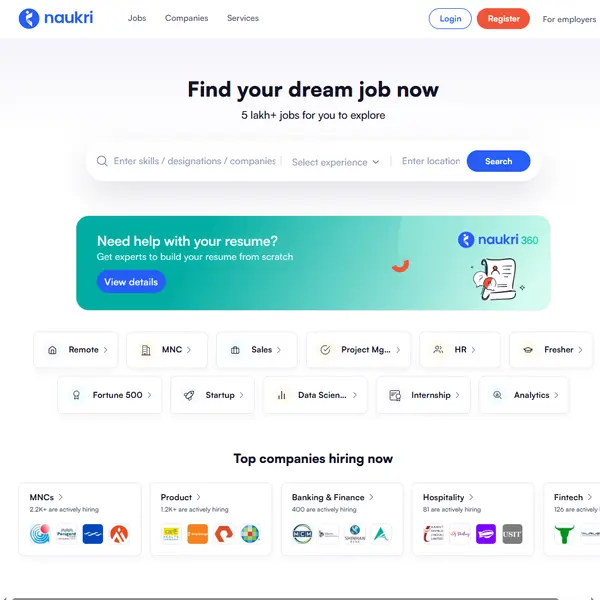
What Is Naukri?

Naukri.com is the main job board of the Indian market and has run since the late 1990s. It belongs to Info Edge (India), the listed group that also operates NaukriGulf, AmbitionBox, iimjobs, hirist and Job Hai. That ownership explains a detail which puzzles buyers: the employer star rating beside a Naukri job card comes from AmbitionBox, a sister site.

The board is built around a taxonomy, not a search box. Every posting is filed under a role and a role category, a department or functional area, an industry type, an employment type and an education requirement split into undergraduate and postgraduate lines. Separate sections carry PSU and government vacancies, international jobs, walk-in interviews and premium roles for top-institute graduates. Browsing runs by company, location, designation, skill, industry and functional area, with clusters such as Engineering and BFSI.

Geography is the other axis, and it is where Naukri parts from a Western board. The public sitemap keeps a job-by-location page for 195 places plus a tier-2 list of 121 cities, so hiring in Vapi, Ankleshwar or Silchar is indexed the way Bengaluru is. Anyone reading India job market data from the metros alone is reading a fraction of it.

Get a Quote

dev_w
25

Developers

customers
500+

Customers worldwide

pages
1 500 000 000+

Pages extracted

stime
15000+

Hours saved for our clients

Plans

Naukri Scraping Plans and Pricing

Airplane

€199 / one-time

setup fee - included

Data limits100,000
Frequencyone-time
Run timeup to 5 days
Data storing7 days

Helicopter

€169 / mo

setup fee €499

Data limits250,000
Frequencymonthly
Run timeup to 5 days
Data storing14 days

Glasses

€229 / mo

setup fee €499

Data limits1,000,000
Frequencyweekly
Run timeup to 5 days
Data storing30 days

DNA

€549 / mo

setup fee €799

Data limits3,000,000
Frequency3 times daily
Run timesame day
Data storing90 days

Why Scrape Naukri?

Scraping Naukri pays off because its structure cuts the Indian labour market more finely than a title search ever will.

  • Salary benchmarking in LPA. Bands are quoted in lakhs per annum against a stated experience range, so a pay curve by years of experience replaces a blunt average.
  • Skills demand data. Key skills are a list, not free text, so counting them month over month shows which stacks are being hired for.
  • Hiring trends by city. Posting volume across Bengaluru, Hyderabad, Pune, Delhi NCR and the tier-2 belt shows where capacity is being added before anyone announces it.
  • Employer tracking. Company pages carry a stable numeric id, so a watchlist survives name spelling changes.
  • Direct hiring versus consultancy churn. Naukri records whether a posting came from the employer or from a staffing agency acting for a client.
  • Feeding your own product. A recruitment data feed can populate a job board, an ATS or an internal dashboard.

Rows arrive cleaned, typed and de-duplicated on the job id.

Our Blog

Reads Our Latest News & Blog

Learn how to use web scraping to solve data problems for your organization

How Artificial Intelligence Is Used In Web Scraping

How Artificial Intelligence Is Used In Web Scraping

Leveraging advances in technology, the AI-powered web scraper has skyrocketed in demand and is helping to expand capabilities by automating tedious daily tasks and speeding up data collection from thousands of websites several times over.

What is Web Scraping and What is it Used For?

What is Web Scraping and What is it Used For?

Web scraping is a method of obtaining web data by extracting it from pages of web resources with the help of a program, that is, in automatic mode. It is used to syntactically convert web pages into more usable forms.

Web Scraping for Machine Learning

Web Scraping for Machine Learning

If you specialize in machine learning, you need to feed large amounts of data to the algorithms. Web scraping is the easiest and the most efficient method of collecting the data from all over the Internet.

scrapeit logo

About Scrapeit

Scrapeit is a managed scraping team, not a tool you install. You approve a sample first: field names, the salary parsing rule and the experience split are agreed on it, so month three matches week one.

We are not affiliated with Naukri or Info Edge. Naukri scraping here covers public job postings and employer pages only, and every delivery ships with a row count and a field-fill report.

FAQ

Do you offer a Naukri API for job data?

Yes. The ScrapeIt Naukri API returns job title, experience range, key skills, locations, salary and posted date as JSON from an endpoint we host, refreshed on the schedule you set. Field names stay fixed across repairs, so your code talks to something stable. The same data also comes as CSV or XLSX files or straight into your database.

What happens when a posting says Not Disclosed?

The salary columns stay empty. Many Naukri postings decline to publish pay, and we would rather show you a blank than a modelled guess dressed up as a figure. Where a band is stated, it is quoted in lakhs per annum, and we keep both the original string and a parsed minimum and maximum in rupees so you can filter on either. Your delivery includes the share of rows that carried a stated band, which is the number a pay study actually needs.

Can you extract Naukri data by skill, experience band or city?

Yes, and those are the natural axes here. Filters are applied at crawl time where Naukri supports them - keyword and key skill, location, minimum experience, minimum salary, industry, functional area, education, employer type, walk-in and freshness - and in post-processing where it does not. A brief such as data engineering roles at 5 to 10 years across Bengaluru, Hyderabad and Pune is a normal starting point.

Do you collect candidate resumes or recruiter contacts?

No. The Naukri CV database sits behind a recruiter login and is out of scope, as are jobseeker profiles. Recruiter names, direct phone numbers and personal email addresses are excluded by default rather than on request. Output is limited to public job postings and employer pages, which are business records.

Will the scraper break when Naukri changes?

Layout changes happen and we do not pretend otherwise. We monitor field fill rates on every run, so a selector that stops returning values raises an alert instead of quietly shipping empty columns, and repairing it is our work rather than a change order. Delivery formats and field names stay fixed across a repair, so your pipeline does not move when ours does.

How does it Work?

Step 1 - Make a Request

You share your needs, expectations, and desired timeframe. We’ll suggest the best solution based on your request and budget.

Step 2 - Configuring Custom Web Crawlers

Our specialists configure the crawlers and extract a sample dataset for your review before proceeding with the full-scale extraction.

Step 3 - Collect and Deliver

Once you approve the sample, we launch the project and start full data collection. We gather, filter, and structure the data for easy use, delivering it on time in your preferred format.

Step 4 - Maintain and Support

Our team manages ongoing processes, monitors website changes, and supports all data extraction cycles. We can also help integrate data into your systems or create dashboards to simplify analysis.

Request a Quote

Tell us more about you and your project information.
Which sites, which fields, how often. A couple of lines is enough.

We reply within 1 business day. No obligation.

scrapiet

Scrapeit Sp. z o.o.
10/208 Legionowa str., 15-099, Bialystok, Poland
NIP: 5423457175
REGON: 523384582