Massachusetts Zillow: For-Sale & Rentals Data Scraped - Refreshed Daily
Daily monitoring of real estate for sale and rent in Massachusetts on Zillow.com with full unit-level listing data.
Learn More
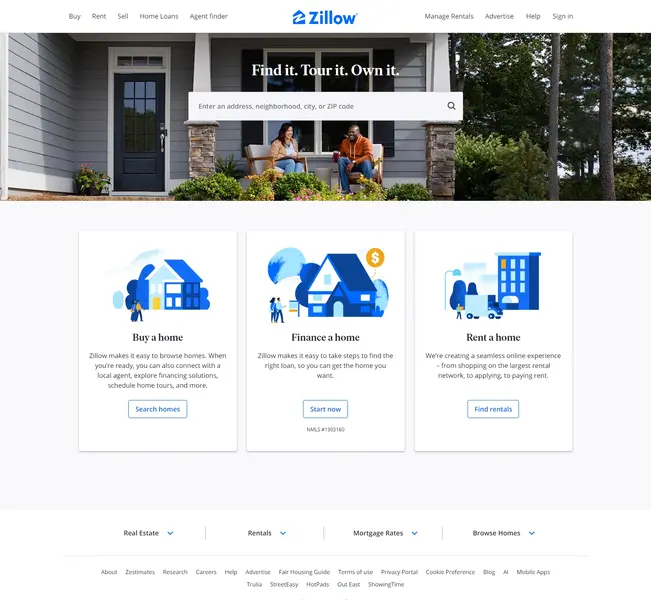
You name the geography, the statuses and the fields. We build the crawlers, run them on your schedule, repair them when Zillow changes its page layout, and hand over clean data. Rows are keyed on zpid so snapshots line up run after run, price history and tax history arrive as child files instead of being flattened into columns, and photo sets are stored separately and linked back by zpid so your main table stays light. Delivery as CSV, JSON, XLSX, straight into your database or through an API. You run no infrastructure and write no code. Plans start from EUR 199. We work with public data only, hold a GDPR and CCPA posture, and sign confidentiality agreements before the first crawl.
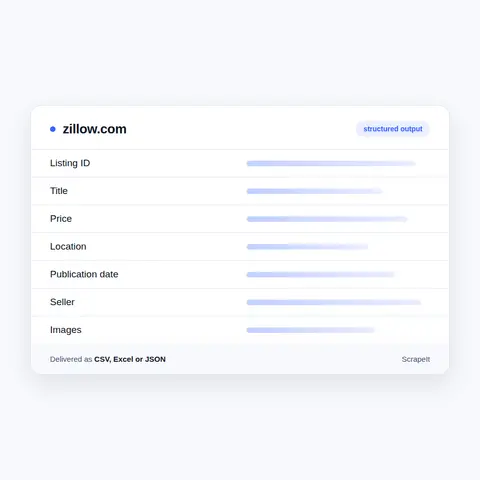
A Zillow extraction is normally specified as one row per zpid per crawl date, with the history tables delivered as child files so nothing is flattened away. Typical fields:
A one time export of Zillow tells you what the market claims today. The value that clients actually keep comes from running the same address set on a schedule and diffing the snapshots, because several of Zillow's most useful signals exist only as changes between crawls:
We keep the full snapshot history so these deltas are already computed when the file reaches you.
Zillow is the best known residential real estate marketplace in the United States, and the thing that makes it unusual as a data source is that its unit of record is not a listing. It is an address. One Zillow property page carries the same home whether it is for sale, for rent, pending, recently sold or simply sitting off market, and it keeps the same numeric zpid identifier through every one of those states. A Zillow record therefore looks nothing like a feed from a single brokerage or a classifieds site: next to the current asking price you also get the Zestimate and the Rent Zestimate, which are Zillow's own modeled values and a completely separate field from what the seller is asking, plus a price history table of listed, price change, pending, sold and delisted events, and a tax history table taken from county assessor records.
Everything else is layered on that address: ZIP, county, neighborhood, assigned elementary, middle and high schools with ratings, walk, transit and bike scores, HOA dues, parcel and MLS numbers, and the "Listing provided by" line naming the brokerage and agent. Property types run from single family, condo and townhouse through multi-family, manufactured homes and land, with new construction held as builder plans inside a community rather than as individual resale homes, and rentals split between whole-home listings and building level floor plans that carry several units under one page.
Get a Quote
Developers

Customers worldwide

Pages extracted

Hours saved for our clients
€199 / one-time
setup fee - included
€169 / mo
setup fee €499
€229 / mo
setup fee €499
€349 / mo
setup fee €499
€549 / mo
setup fee €799
Zillow puts the asking price, a modeled value and a rent estimate on the same address record, so much of the demand is arithmetic that is awkward to do anywhere else in a single row. Investors compute gross yield straight from Rent Zestimate against list price and filter for homes where the ask sits below the Zestimate range low. Appraisal and AVM teams use the sold and off-market side of the same address grain to build comparable sets that include homes never publicly relisted. Brokerages and proptech vendors track days on Zillow and price cut behavior by ZIP to see where negotiating power is moving. Lenders, insurers and iBuying operations use tax history and assessed value to sanity check what a market is really paying against what it is assessed at.
We should be plain about the engineering: Zillow is hard to collect at scale. The map search returns only a capped page of results per viewport, so a state has to be walked as a grid of small geographic cells rather than queried once. Pages render client side, inventory churns through the day, and rate limits are strict. We work only with publicly visible pages, we do not go behind any login, paywall or challenge, and we build the crawl around the geography rather than around a single search URL.

Daily monitoring of real estate for sale and rent in Massachusetts on Zillow.com with full unit-level listing data.
Learn More
Monitoring of real estate listings on funda.nl, pararius.com, rentberry.com, rentola.com, and zimmo.be to support the growth of a European property portal.
Learn More
Daily detection of new private property listings in Switzerland on Homegate.ch and ImmoScout24.ch, giving the agency first access to high-value leads.
Learn MoreLearn how to use web scraping to solve data problems for your organization

Real estate teams work in a fragmented data landscape. The sites that drive demand in Boston look nothing like the ones that matter in Berlin, São Paulo, Dubai, or Mumbai.

Real estate teams are operating in a data environment that is bigger, faster, and more fragmented than ever. Listings go live and disappear in hours, price cuts happen quietly, and the portals that matter most in each country are rarely the same global “top 5.”

Real estate web scraping: a powerful tool for data collection and analysis. Learn how to choose the right data collection method and benefit from real estate web scraping
Property portals are most of what we do. We already run Massachusetts Zillow for-sale and rentals refreshed daily. We collected 226K listings and 3.4M images from Immobilienscout24 across Germany and Mallorca, standardized five European property portals into one schema at 230,000 rows a day, and put Switzerland private listings into a client CRM through an API at 85K rows a day, live in 7 days. Address matching, media at volume and schema drift are familiar ground.
Yes. Because Zillow keeps for-sale, for-rent, sold and off-market homes on the same address record under one zpid, we can crawl any of those states and return them in one schema. Sold homes bring their sold price and sold date, off-market homes still carry the Zestimate, tax history and full price history table. This is the usual way clients build comparable sets that include properties never relisted publicly.
No, and we deliver them as separate columns. The asking price is what the seller wants. The Zestimate is Zillow's own modeled valuation, published with a range low and high, and the Rent Zestimate is the same idea for rent. Both appear on for-sale and off-market homes alike, which is what lets you compute yield or spot a listing priced under the model. We never merge the two fields.
The map search returns only a capped page of results per viewport, so a single statewide query can never return everything. We walk the geography instead: the area is split into a grid of cells small enough that each returns under the cap, then crawled cell by cell and deduplicated on zpid. Dense metros get finer cells than rural counties. Coverage is verified against ZIP and county-level counts between runs.
Yes. We pull the full public photo set at original resolution, plus floor plans where present and flags for whether a home has a 3D tour or video. Images are stored separately and linked back to the property by zpid, so your row stays light. We handled 3.4M images on a single European property project, so volume is not the constraint. We respect trademarks and do not repackage branded material.
Daily is the normal cadence for Zillow and it is what we already run on the Massachusetts for-sale and rental feed. Daily is also what the platform's own fields reward, since price cuts, pending flags and days on Zillow move intraday and a weekly crawl loses the sequence. Faster than daily is possible for a narrow watchlist of ZIPs or specific addresses. Slower is fine for research datasets.
Step 1 - Make a Request
You share your needs, expectations, and desired timeframe. We’ll suggest the best solution based on your request and budget.
Step 2 - Configuring Custom Web Crawlers
Our specialists configure the crawlers and extract a sample dataset for your review before proceeding with the full-scale extraction.
Step 3 - Collect and Deliver
Once you approve the sample, we launch the project and start full data collection. We gather, filter, and structure the data for easy use, delivering it on time in your preferred format.
Step 4 - Maintain and Support
Our team manages ongoing processes, monitors website changes, and supports all data extraction cycles. We can also help integrate data into your systems or create dashboards to simplify analysis.

Scrapeit Sp. z o.o.
10/208 Legionowa str., 15-099, Bialystok, Poland
NIP: 5423457175
REGON: 523384582