Booking.com, End-to-End: Hotels, Flights, Cars, Attractions Scraped Daily
Daily scraping of Booking.com services - hotels, flights, car rentals, and attractions - with best-price selection across global destinations.
Learn More
Plans from €169/month · Free project assessment · Reply within 1 business day
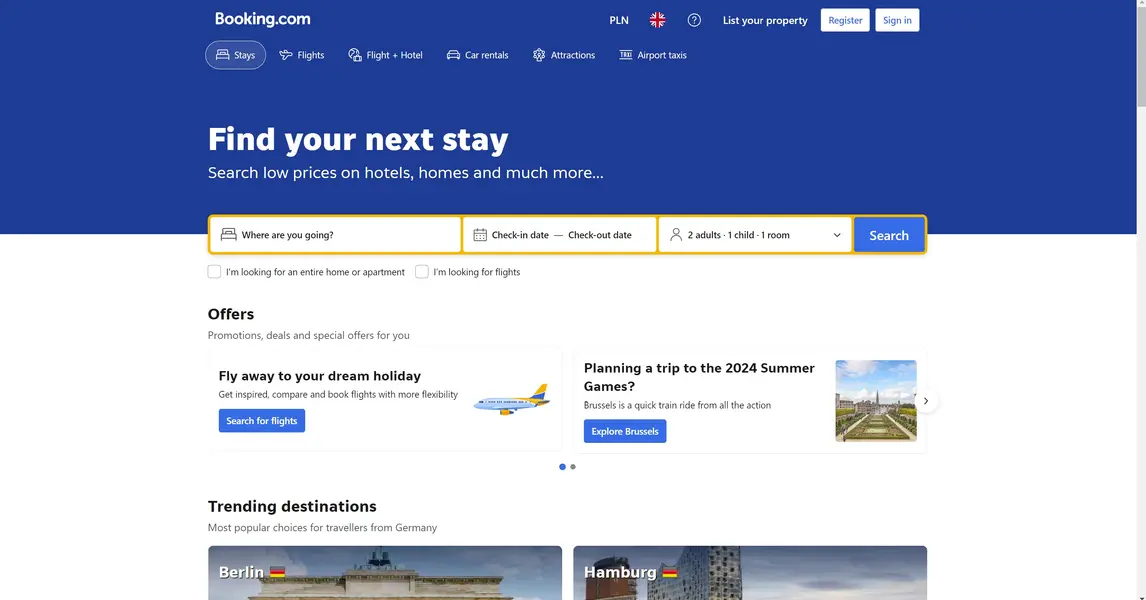
You name the destinations, the date grid, the occupancies, the currency and the fields. We build the crawlers, run them on your schedule, watch them, and fix them when Booking.com changes. You run no infrastructure and write no code.
Delivery is CSV, JSON, XLSX, straight into your database, or through an API your systems call. Plans start from EUR 169 a month, or EUR 199 for a one-time extract. Maintenance when the target changes is part of the plan, not an extra.
Every crawl is defined by your field list. A typical Booking.com specification includes:
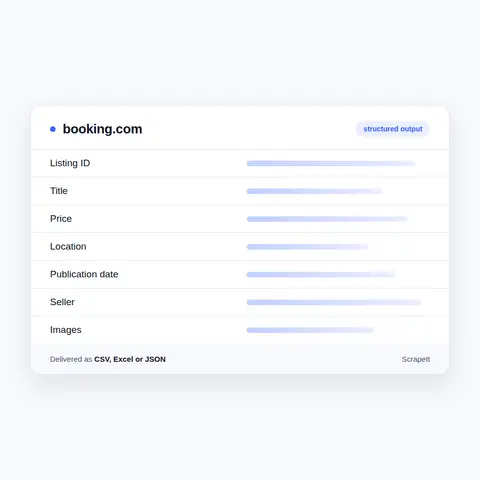
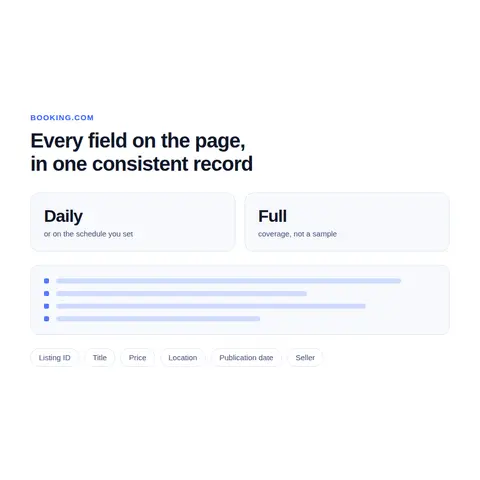
A single snapshot of Booking.com gives you today's prices. Running the same date grid every day gives you a different class of information:
Booking.com is a global accommodation and travel marketplace, and its inventory reaches well past hotels. Apartments, aparthotels, guesthouses, hostels, villas, B&Bs and holiday homes sit inside the same property taxonomy, and alongside stays the platform sells flights, car rental, attraction tickets and airport taxis.
The thing that shapes every serious collection project here is that a Booking.com price is not a property attribute - it is the answer to a query. The same room returns a different rate depending on check-in date, length of stay, number of adults, number and ages of children, room count, display currency and locale. Change one input and the number changes. A price stored without the query that produced it is not data, it is noise.
Above the rate sits the rate plan: board type from room only through breakfast included, half board and all inclusive; a cancellation deadline; prepay or pay at the property; and conditions such as non-refundable or a minimum stay. Below the rate sits the room itself: bed configuration, maximum occupancy, room size, and room-level facilities that are a different set from the property-level ones. One room is routinely sold under several plans at once, which is why the unit of a Booking.com dataset is the rate plan and not the property.
Get a Quote
Developers

Customers worldwide

Pages extracted

Hours saved for our clients
€199 / one-time
setup fee - included
€169 / mo
setup fee €499
€229 / mo
setup fee €499
€349 / mo
setup fee €499
€549 / mo
setup fee €799
Revenue managers rate-shop a compset the honest way: a fixed date grid, fixed occupancy, one currency, refreshed every morning, so the comparison holds. Without that discipline you end up comparing a two-night couple rate against a seven-night family rate and calling it a market move.
Distribution and parity teams use it to check that the rate and the cancellation terms shown on Booking.com match what their own channel is publishing for the same room, board type and date.
Investors and market-intelligence teams read a destination through its supply mix, and on Booking.com that means splitting a city's result set by property type before counting anything, because hotels, aparthotels, hostels and holiday homes all come back together. Travel tech and metasearch products want the structured property record itself: coordinates, the location score, the distances to named landmarks and airports, facilities by category, the room inventory and the image set. Short-term rental operators benchmark their own listings against the apartment and holiday-home stock on the same streets, and against the sub-scores - cleanliness, location, value for money - that Booking.com guests actually grade them on.
ScrapeIt already runs Booking.com end to end - hotels, flights, cars and attractions - collected daily. The pipeline exists, the field mapping exists, and the shape of your project is a configuration on top of it rather than a research effort from zero.

Daily scraping of Booking.com services - hotels, flights, car rentals, and attractions - with best-price selection across global destinations.
Learn More
Automated scraping of filtered flight ticket data from Opodo.com, including complex on-page interactions for airline and pricing selection.
Learn MoreLearn how to use web scraping to solve data problems for your organization

If you work in travel tech, an OTA, a hotel chain, or at an airport, you are in a price-and-availability arms race. Fares change by the hour, room inventory disappears in minutes, and competitors test new bundles and ancillaries constantly.

Leveraging advances in technology, the AI-powered web scraper has skyrocketed in demand and is helping to expand capabilities by automating tedious daily tasks and speeding up data collection from thousands of websites several times over.

Web scraping is a method of obtaining web data by extracting it from pages of web resources with the help of a program, that is, in automatic mode. It is used to syntactically convert web pages into more usable forms.
ScrapeIt is a fully managed web scraping service. Recent work includes Booking.com end to end - hotels, flights, cars and attractions - daily; Immobilienscout24 in Germany and Mallorca at 226K listings and 3.4M images; five European property portals standardized into one schema at 230,000 rows a day; and Switzerland private listings pushed into a client CRM by API at 85K rows a day, live in 7 days.
We collect public data only, keep a GDPR and CCPA posture, sign confidentiality agreements and respect trademarks.
Yes, and that is the normal shape of the job. You give us the date grid - which check-in dates, which lengths of stay - plus adults, children and their ages, room count and the currency. Every rate we deliver is written together with the exact query that produced it, so your analysts can compare like with like instead of guessing what a stored number referred to.
Daily is the standard cadence, and our existing Booking.com project runs end to end daily across hotels, flights, cars and attractions. For a narrow compset - a few dozen properties on a short date horizon - a more frequent refresh is possible. The wider the destination and the deeper the date grid, the more the schedule is a matter of volume planning, which we size with you before the build.
No. ScrapeIt does not bypass logins, paywalls or CAPTCHAs. We collect what Booking.com publishes publicly. Where a public page shows that a loyalty or member discount applies to a property, we can record that flag as a field, but we do not go behind an account to retrieve the discounted rate itself.
CSV, JSON, XLSX, a direct load into your database, or an API your systems call. Images can be delivered as URLs or as files. Monthly plans start from EUR 169, and the final figure depends on the number of properties, the depth of the date grid, the verticals involved and the refresh frequency.
Only for contracted partners. The Booking.com Demand API opens to Managed Affiliate Partners after they sign a contract and returns the best available rate per property with availability, plus cars and attractions, up to 1,000 properties per search. We collect everything Booking.com shows to visitors - hotel rates by room type and date, availability, review scores, cars and attractions - and keep daily snapshots as a price history, delivered as CSV, JSON or via our API.
Step 1 - Make a Request
You share your needs, expectations, and desired timeframe. We’ll suggest the best solution based on your request and budget.
Step 2 - Configuring Custom Web Crawlers
Our specialists configure the crawlers and extract a sample dataset for your review before proceeding with the full-scale extraction.
Step 3 - Collect and Deliver
Once you approve the sample, we launch the project and start full data collection. We gather, filter, and structure the data for easy use, delivering it on time in your preferred format.
Step 4 - Maintain and Support
Our team manages ongoing processes, monitors website changes, and supports all data extraction cycles. We can also help integrate data into your systems or create dashboards to simplify analysis.

Scrapeit Sp. z o.o.
10/208 Legionowa str., 15-099, Bialystok, Poland
NIP: 5423457175
REGON: 523384582