CareerBuilder Scraper for Public Job Posting Data

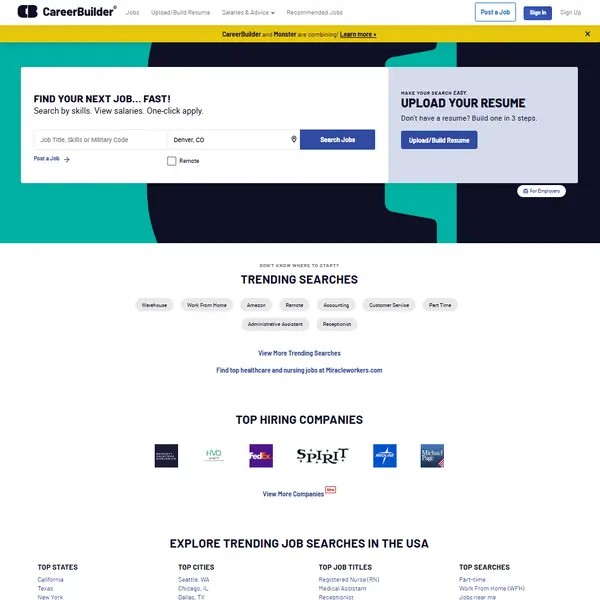
CareerBuilder now runs on Monster's platform under new ownership, and its job pages name the applicant tracking system each vacancy arrived from. We collect the public parts.

CareerBuilder Scraper
Solutions

Coverage, Delivery and Limits

CareerBuilder organizes public inventory by title, by city with a literal comma in the path such as /jobs-academic-advisor-in-chicago,il, by state and by category, and its sitemaps split the same way. We scope a run by slicing that URL space rather than paging one query deeply, which gives predictable coverage and a resumable job. Results advance through a page parameter behind a load more control.

We collect public pages only, respect robots.txt, and run at a polite request rate. We do not promise to defeat anti-bot protection, solve CAPTCHAs or evade detection. careerbuilder.com turns unrecognized automated clients away, so proxy rotation and a conservative cadence are our side of the job.

Delivery is CSV, JSON, XLSX, SQL dump or an API on your schedule. A paid sample comes first, and most projects ship in five to seven business days.

Handling that firewall is our side of the job, not yours. Proxy rotation, CAPTCHA solving and adaptive request pacing are part of the managed service, so you never build or maintain that layer. You receive the postings.

What a CareerBuilder Job Posting Exposes

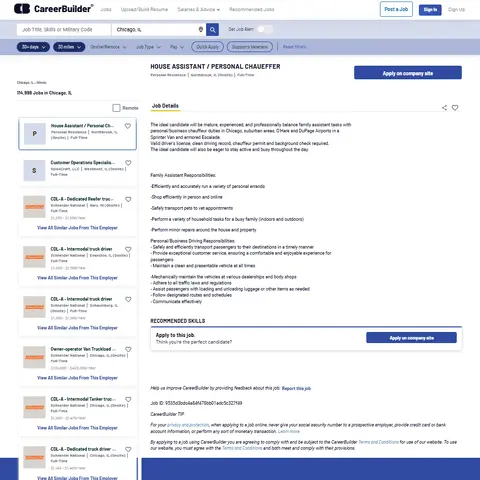
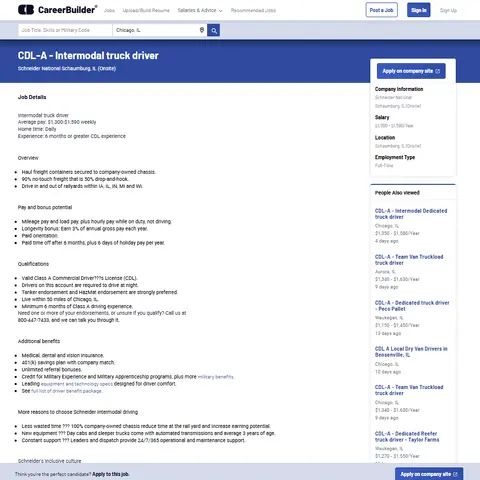
CareerBuilder renders result and job-details pages from a structured payload, so these fields are read, not guessed from formatted text.

  • Job title as the employer wrote it, plus the normalized title the site uses for its landing pages.
  • Employer name, with a caveat: some postings render as Company Confidential and carry no employer. We flag them.
  • Location as city and state, with the coordinates the page publishes.
  • Dates. The payload carries a posted date, a created date, a modified date and a recency bucket, and they do not agree. We deliver all of them, because freshness analysis breaks if you pick the wrong one.
  • Salary, paired with a flag saying whether the employer stated the figure or the platform generated it.
  • Employment type, often returned as OTHER rather than a usable value, so we pass the raw value through.
  • Full description, markup stripped and list structure kept for text processing.
  • Apply route as a type, for example offsite, not a destination link. The payload often carries an empty apply URL, and robots.txt disallows /apply, so we do not follow it.
  • Posting identifier. Each vacancy has a UUID, and the URL is a title, city and state slug, a double hyphen, then that UUID. The UUID is the stable key; the slug changes if the title is edited.
  • Source system, the applicant tracking system or feed a posting arrived through.

Excluded by default, not on request. Output is limited to posting and employer data. We do not extract named recruiter emails, phone numbers or personal messaging links, and we do not build person-level records about recruiters or candidates. An earlier version of this page offered recruiter contact fields; that was wrong and is withdrawn. Under the GDPR a named person's work email and direct phone number are personal data. Resumes and candidate profiles sit behind a recruiter login. We do not collect them and we do not access anything behind a login.

What a CareerBuilder Job Posting Exposes
What CareerBuilder Scraping Has To Resolve

What CareerBuilder Scraping Has To Resolve

CareerBuilder shows two kinds of pay figure and labels them differently. Some are stated by the employer. Others are generated by the platform under a Monster Estimated Salary heading, with a note saying the range is an estimate based on averages for the role and location and was not supplied by the employer. Merge them into one column and you are averaging model output with real employer numbers, and every wage benchmark built on it is wrong. We keep the provenance flag as a first-class field. Many postings carry a currency with no amount, so an empty salary is a real absence, not a parsing failure.

Other fields are derived by the platform rather than entered by the employer, and we label them derived:

  • Remote and onsite status arrives as a policy decision with a written explanation, not an employer checkbox.
  • Skill tags are machine-extracted from the description and tied to opaque internal codes.
  • Descriptions carry a platform-generated summary alongside the employer's original text.
  • Each posting carries an occupational classification code from the platform's own taxonomy.
  • Paid placement is exposed as a promotion flag and an ad pricing type, so organic and sponsored rows separate.

None of these derived fields describe a person. The exclusion above holds across the pipeline: no recruiter contact details, no candidate data, nothing from behind a login. If a field would identify an individual rather than a vacancy or an employer, it does not enter the dataset.

What CareerBuilder Is Today

CareerBuilder launched in 1995 and was run from Chicago. It was co-owned for years by US newspaper groups, which is how it carried classified recruitment advertising from print into the browser. That heritage still shows: much of the inventory comes from small and mid-market employers in healthcare, education, logistics and skilled trades rather than from technology firms.

The corporate picture changed, and it should shape how you budget a CareerBuilder data project. Monster and CareerBuilder were combined in September 2024 under Apollo Global Management and Randstad, held through a joint venture named Zen JV, LLC. In June 2025 Zen JV filed for Chapter 11 in the US Bankruptcy Court for the District of Delaware. A court-supervised auction followed in July 2025. BOLD, the company behind LiveCareer and Zety, won the job board business with a bid of 28.4 million dollars, outbidding the stalking horse bidder JobGet. Trade press reported the sales as closed at the end of July 2025, with BOLD keeping the CareerBuilder and Monster brands.

The board did not shut down. careerbuilder.com still publishes job pages and still ranks for them. What changed is the machinery underneath. The salary widget is labeled as a Monster estimate, the front end ships a styled component named MonsterBadge, the internal search identifier in the page payload reads MCJOBS_ORGANIC, and even the block page shown to automated clients names Monster. You are now scraping the Monster stack under CareerBuilder branding, so if you also buy Monster data, expect overlapping inventory.

Get a Quote

dev_w
25

Developers

customers
500+

Customers worldwide

pages
1 500 000 000+

Pages extracted

stime
15000+

Hours saved for our clients

Plans

Airplane

€199 / one-time

setup fee - included

Data limits100,000
Frequencyone-time
Run timeup to 5 days
Data storing7 days

Helicopter

€169 / mo

setup fee €499

Data limits250,000
Frequencymonthly
Run timeup to 5 days
Data storing14 days

Glasses

€229 / mo

setup fee €499

Data limits1,000,000
Frequencyweekly
Run timeup to 5 days
Data storing30 days

DNA

€549 / mo

setup fee €799

Data limits3,000,000
Frequency3 times daily
Run timesame day
Data storing90 days

Why Scrape CareerBuilder

The strongest reason to scrape CareerBuilder is provenance. Most boards hide where a vacancy came from. CareerBuilder does not: each result carries a named provider and an ingestion method. In pages we read, provider values included Workable, BreezyHR, JazzHR, iCIMS and Jobvite Talemetry, alongside employers posting under their own name. Ingestion method values included FEED and ADAPTED_NOW. That turns deduplication from guesswork into a join. You can see that two similar rows are one vacancy syndicated from one applicant tracking system, and you can measure which ATS vendors actually carry volume in a given sector, which is a market signal no aggregate posting count gives you.

The second reason is the corporate discontinuity itself. A board that went through Chapter 11 and changed owners in 2025 has an inventory mix, employer base and pricing behavior that are still moving. Nobody holds a clean longitudinal series across that break, because the identifier scheme changed along with the platform. If you start collecting CareerBuilder jobs now you own the series from here forward.

The third is coverage of employers that never appear on technology-led boards. Regional healthcare systems, school districts, charter networks, staffing firms and distribution centers post here, and those listings are what make CareerBuilder data useful for regional wage benchmarking, staffing-agency territory planning and prospecting into HR software buyers.

Our Blog

Reads Our Latest News & Blog

Learn how to use web scraping to solve data problems for your organization

How Artificial Intelligence Is Used In Web Scraping

How Artificial Intelligence Is Used In Web Scraping

Leveraging advances in technology, the AI-powered web scraper has skyrocketed in demand and is helping to expand capabilities by automating tedious daily tasks and speeding up data collection from thousands of websites several times over.

What is Web Scraping and What is it Used For?

What is Web Scraping and What is it Used For?

Web scraping is a method of obtaining web data by extracting it from pages of web resources with the help of a program, that is, in automatic mode. It is used to syntactically convert web pages into more usable forms.

Web Scraping for Machine Learning

Web Scraping for Machine Learning

If you specialize in machine learning, you need to feed large amounts of data to the algorithms. Web scraping is the easiest and the most efficient method of collecting the data from all over the Internet.

scrapeit logo

About ScrapeIt

ScrapeIt is a managed web scraping agency. We build the crawler, host it, watch it for layout changes and hand you clean data on a schedule. You do not run infrastructure and you do not maintain selectors.

The process is short. You describe the fields and the cadence, we send a sample for approval, then we run at full scale. When CareerBuilder changes its markup, repairing the crawler is our job. We reply to enquiries within one business day, and maintenance runs for as long as your subscription does.

FAQ

Does CareerBuilder have a public API?

Not one you can buy job data through. CareerBuilder published a developer job search API years ago at api.careerbuilder.com. That host serves nothing at its root, developer.careerbuilder.com resolves to the same addresses and is just as empty, and robots.txt disallows the /api/ path. The integrations that do exist are employer and partner facing: they are built for pushing job postings into the board from an applicant tracking system, not for pulling structured data out of it. If you need CareerBuilder jobs as a dataset, scraping the public pages is the available route.

Is it legal to scrape CareerBuilder job listings?

We collect only pages that CareerBuilder publishes publicly, we honor robots.txt, and we never sign in. We do not touch the resume database, candidate profiles or any recruiter-only area. What we hand over is posting and employer information. How you use it, and any licensing or compliance review your own counsel requires, remains your decision.

Do you provide recruiter emails or phone numbers from CareerBuilder?

No. Named recruiter emails, direct phone numbers and personal messaging links are excluded by default rather than withheld pending a request, and we will not add them for a fee. They are personal data about identifiable people. We also do not assemble person-level profiles of recruiters or candidates. If you need to reach an employer, use the company-level information carried in the posting.

The same job appears more than once in my CareerBuilder export. Why?

Because CareerBuilder ingests postings from employer systems and feeds, so one vacancy can enter through more than one route and surface under slightly different titles or locations. The useful part is that the platform names the source system and the ingestion method on each record. We pass those through and can deduplicate on source, employer, title and location before delivery, or leave the raw rows intact if you would rather run your own matching.

How long does a CareerBuilder scraper take to set up, and what do I get?

Most projects ship in five to seven business days from an agreed field list, and you approve a sample first. Delivery is CSV, JSON, XLSX, SQL dump or an API, on a one-off, daily or weekly schedule. Runs are scheduled rather than live, so every record carries the timestamp of the run that produced it and you always know how old a row is.

How does it Work?

Step 1 - Make a Request

You share your needs, expectations, and desired timeframe. We’ll suggest the best solution based on your request and budget.

Step 2 - Configuring Custom Web Crawlers

Our specialists configure the crawlers and extract a sample dataset for your review before proceeding with the full-scale extraction.

Step 3 - Collect and Deliver

Once you approve the sample, we launch the project and start full data collection. We gather, filter, and structure the data for easy use, delivering it on time in your preferred format.

Step 4 - Maintain and Support

Our team manages ongoing processes, monitors website changes, and supports all data extraction cycles. We can also help integrate data into your systems or create dashboards to simplify analysis.

Request a Quote

Tell us more about you and your project information.
Which sites, which fields, how often. A couple of lines is enough.

We reply within 1 business day. No obligation.

scrapiet

Scrapeit Sp. z o.o.
10/208 Legionowa str., 15-099, Bialystok, Poland
NIP: 5423457175
REGON: 523384582