Beauty Price Monitoring on Notino and Douglas in 15+ Countries, in English
A cosmetics company got monthly prices and promotions from 40+ beauty stores in 15+ countries, translated to English and fed into its existing import.
Learn More
Every Argos item carries a catalogue number that doubles as its product address, and its price, its badges and its shop stock all change by store, by postcode and by day.
Plans from €169/month · Free project assessment · Reply within 1 business day
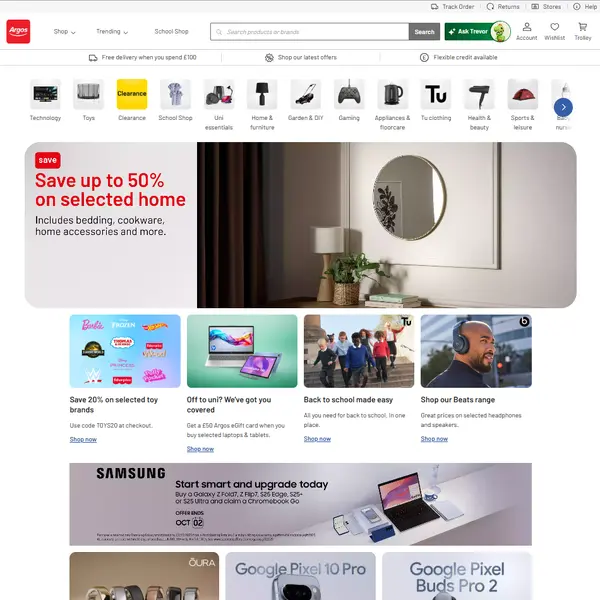
You get files, not a tool to operate. Output comes as CSV, JSON, XLSX or a REST Argos API, with the schema agreed before the first crawl and held stable. Delivery goes to S3, Google Cloud Storage, SFTP, a database you nominate or an endpoint we host.
The site is defended at the edge, so anti-bot handling, proxy rotation and CAPTCHA solving sit on our side of the job rather than yours. We collect only publicly available data - everything a visitor can see on Argos - and we collect it legally. Nothing behind a login is touched.
Every run is checked before it ships: catalogue number well formed, price parsed as a number, variants attached to a parent, and volumes compared with the previous run.
Each product becomes one flat row, and we keep the site's own naming so an Argos data extract stays auditable against the live page:
Listings return sixty products a page and paginate through the path itself, so coverage is planned rather than guessed.
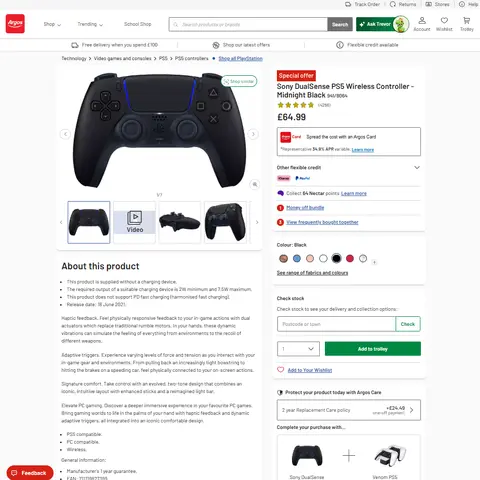
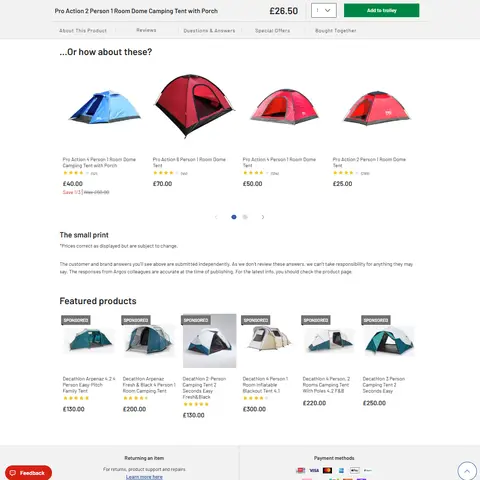
A single Argos scraping run gives you a catalogue. A schedule gives you the behaviour behind it.
Price history comes first, and Argos makes the argument better than we can. Some pages carry a footnote calling the current figure the lowest the retailer has ever charged for that item - a statement about the past, with no series behind it. Your own dated rows are the only way to audit it.
Promotion timing comes second. Clearance and new in badges carry explicit start and end dates, so a schedule that reads them separates a planned campaign from a quiet repricing and catches the day a line enters clearance.
Range rotation comes third. Products leave without leaving a trail readable from outside. Comparing today's product sitemap against yesterday's is how a delisting is caught, and facet counts show a category growing or shrinking.
Stock is fourth, and the most local. The same catalogue number can be collectable in one town, delivery only in the next, and absent across a county. Following that per store, over weeks, separates a real sell through from a warehouse blip - and it is why an in stock flag with no location attached means nothing here.
Argos is a British catalogue retailer owned by Sainsbury's, which bought its parent Home Retail Group in 2016. It opened in 1972 and sold from printed catalogues for almost fifty years. The books are gone - Argos says it no longer prints them - but the model still shapes the site: a shopper picks an item by number, and the number is the product.
That number is the catalogue number, shown on the page as 466/5094 and stored everywhere else as 4665094, the final segment of the product address argos.co.uk/product/4665094. The same seven digits appear as the sku in the markup, as the partNumber in the page data, and inside every image filename - one short, stable, public key per sellable item.
The catalogue sits in a browse tree - eleven top level sections, category landing pages that only list their children, and product listing pages that hold the goods - with a numeric id after c: in every browse address. Argos trades in GBP for Great Britain and Northern Ireland only, having shut its Irish stores in 2023.
The shop estate is moving. The store locator mixes standalone Argos stores, Argos counters inside Sainsbury's supermarkets, and Sainsbury's stores holding only a collection point, where a paid order is handed over but nothing can be bought. In September 2026 it listed roughly 1,224 store pages, about 207 of them standalone. Which kind of location sits near a customer decides what in stock means for them.
Get a Quote
Developers

Customers worldwide

Pages extracted

Hours saved for our clients
€199 / one-time
setup fee - included
€169 / mo
setup fee €499
€229 / mo
setup fee €499
€349 / mo
setup fee €499
€549 / mo
setup fee €799
Delivery: CSV, JSON or XLSX files, our API or a JSON feed. MCP server on request.
Full plan details →Argos states plainly that it does not price match other retailers, in store or online. That makes an Argos price an independent reading rather than an echo of somebody else's - what belongs at the centre of a UK retail price monitoring panel.
Suppliers use the rows for listing and RRP compliance: is the line live, is the price the agreed one, is the right variant on sale. Buying teams watch assortment instead - what enters the range, what drops into clearance, how deep the cut goes. Competitor price tracking here is cheap because the catalogue number never needs fuzzy matching.
Marketplace and comparison sellers take the same rows as a product feed input: a catalogue number and an EAN settle a match that a title never would. Supply teams take the store dimension: an offer visible online but missing from the shops nearest a customer is a different commercial fact.
Scrape Argos on a schedule and the four questions a category manager asks - what is ranged, what it costs, what it cost last week, and where it can be collected - collapse into one table.

A cosmetics company got monthly prices and promotions from 40+ beauty stores in 15+ countries, translated to English and fed into its existing import.
Learn More
A consultancy working for a fragrance brand owner got sellers, official-store flags and USD prices for 25 fragrances on about 30 marketplaces in 12 countries.
Learn More
Three Amazon US lighting categories collected in full for a lighting manufacturer, with description text and images from brand content blocks.
Learn MoreLearn how to use web scraping to solve data problems for your organization
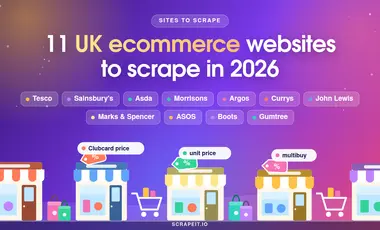
Eleven UK ecommerce websites worth scraping in 2026, from Tesco and Sainsbury's to ASOS, Boots and Gumtree: what each site shows, the fields a data buyer needs, what only it adds and how to merge them into one dataset.
If you sell online, run a marketplace, or advise e-commerce clients, you already know why eBay matters: it’s one of the few places where big retailers compete side by side with thousands of small merchants and private sellers.

E-commerce teams do not just need “some” competitor data anymore. They need a continuous stream of real prices, discounts, stock levels, reviews, and seller behavior from the platforms that actually shape their markets.
ScrapeIt is a managed service. We build the crawler, run it on your schedule, watch it when Argos changes its front end, and repair it without you filing a ticket. You never see a proxy pool or a parser.
UK catalogue retail is generous to whoever holds the identifiers and punishing to whoever does not. We scope a pilot against your real field list and a sample of your own catalogue numbers first.
Yes. We take the current price, the was price and the saving, together with the flash line Argos prints over the price and the footnote that restates it in words. Prices differ between variants, so we return a row per catalogue number rather than one price for a product family. On a schedule each row is stamped with the date it was read, which is the only way to reconstruct a promotion after it has ended.
It is the seven digit number that identifies a sellable item, shown on the page in the slashed form 466/5094 and used elsewhere as 4665094. It is the last part of the product address, it is repeated as the sku in the markup, and it even appears inside the image filenames. Every size and colour carries its own. That makes it the cheapest join key in UK retail: no fuzzy title matching, no colour normalisation, no guessing which listing belongs to which supplier line.
Yes. The ScrapeIt Argos API returns the catalogue number, EAN, current price, was price, saving and per store availability as JSON from an endpoint we host, refreshed on the schedule you set. The same data also comes as CSV or XLSX files or straight into your database, so your integration does not move when Argos reorganises its front end.
Yes, within what the site exposes. Argos answers availability per location: give it a postcode or town and it reports the nearest shops, whether the item is there, and how quickly it could be moved in. We run that same check across whatever list of postcodes you choose. Two caveats belong in the output: a collection point holds no shop stock at all and only hands over orders already paid for online, and Trusted Seller items are couriered by the seller and never collectable in store.
It needs real engineering rather than a script. The site is protected at the edge and the catalogue is rendered client side, so pages have to be fetched the way a browser fetches them. The sitemap index points at product, browse, refined listing and store files, so a planned crawl works from those instead of hammering search.
Step 1 - Make a Request
You share your needs, expectations, and desired timeframe. We’ll suggest the best solution based on your request and budget.
Step 2 - Configuring Custom Web Crawlers
Our specialists configure the crawlers and extract a sample dataset for your review before proceeding with the full-scale extraction.
Step 3 - Collect and Deliver
Once you approve the sample, we launch the project and start full data collection. We gather, filter, and structure the data for easy use, delivering it on time in your preferred format.
Step 4 - Maintain and Support
Our team manages ongoing processes, monitors website changes, and supports all data extraction cycles. We can also help integrate data into your systems or create dashboards to simplify analysis.
Argos data from €169/month. Free project assessment, reply within 1 business day.

Scrapeit Sp. z o.o.
10/208 Legionowa str., 15-099, Bialystok, Poland
NIP: 5423457175
REGON: 523384582