Marketplace Monitoring on Amazon, Lazada, Coupang: 30 Sites in 8 Weeks
A consultancy working for a fragrance brand owner got sellers, official-store flags and USD prices for 25 fragrances on about 30 marketplaces in 12 countries.
Learn More
Lazada is not one marketplace but six. Singapore, Malaysia, Thailand, Indonesia, Vietnam and the Philippines each run a separate catalog, and we collect every one of them.
Plans from €169/month · Free project assessment · Reply within 1 business day
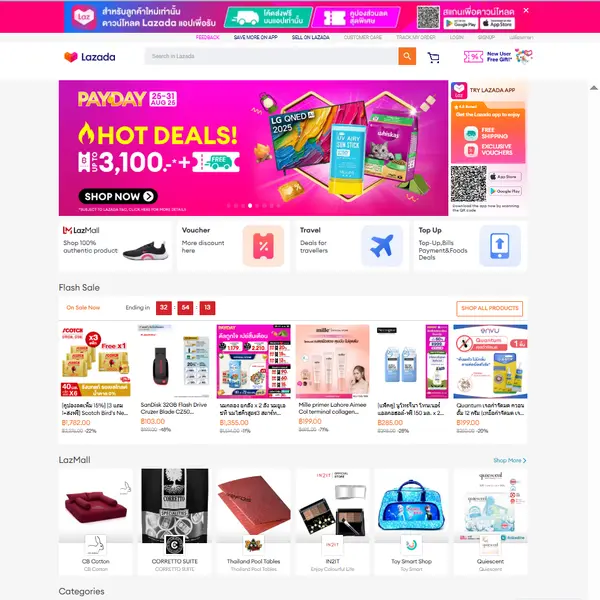
This is a managed service, not a tool you install. You describe the scope - which storefronts, which categories, keywords, brands or sellers, how often - and we build the extractors, run them and repair them when Lazada changes its markup. Product pages sit behind an anti-bot layer that answers unfamiliar traffic with a challenge, so anti-bot handling, proxy rotation and CAPTCHA solving are part of the service.
Delivery fits your pipeline: CSV, JSON, XLSX, a database drop or an API endpoint, one-off or scheduled. Every row is stamped with its storefront and identifiers, so the six countries compare cleanly.
A Lazada scraper starts with the two identifiers the site is built on. The itemId names the product; the skuId names one buyable variant. A product address ends in -i and the itemId; choose a colour and it gains -s and the skuId, while the canonical link drops the variant again. Lazada joins the two into a composite key carrying the venture code, and that key keeps a row stable between runs.
Search and category pages return the same fields, so a Lazada product feed can start from a keyword list or from the category tree.
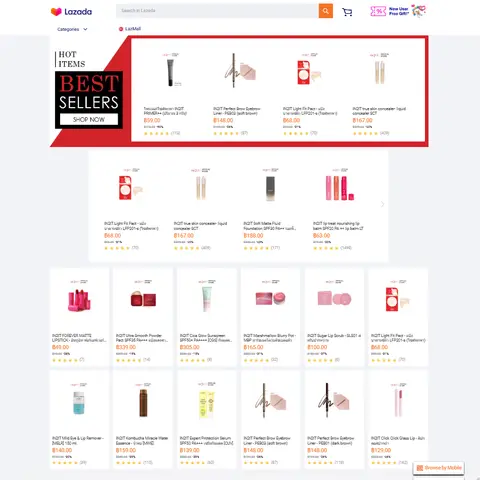
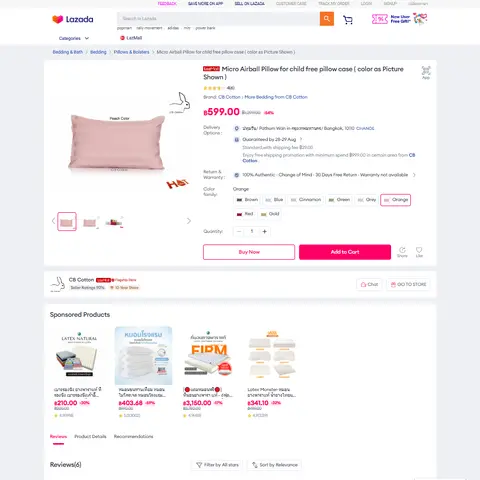
Coverage is a design problem before it is a bandwidth problem. Search and category listings return forty items per page and cap the result set at roughly four thousand items per query - about a hundred pages - however large the category, and raising the page size does nothing. Full coverage comes from slicing: by category, brand, price band, shipped-from country and the service filters Lazada exposes, then merging on itemId. Those filters are worth keeping as data themselves: brand lists, price sliders and attribute facets show how each country organises the category.
Every storefront publishes its own sitemap index, split into gzipped files of ten thousand URLs covering products, sellers, brands, categories, reviews and top lists. Store and brand pages have their own address grammar and carry seller metrics - positive rating share, shipped-on-time share, chat response speed, seller size and time on the platform.
Repeated runs keyed on the composite key turn the price, crossed-out original, discount and voucher columns into a Lazada price history per variant and per storefront. Reviews are readable with text, rating, photos, purchase confirmation and timestamps; reviewer names are personal data and we leave them out by default.
Lazada launched in 2012 and has been part of Alibaba Group since 2016. It is not one site with a country switch but six separate storefronts on six domains - www.lazada.sg, www.lazada.com.my, www.lazada.co.th, www.lazada.co.id, www.lazada.vn and www.lazada.com.ph. Lazada's own listing payload calls each one a venture, tagged SG, MY, TH, ID, VN or PH.
Every venture has its own currency - SGD, MYR, THB, IDR, VND and PHP - its own default language and its own catalog. Singapore, Malaysia and the Philippines open in English; the other three open in Thai, Indonesian and Vietnamese. The split runs deeper than translation: the same Revlon lipstick carries a different product id on each storefront, and a Singapore id does not resolve on the Malaysian domain. Six Lazada catalogs mean six crawls and six price tables, with no shared key to join them on.
Sellers are split too. LazMall holds the official brand and retailer stores, backed by an authenticity guarantee, free returns within fifteen days and next-day delivery; everything outside it is an ordinary marketplace seller. Part of the volume ships from Lazada's own warehouses under the Fulfilled By Lazada label, and cross-border listings carry the country they ship from, so stock from China, Hong Kong, South Korea and Japan sits beside local stock.
Get a Quote
Developers

Customers worldwide

Pages extracted

Hours saved for our clients
€199 / one-time
setup fee - included
€169 / mo
setup fee €499
€229 / mo
setup fee €499
€349 / mo
setup fee €499
€549 / mo
setup fee €799
Delivery: CSV, JSON or XLSX files, our API or a JSON feed. MCP server on request.
Full plan details →Lazada scraping is worth doing properly because the six storefronts disagree with each other. A brand priced one way in Singapore is priced another way in Malaysia, sold by a different store, and sometimes absent from Indonesia. One extract per country is the only way to see it; Lazada price data from a single domain misrepresents the region.
Inside one storefront the disagreement continues. A search for one branded lipstick returns listings from more than a dozen sellers, a minority of them inside LazMall, prices spread across a wide band, and a no-name listing from a cross-border seller above the brand's own store. That is the case for brand protection: the LazMall flag separates an authorised store from everyone else, and everyone else is where grey imports and counterfeits live.
The rest follows from the same rows - price monitoring across sellers and countries, assortment and share of shelf by brand, campaign tracking through the 11.11 and 12.12 peaks and the LazFlash windows, demand signals from sold counters and review volume, and seller intelligence for choosing a marketplace partner per country.
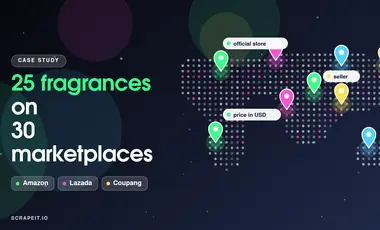
A consultancy working for a fragrance brand owner got sellers, official-store flags and USD prices for 25 fragrances on about 30 marketplaces in 12 countries.
Learn More
A cosmetics company got monthly prices and promotions from 40+ beauty stores in 15+ countries, translated to English and fed into its existing import.
Learn More
Three Amazon US lighting categories collected in full for a lighting manufacturer, with description text and images from brand content blocks.
Learn MoreLearn how to use web scraping to solve data problems for your organization
If you sell online, run a marketplace, or advise e-commerce clients, you already know why eBay matters: it’s one of the few places where big retailers compete side by side with thousands of small merchants and private sellers.

E-commerce teams do not just need “some” competitor data anymore. They need a continuous stream of real prices, discounts, stock levels, reviews, and seller behavior from the platforms that actually shape their markets.
Amazon provides valuable information gathered in one place: products, reviews, ratings, exclusive offers, news, etc. So scraping data from Amazon will help solve the problems of the time-consuming process of extracting data from e-commerce.
ScrapeIt is a data extraction service. We collect structured, ready-to-use information from marketplaces, retailers and classifieds and hand it over clean - no setup, no coding, no dashboards to learn.
Marketplaces like Lazada are most of our work: many sellers on one product, prices that move daily, and a different catalog behind every country domain. Tell us which markets and which fields matter, and we handle the collection.
Yes, you can export data from a single regional domain - like lazada.sg or lazada.co.id - or from multiple markets at once.
No - we adjust the extractor for each country, since structure, language, and pricing formats differ across local sites.
We parse product pages down to variant options, promo labels, and stock indicators - not just surface content.
Yes, we extract data from both LazMall and independent stores - including pricing, seller info, and shipping methods.
Yes. The ScrapeIt Lazada API returns itemId, skuId, the current and crossed-out price, seller name and the LazMall flag for each of the six storefronts as JSON from an endpoint we host, refreshed on the schedule you set. The same data also comes as CSV or XLSX files or straight into your database.
Step 1 - Make a Request
You share your needs, expectations, and desired timeframe. We’ll suggest the best solution based on your request and budget.
Step 2 - Configuring Custom Web Crawlers
Our specialists configure the crawlers and extract a sample dataset for your review before proceeding with the full-scale extraction.
Step 3 - Collect and Deliver
Once you approve the sample, we launch the project and start full data collection. We gather, filter, and structure the data for easy use, delivering it on time in your preferred format.
Step 4 - Maintain and Support
Our team manages ongoing processes, monitors website changes, and supports all data extraction cycles. We can also help integrate data into your systems or create dashboards to simplify analysis.
Lazada data from €169/month. Free project assessment, reply within 1 business day.

Scrapeit Sp. z o.o.
10/208 Legionowa str., 15-099, Bialystok, Poland
NIP: 5423457175
REGON: 523384582