The Entire Iherb Supplements Catalog, Captured End-to-End in 3 Days
Scraping supplement products from iHerb.com with full details, including descriptions and packaging variations.
Learn More
On Mercari each listing is a single physical item, so prices form a distribution across comparable listings rather than one product price. We scrape Mercari with that in mind.
Plans from €169/month · Free project assessment · Reply within 1 business day
Delivery is CSV, Excel, JSON or an API endpoint, on a schedule matched to how fast the segment turns over: fast categories daily, so disappearance is dated tightly, slower ones weekly. Every row carries its observation timestamp, because on a marketplace with no restocking the timestamp is half the data. Price history is built the same way, by repeated observation, so original price, later price and the gap between them come from runs we made.
Sellers on Mercari are private individuals with public profiles. Output is limited to listing and commercial data. Seller display names, profile identifiers, profile links and profile photographs are excluded by default rather than on request, and rating and review counts are kept as aggregates with nothing pointing back to a person. The GDPR treats such identifiers as personal data.
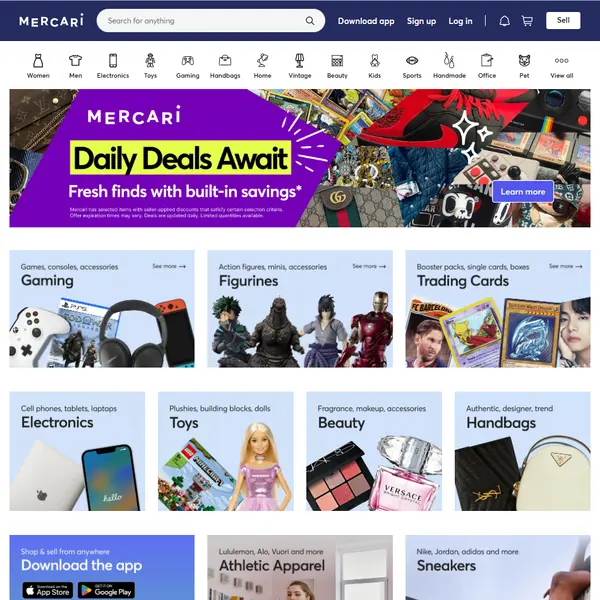
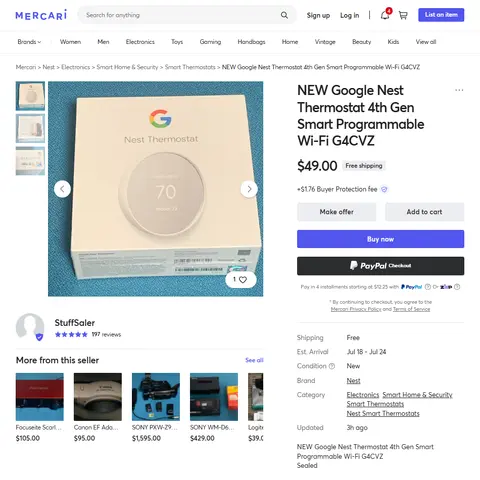
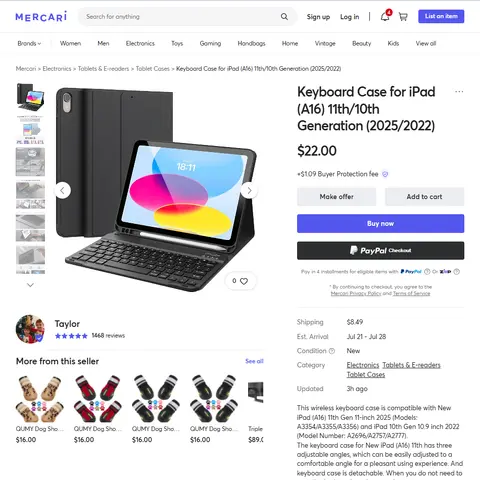
The listing page at mercari.com/us/item/{id}/ carries the commercial record. The identifier is the path segment between /item/ and the trailing slash, an "m" followed by digits, and it is the join key we carry through every delivery so rows match across runs.
A standard extract covers:
Condition deserves its own note, because on used goods it is the main price driver. Mercari defines the five labels differently for clothing than for general items. "New" for clothing means unworn, unaltered and still tagged. "New" for a general item means unused, with original tags, sealed packaging, or original condition from the manufacturer. Comparing a clothing listing with an electronics listing on the label alone compares two different scales, so we keep the category next to the condition in every row.
On a resale marketplace the most valuable signal is what things actually sold for, so it is worth being precise about how much of that is visible.
Sold listings stay in the index. Mercari's help documentation describes a Status filter whose purpose is to display only listings on sale, which is only meaningful because sold listings otherwise appear in results, and search results carry a sold badge distinct from the on-hold badge used while a transaction is in progress. The fact of sale is therefore observable, and the moment a listing leaves the on-sale set can be dated to within one crawl interval.
The price is where it stops. What stays visible is the last asking price, not the amount the buyer paid. Mercari runs an offer system: a buyer can offer below the asking price and, in Mercari's own wording, if the seller accepts they are automatically charged the new price. Offers to Likers runs the same mechanism in reverse, sending a private discount to people who liked the item while the public listing price is left alone. The accepted amount is not published.
So the honest position is this. We can tell you that an item sold, when it left the market, and what it was asking at that moment. We cannot tell you the transacted price, and we will not model one and present it as observed.
Mercari is a consumer-to-consumer marketplace where private individuals list used and new goods. Two facts about it shape every extraction job here. One is structural: a listing is a single physical object, not a catalogue position. The other is corporate: the US marketplace at mercari.com and the Japanese business run as separate marketplaces, with separate inventory and separate users.
That second point is usually assumed rather than checked. Mercari's own announcement of the Mercari Global app, dated 17 June 2026, presents the Global App as covering crossborder transactions alongside the US Mercari app, which stays centered on domestic trade, and states that the Mercari x Japan crossborder function inside the US app was folded into the Global App. A request for Mercari data therefore needs a marketplace named before anything else.
Discovery is its own problem. The US sitemap index at mercari.com/us-sitemap-index.xml points at brand pages, category pages, brand-and-category combinations, shop pages and landing pages. It does not publish item URLs. Listings are reached through search and category browse instead. Search and item pages sit behind bot protection, so reading Mercari starts with access handling rather than parsing.
Get a Quote
Developers

Customers worldwide

Pages extracted

Hours saved for our clients
€199 / one-time
setup fee - included
€169 / mo
setup fee €499
€229 / mo
setup fee €499
€349 / mo
setup fee €499
€549 / mo
setup fee €799
Buyers usually arrive asking how Mercari prices for a given product moved last month. As stated, that question has no answer, and it is better said before a project starts than after.
There is no product record to hang a price series on. Two people listing the same camera create two unrelated listings, each with its own photos, its own condition grade and its own price. Neither restocks. When one sells, that supply is gone, and the listing does not return at a new price. A series keyed to a product identifier would be built on something that does not exist.
What is real, and what we build, is a distribution. We define a matched set - a brand, a model string, a condition band, a category - and track the asking prices inside that set over time, together with how many listings enter it, how long they persist and how many leave. Median asking price by condition band, the spread between the tenth and ninetieth percentile, and time to disappearance are all measurable, and all stable enough to trend month over month. That is a different chart from a product price line. On a resale market it is the more useful one.

Scraping supplement products from iHerb.com with full details, including descriptions and packaging variations.
Learn More
Daily scraping of lowest prices for 150K products on Allegro.pl to support marketplace pricing and margin optimization.
Learn More
Regular monitoring of Ralph Lauren clothing, footwear, and accessories sold across Amazon subdomains: AE, DE, ES, FR, IT, NL, PL, UK.
Learn MoreLearn how to use web scraping to solve data problems for your organization
If you sell online, run a marketplace, or advise e-commerce clients, you already know why eBay matters: it’s one of the few places where big retailers compete side by side with thousands of small merchants and private sellers.

E-commerce teams do not just need “some” competitor data anymore. They need a continuous stream of real prices, discounts, stock levels, reviews, and seller behavior from the platforms that actually shape their markets.
Amazon provides valuable information gathered in one place: products, reviews, ratings, exclusive offers, news, etc. So scraping data from Amazon will help solve the problems of the time-consuming process of extracting data from e-commerce.
ScrapeIt is a managed scraping agency. We build the crawler, run it, maintain it when the site changes, and hand over clean data. You host nothing and repair no parser at midnight when a class name moves. We agree the fields with you first, deliver a sample from a real run so you can check it line by line against the live site, then put the job on a schedule. When Mercari's markup changes, fixing it is our work, not yours.
Yes. The ScrapeIt Mercari API returns item id, asking price and currency, condition, listing status and like count as JSON from an endpoint we host, refreshed on the schedule you set. The same Mercari data also comes as CSV or XLSX files or straight into your database.
No, and no public source can. Mercari keeps sold listings addressable and marks them sold, so we record that a sale happened and what the asking price was at that point. The accepted amount is not published. Buyers can offer below the asking price, and sellers can send private discounts to people who liked an item, so the paid amount and the visible price often differ. We deliver the asking price and the sale event, each labelled for what it is.
Not at product level, because there is no product level. Each listing is one physical item with its own condition and price, and it never restocks. What we build instead is a matched set defined by brand, model text, condition band and category, then track the distribution of asking prices inside it over time, plus how many listings enter, persist and leave. That yields median and percentile asking prices by condition, and turnover rates you can compare month to month.
No. They are separate marketplaces with separate inventory and separate users under one parent brand. Mercari's June 2026 announcement of the Mercari Global app describes it as a crossborder app running alongside the domestic US marketplace, with the earlier Mercari x Japan function inside the US app folded into it. We can extract from either, accounting for language, currency and layout differences, and we name the marketplace on every delivery so the two are never mixed.
Item id and URL, title, description, asking price and currency, condition on the five-label scale, category path, brand, size where the category uses it, shipping arrangement, listing status, like count, photo URLs, listing badges, and seller rating and review count as aggregate numbers. Where reviews are displayed we can collect rating and date. Seller names, profile identifiers and profile photographs are excluded by default. If you need a field that is on the page and not on this list, ask, and we confirm it is reachable before quoting.
Step 1 - Make a Request
You share your needs, expectations, and desired timeframe. We’ll suggest the best solution based on your request and budget.
Step 2 - Configuring Custom Web Crawlers
Our specialists configure the crawlers and extract a sample dataset for your review before proceeding with the full-scale extraction.
Step 3 - Collect and Deliver
Once you approve the sample, we launch the project and start full data collection. We gather, filter, and structure the data for easy use, delivering it on time in your preferred format.
Step 4 - Maintain and Support
Our team manages ongoing processes, monitors website changes, and supports all data extraction cycles. We can also help integrate data into your systems or create dashboards to simplify analysis.

Scrapeit Sp. z o.o.
10/208 Legionowa str., 15-099, Bialystok, Poland
NIP: 5423457175
REGON: 523384582