The Entire Iherb Supplements Catalog, Captured End-to-End in 3 Days
Scraping supplement products from iHerb.com with full details, including descriptions and packaging variations.
Learn More
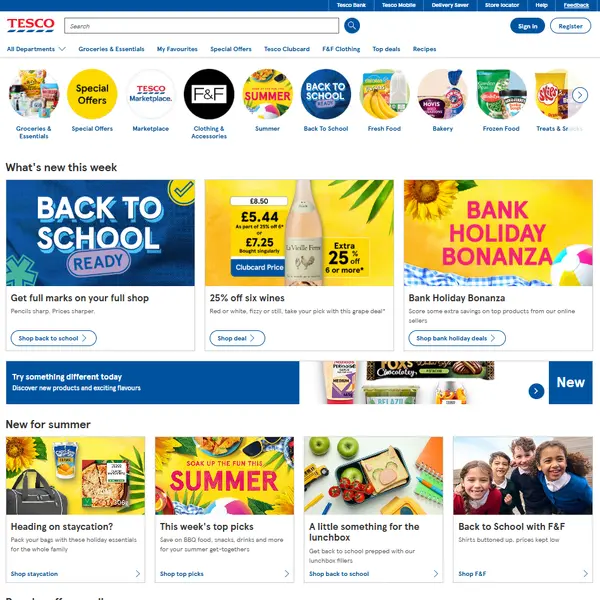
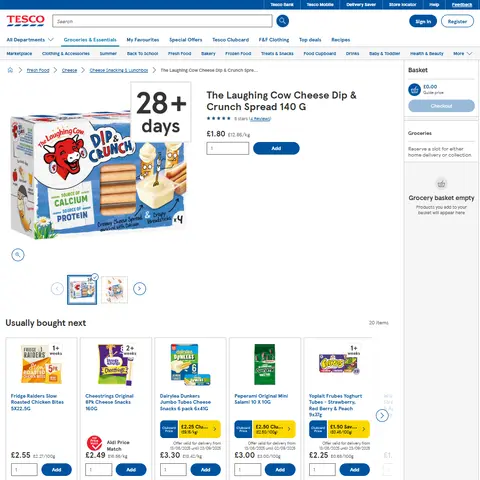
Tesco lists two current prices for many products: the regular price and the Clubcard price. We capture both, with unit price and promotion text, on a schedule you set.
Plans from €169/month · Free project assessment · Reply within 1 business day
Price intelligence teams comparing Tesco against Sainsbury's, Asda and the discounters, on the regular and the member price side by side. Suppliers and brand owners checking that their own lines are listed, priced and in stock across the range they sell in. Category analysts following range rotation, seasonal lines and movement in and out of Clubcard Prices. Researchers building unit-price series that survive a pack size change. Journalists and consumer bodies checking pricing claims against what the site actually showed on a given day.
Cadence is yours to set. Teams watching Tesco prices day to day usually run daily or more often; range and assortment work is fine weekly.
A grocery listing on tesco.com carries more than one number that a buyer would call 'the price'. We record them as separate columns rather than flattening them into one.
Collection covers public product and pricing data only. No customer data, no accounts, no order histories, nothing behind a login.
The site sits behind an edge network that refuses automated clients. A request from an ordinary command line tool returns an access denied page instead of markup. Anything built on a bare request library will come back with nothing usable. We run browser-grade collection at a measured rate, adjust pacing and rotate proxies when the edge pushes back, and tell you when a section stops being reachable instead of filling the gap with stale rows.
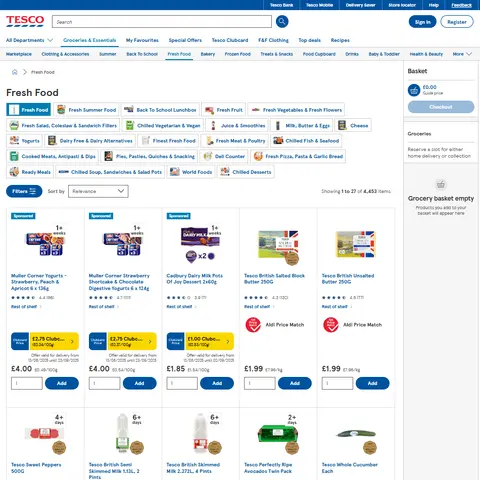
We work from the sitemap index under /sitemaps/en-GB/ and from category entry points, so every row keeps the numeric identifier from the URL alongside the aisle, shelf and sub-shelf path it was found under.
Two further things catch people out. Personalised offers, shown to a signed-in shopper as 'Your Clubcard Prices', are not part of the public listing, so a public crawl records the general member price and never an individual's tailored one. And availability is fulfilment dependent: Tesco asks for a postcode and a delivery slot, and what a given store can supply is not identical everywhere, so availability from a public crawl should be read as the national listing state rather than one shop's shelf.
Tesco is the largest grocery retailer in the United Kingdom, trading through superstores, Express convenience shops and an online grocery operation that delivers nationwide. For anyone collecting data, the point to grasp early is that tesco.com is not a single catalogue. Groceries sit under their own set of paths, and since 2024 a third-party marketplace sits alongside them, with those items shipped by the seller rather than picked from a Tesco store. A listing that looks like any other on the site may not be a Tesco grocery line at all, and mixing the two quietly corrupts a price file.
Grocery product pages are addressed by a numeric identifier, in the form tesco.com/groceries/en-GB/products/ followed by that number. Category browsing runs through an aisle, shelf and sub-shelf hierarchy that ends in an 'all' segment. Curated pages exist as well: zone pages and buylists gather Clubcard Prices, Aldi Price Match lines and new ranges under their own URLs. Both a /groceries/en-GB/ prefix and a newer /shop/en-GB/ prefix are in service, and a crawl plan that assumes only one of them will miss pages.
Products carry a base product number, commonly called the TPNB, and a consumer unit number, the TPNC. The number in a product URL is the consumer unit identifier. Many pages also expose a GTIN or EAN. Which of these you key your warehouse on matters, because one base product can be sold in more than one pack.
Get a Quote
Developers

Customers worldwide

Pages extracted

Hours saved for our clients
€199 / one-time
setup fee - included
€169 / mo
setup fee €499
€229 / mo
setup fee €499
€349 / mo
setup fee €499
€549 / mo
setup fee €799
Clubcard Prices changed what 'the price' means here. A product can show a regular price and a lower member price at the same time, and which one a shopper pays depends on whether a Clubcard is presented. If your dataset holds one number, it holds an incomplete fact. A comparison against a competitor that ignores the member price is measuring the wrong figure, and an elasticity model fitted to it is fitted to a price a large share of shoppers never paid.
This is not a passing promotion. The Competition and Markets Authority published a review of loyalty pricing in the groceries sector in November 2024, looking at member prices across the major UK grocers. Two-tier pricing is now a standing feature of the market, and it needs a column of its own.
Pack size is the second trap. Two lines that look like the same product at different Tesco prices are often different weights. The unit price resolves that, and it is printed on the listing, so there is no need to guess a conversion out of a title string.
Then there is what the price is attached to. Multibuy wording, meal deal membership and reference prices sit outside the price element. Parse the price element alone and the mechanic disappears.

Scraping supplement products from iHerb.com with full details, including descriptions and packaging variations.
Learn More
Daily scraping of lowest prices for 150K products on Allegro.pl to support marketplace pricing and margin optimization.
Learn More
Regular monitoring of Ralph Lauren clothing, footwear, and accessories sold across Amazon subdomains: AE, DE, ES, FR, IT, NL, PL, UK.
Learn MoreLearn how to use web scraping to solve data problems for your organization
If you sell online, run a marketplace, or advise e-commerce clients, you already know why eBay matters: it’s one of the few places where big retailers compete side by side with thousands of small merchants and private sellers.

E-commerce teams do not just need “some” competitor data anymore. They need a continuous stream of real prices, discounts, stock levels, reviews, and seller behavior from the platforms that actually shape their markets.
Amazon provides valuable information gathered in one place: products, reviews, ratings, exclusive offers, news, etc. So scraping data from Amazon will help solve the problems of the time-consuming process of extracting data from e-commerce.
ScrapeIt is a managed service. A Tesco scraper is only worth having if it keeps running, so we build it, host it, monitor it and repair it when the markup changes. You describe the categories, fields and cadence; you approve a sample before the first full run. Delivery is CSV, JSON, XLSX or an API endpoint, pushed to your bucket or ours on the schedule you set. Nothing to install, and no scraping code for your team to maintain.
Yes. The ScrapeIt Tesco API returns the regular price, Clubcard price, unit price, promotion labels, availability and the numeric product identifier as JSON from an endpoint we host, refreshed on the schedule you set. The same data also comes as CSV or XLSX files or straight into your database.
Yes. Both are captured as separate fields, along with the promotion wording and the delivery validity dates printed with the offer. Where a product has no member price, the Clubcard field is left empty rather than copied from the regular price, so the two states stay distinguishable in your warehouse. Personalised offers that Tesco shows only inside a signed-in account are not part of a public listing and are not included.
As often as you need. Prices and promotions move on their own cycle and Clubcard offers carry start and end dates, so most pricing customers run daily and some run more than once a day. Range and assortment work is usually fine at a weekly cadence. Seasonal lines and range rotation argue for keeping a history rather than overwriting the last file, so you can see when a product entered or left the catalogue.
Title, brand, regular price, Clubcard price, unit price, promotion labels, availability, purchase limits, the numeric product identifier from the URL, GTIN or EAN where shown, category path, description, pack size, ingredients, nutrition values, allergen labels, rating, review count and image URLs. If you need something not on that list, say so before the build and we will check whether the listing carries it.
Yes. We collect only publicly available data - the product and pricing information any visitor can see on Tesco - and we collect it legally. We do not sign in, we do not touch accounts or order histories, and we collect no customer data. Each row carries the regular price, Clubcard price, unit price, promotion wording and availability as the listing shows them.
Step 1 - Make a Request
You share your needs, expectations, and desired timeframe. We’ll suggest the best solution based on your request and budget.
Step 2 - Configuring Custom Web Crawlers
Our specialists configure the crawlers and extract a sample dataset for your review before proceeding with the full-scale extraction.
Step 3 - Collect and Deliver
Once you approve the sample, we launch the project and start full data collection. We gather, filter, and structure the data for easy use, delivering it on time in your preferred format.
Step 4 - Maintain and Support
Our team manages ongoing processes, monitors website changes, and supports all data extraction cycles. We can also help integrate data into your systems or create dashboards to simplify analysis.

Scrapeit Sp. z o.o.
10/208 Legionowa str., 15-099, Bialystok, Poland
NIP: 5423457175
REGON: 523384582