The Entire Iherb Supplements Catalog, Captured End-to-End in 3 Days
Scraping supplement products from iHerb.com with full details, including descriptions and packaging variations.
Learn More
On Vinted every garment exists in a single copy and leaves the catalogue for good once it sells, so a snapshot ages in hours. Our Vinted scraper captures listings and prices while they are still there.
Plans from €169/month · Free project assessment · Reply within 1 business day
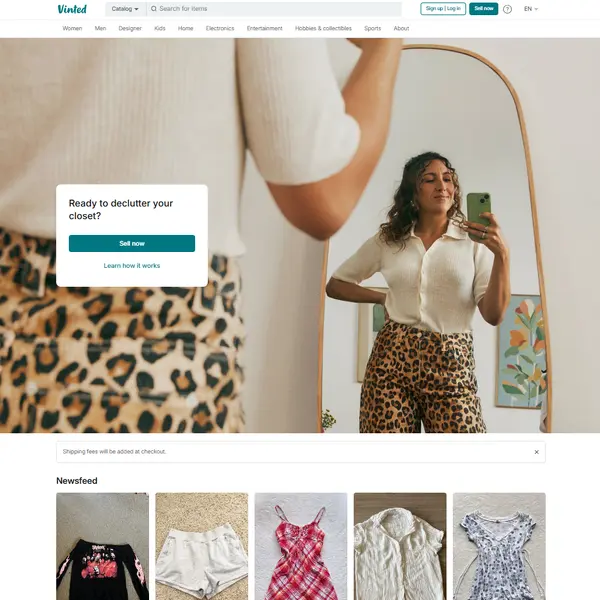
This is a done-for-you service: we run the Vinted data scraper, you receive the files. You choose the country sites, categories, brands and price bands; we design the slicing plan that gets past the ten-page ceiling, run it on your cadence, normalise sizes, conditions and currencies, and deliver CSV, Excel or JSON on a stable schema. Vinted sits behind commercial bot protection, so anti-bot handling, proxy rotation and CAPTCHA solving are part of what you buy, not something you arrange. Nothing to install, and runs repeated tightly enough that the price history exists when you need it.
Our Vinted scraper reads the item card as the marketplace renders it and returns one row per listing. The address is the anchor: a listing lives at /items/ plus a numeric id and a slug built from the seller's wording, and that id is global - the same number opens on any country domain. Core fields we extract from Vinted:
Why two prices sit on every card. Vinted shows the seller's asking price and, beneath it, a larger figure marked as including Buyer Protection. That second number is what the buyer pays, and the gap is a fixed part plus a percentage of the asking price: 0.70 euro plus five percent on the French and German sites, 0.70 pound in Britain, 2.90 zloty in Poland. Read the list figure as the transaction and every margin built on Vinted price data is short by a euro or two an item - on a cheap top, a tenth of the ticket. Both amounts go in separate columns.
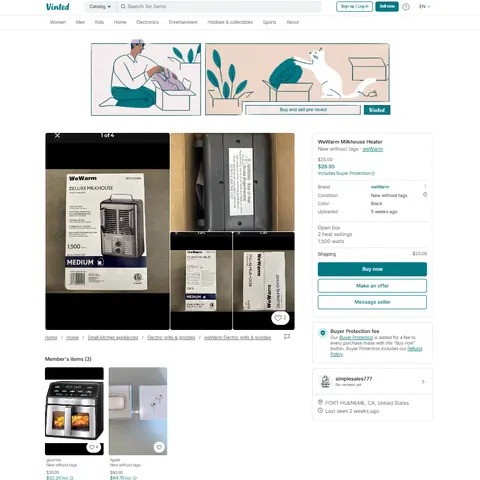
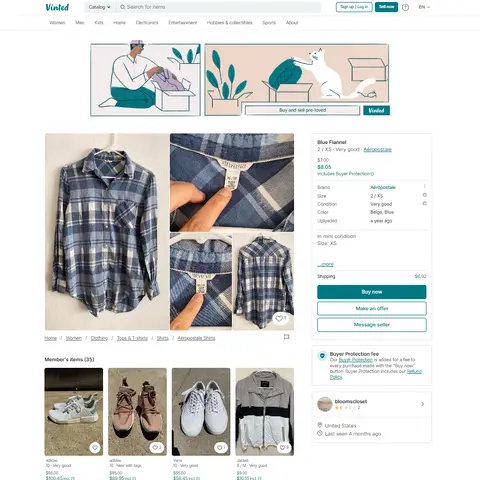
The card is half the job. What makes Vinted listings a usable feed is the slicing and how often the run repeats.
Seller names, handles and profile photographs are personal data, so we leave them out by default and keep the aggregate reputation signals only.
Vinted is a peer-to-peer marketplace for second-hand fashion, started in Lithuania and still run from there. It holds no stock: members list what they already own, each item exists in a single copy, and it leaves the catalogue for good the moment somebody buys it. That shapes everything a buyer of Vinted data plans around - no stock counts, no restocks, no recommended retail price to anchor on.
The marketplace runs as 27 country sites - vinted.fr, vinted.de, vinted.co.uk, vinted.pl, vinted.lt, vinted.es, vinted.com and the rest - each with its own language, currency and delivery partners. They share one category tree and one brand register: the outerwear branch keeps the same numeric id everywhere and merely reads Manteaux et vestes in France, Outerwear in Britain, Okrycia wierzchnie in Poland. The goods are not shared - open that branch on two domains and the wardrobes barely overlap, so Vinted scraping is aimed at each market separately, never at one global index.
Nine departments sit above the tree: Women, Men, Designer, Kids, Home, Electronics, Books and Media, Hobbies and collectibles, Sports. Listing costs a private seller nothing; the platform earns from a Buyer Protection fee charged to the buyer and from paid visibility tools, Bump and Wardrobe Spotlight. Businesses trade under Vinted Pro.
Get a Quote
Developers

Customers worldwide

Pages extracted

Hours saved for our clients
€199 / one-time
setup fee - included
€169 / mo
setup fee €499
€229 / mo
setup fee €499
€349 / mo
setup fee €499
€549 / mo
setup fee €799
Resale prices answer a question a brand cannot put to its own customers: what is a garment worth once the shop is out of the picture? Scrape Vinted by brand and size and the answer arrives as a distribution, not an opinion.

Scraping supplement products from iHerb.com with full details, including descriptions and packaging variations.
Learn More
Daily scraping of lowest prices for 150K products on Allegro.pl to support marketplace pricing and margin optimization.
Learn More
Regular monitoring of Ralph Lauren clothing, footwear, and accessories sold across Amazon subdomains: AE, DE, ES, FR, IT, NL, PL, UK.
Learn MoreLearn how to use web scraping to solve data problems for your organization
If you sell online, run a marketplace, or advise e-commerce clients, you already know why eBay matters: it’s one of the few places where big retailers compete side by side with thousands of small merchants and private sellers.

E-commerce teams do not just need “some” competitor data anymore. They need a continuous stream of real prices, discounts, stock levels, reviews, and seller behavior from the platforms that actually shape their markets.
Amazon provides valuable information gathered in one place: products, reviews, ratings, exclusive offers, news, etc. So scraping data from Amazon will help solve the problems of the time-consuming process of extracting data from e-commerce.
ScrapeIt is a data services company that collects and delivers ready-to-use datasets from e-commerce, real estate, job boards and other sites. With our Vinted scraper we run the extraction for you and hand over structured listing information and seller signals on the cadence you choose. You pick the countries, categories and fields; we handle monitoring, parsing and quality checks, and we say plainly when a field is not published instead of guessing at the column.
Yes. The ScrapeIt Vinted API returns item id, title, brand, size, condition, asking price and total, delivery options, upload date and favourites as JSON from an endpoint we host, refreshed on the schedule you set. The same data also comes as CSV or XLSX files or straight into your database. Everything we deliver comes from the pages the marketplace publishes to ordinary visitors, so we do not go behind a login: if a field is only visible to a signed-in member or to the seller, it is not in the dataset, and we say so up front.
Item id and URL, title and free-text description, brand, size, condition, material, colour, upload date, the asking price and the total including Buyer Protection with both currency codes, delivery price and options, photo addresses, the favourites counter, the full category path, and the seller's feedback count, reputation score and badges. Sizes, conditions and currencies are normalised across markets, and every value keeps the numeric id the platform assigns it so rows from different countries can be joined.
Yes, and it is usually the point. The 27 country sites share a category tree and a brand register but hold different goods, so each market has to be crawled on its own and then stitched together on the shared ids. We deliver one table with a market column, the local price, the seller's original price and both currencies, so a brand comparison between France, Germany, Poland and Britain is a filter rather than a project.
More often than a retail catalogue. Each item is a single unit, so it vanishes when it sells and cannot be re-checked afterwards - sitemap entries go stale within days, and a listing that has already sold answers with a removed shell or with nothing at all. Price history and sell-through only exist if the same slices are revisited on a schedule, typically daily for pricing work and several times a day for fast categories like sneakers and designer bags.
No, it is a managed service - we operate the extractor and hand you the files, with nothing to install. Scheduled deliveries go out as CSV, Excel or JSON on a stable schema with field descriptions, and we can split them by country, brand or category, or map them differently for analysts, pricing and catalogue teams. Our parsing absorbs layout changes and tracks the platform's updates, so the columns you build reports on stay put.
Step 1 - Make a Request
You share your needs, expectations, and desired timeframe. We’ll suggest the best solution based on your request and budget.
Step 2 - Configuring Custom Web Crawlers
Our specialists configure the crawlers and extract a sample dataset for your review before proceeding with the full-scale extraction.
Step 3 - Collect and Deliver
Once you approve the sample, we launch the project and start full data collection. We gather, filter, and structure the data for easy use, delivering it on time in your preferred format.
Step 4 - Maintain and Support
Our team manages ongoing processes, monitors website changes, and supports all data extraction cycles. We can also help integrate data into your systems or create dashboards to simplify analysis.

Scrapeit Sp. z o.o.
10/208 Legionowa str., 15-099, Bialystok, Poland
NIP: 5423457175
REGON: 523384582