mobile.de Data for Residual Value Models: 1M Car Listings a Month
A monthly snapshot of mobile.de for an automotive data company: cars and vans up to 12 years old, delivered in the client's own CSV template.
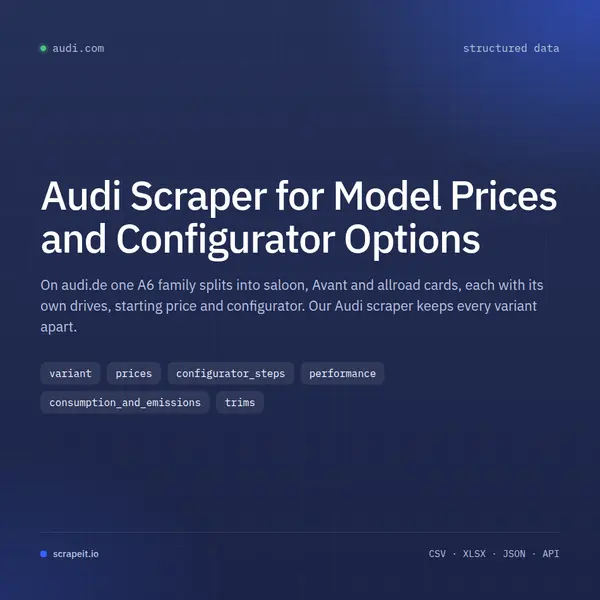
On audi.de one A6 family splits into saloon, Avant and allroad cards, each with its own drives, starting price and configurator. Our Audi scraper keeps every variant apart.
Plans from €169 a month · Free project assessment · Reply within 1 business day
API · JSON feed · CSV · Excel · JSON · XML · FTP · SFTP · Amazon S3 · Google Cloud
API, JSON feed or CSV, XLSX and JSON files
ScheduleOne-time, monthly, weekly, daily or 3 times a day
Audi pages, filters, fields and a schedule
Built, monitored and repaired by our team
API, JSON feed or CSV, XLSX and JSON files
You choose the markets and the depth: starting prices for the whole range, or full configurator runs for the models you name. We build the crawlers, run them daily, weekly or on demand, and keep them working when Audi changes a page. A configurator run walks the steps a visitor sees and records each choice with its price, so the output describes a car down to wheels and headlights instead of stopping at the base model. Every project starts with a free assessment and a sample on your models, and field documentation is part of the delivery. Test-drive and consultation forms are never submitted.
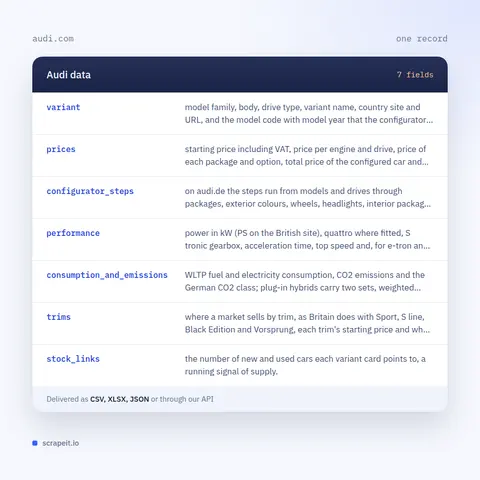
Audi publishes its range in three layers, and we collect each of them. The model overview lists every family with filters for drive (electric, petrol and diesel, plug-in hybrid) and vehicle type (compact, saloon, Sportback, Avant, allroad, allstreet, SUV, sports car). A family page such as the A6 then shows one card per body and drive - saloon, A6 Avant, A6 Avant e-hybrid, allroad - with its starting price, its WLTP block and links to configure, compare or browse stock. The configurator is the deepest layer.
S and RS models appear on family pages with emissions data even when no starting price is printed; we keep them in the table and leave the price empty rather than guess.
The configurator answers what one car costs; the rest of the site shows how the offer is shifting.
Used cars sit in a separate used-car search and make a different dataset from the new-car catalogue.
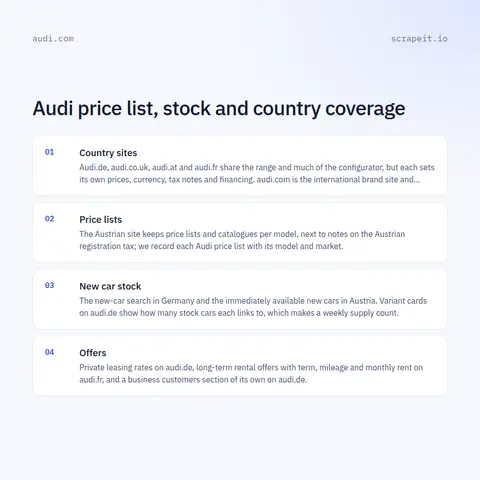
AUDI AG runs audi.com as its international site, in German and English, with models, technology, sustainability, motorsport and careers; for the configurator, pricing and leasing it sends visitors to the national sites - audi.de in Germany, audi.co.uk in Britain, audi.at in Austria, audi.fr in France and their counterparts elsewhere in Europe - each with a model overview, family pages, configurator, dealer search and finance pages.
The range is organised by family and body. A and Q families sit side by side, e-tron in a name marks an electric model (Q4 e-tron, Q6 e-tron, A6 e-tron, e-tron GT), e-hybrid marks a plug-in hybrid, Avant is the estate, Sportback the fastback, allroad the raised estate, and S and RS mark the sport models. What a buyer thinks of as one car can therefore sit in two families - a petrol, diesel and plug-in A6, and a separate electric A6 e-tron.
How a car is sold differs by market. The German site builds a car from technology packages added to a base model; the British site sells a ladder of trims, each including the one below; the French homepage leads with monthly long-term rental. Prices carry the footnote of their market - on audi.de, VAT included and all figures based on German-market features.
Delivery: CSV, JSON or XLSX files, our API or a JSON feed. MCP server on request.
Full plan detailsIn the premium segment the options decide the price: two cars of the same model can be thousands apart once packages, wheels and lights are added, so a base price alone answers few questions.
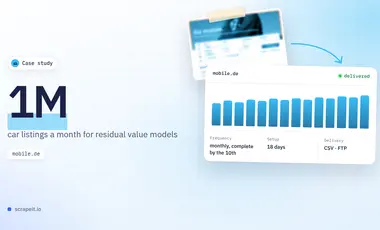
A monthly snapshot of mobile.de for an automotive data company: cars and vans up to 12 years old, delivered in the client's own CSV template.
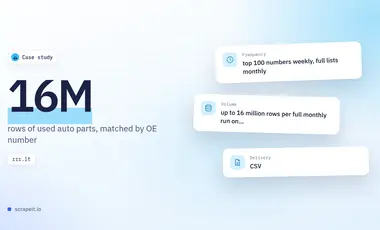
Weekly and monthly prices of used parts by OE number from rrr.lt and a Scandinavian marketplace, for a car dismantling business.
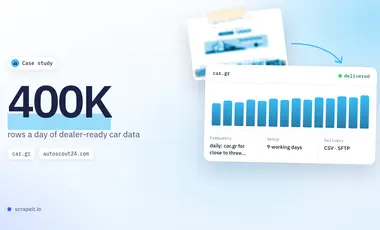
Daily monitoring of car listings on car.gr and autoscout24.com, collecting full technical specifications to support a European auto dealer.
Learn how to use web scraping to solve data problems for your organization
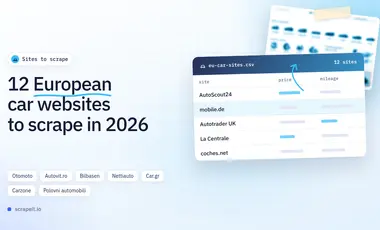
Twelve car marketplaces across Europe compared as data sources, from AutoScout24 and mobile.de to Otomoto, Bilbasen and Car.gr: what each shows, how VAT, mileage, inspection and seller fields differ by market, and how to merge them into one schema.
If you specialize in machine learning, you need to feed large amounts of data to the algorithms. Web scraping is the easiest and the most efficient method of collecting the data from all over the Internet.
Web crawling and web scraping are not synonyms. Read this article to get to know the difference between these two terms.

ScrapeIt is a team that builds and operates crawlers for clients who want web data delivered rather than a tool to run. For a premium configurator like Audi's we treat each configuration as a record with its own price, codes and date, and keep markets apart until you decide how to join them. Plans start from EUR 169 a month, or EUR 199 for a one-time extract. For a brand that sells new cars direct, see our Tesla scraper.
Still unsure? Write to info@scrapeit.io
Yes. The ScrapeIt Audi API delivers variant name, model code, starting price, package prices, total configured price and WLTP figures as JSON from an endpoint we host, on the refresh schedule you pick. The same records come as CSV, XLSX or JSONLines files, by FTP or Google Cloud Storage, or loaded into your database. An MCP server is available on request.
Yes. Model pages, configurator prices, technical data and price lists on the Audi national sites are open to anyone without signing in. We collect only publicly available data - everything a visitor can see on Audi - and we collect it legally.
Starting prices move with new model years and price lists, package prices and leasing rates with campaigns, and stock counts whenever dealers add or sell cars. We run the overview weekly and the configurator on the schedule your use case needs, and every record carries the date it was read, so changes form a history per variant.
Yes. Give us the model, the drive and the packages, colours and wheels you care about, or a list of Audi Codes for saved configurations, and we price exactly those on each run. Each result lists every option with its price and the total, so you can see whether a change came from the base car or from the options.
The German, British, Austrian and French sites follow one pattern, and other European national sites can be added the same way. Each market keeps its currency, tax basis and selling logic - packages in Germany, trims in Britain - with a mapping column that lines up the same variant across countries.
You share your needs, expectations, and desired timeframe. We'll suggest the best solution based on your request and budget.
Our specialists configure the crawlers and extract a sample dataset for your review before proceeding with the full-scale extraction.
Once you approve the sample, we launch the project and start full data collection. We gather, filter, and structure the data for easy use, delivering it on time in your preferred format.
Our team manages ongoing processes, monitors website changes, and supports all data extraction cycles. We can also help integrate data into your systems or create dashboards to simplify analysis.
Tell us which sites, which fields and how often. A couple of lines is enough to start.
Audi data from €169/month. Free project assessment, reply within 1 business day.