
Build Your Own Scraper or Hire a Service
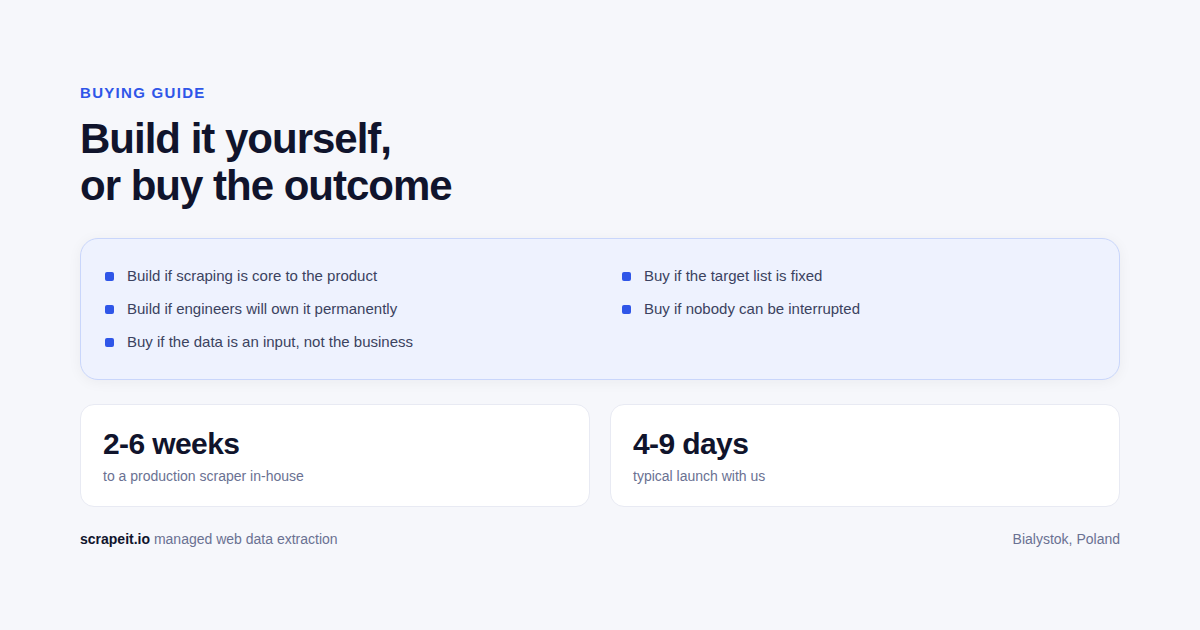
Writing a scraper is not hard. Keeping one running for two years is a different job. This page is about where that line falls, including the cases where building it yourself is the right answer.
When building it yourself makes sense
If the source is simple, the job is one-off, and someone on your team has the time, write it yourself. A single page structure, no login, no protection, a few thousand rows you need once: that is an afternoon, and paying a vendor for it is waste.
The same is true for anything experimental. If you are still working out whether the data is useful at all, a rough script that answers that question is worth more than a proper pipeline.
What changes on a longer horizon
The reason in-house scrapers get abandoned is rarely the first version. It is everything after it:
- The site changes. Not once. One source in our portfolio was rebuilt several times over the years, and each rebuild moved the structures the collector depended on.
- Access gets harder. The same source also changed how it handles automated traffic, more than once.
- Volume grows. A script that works on a thousand rows behaves differently at 200,000 a day, which is what one of our projects delivers.
- Sources multiply. The second and third source are not twice and three times the work, because now the outputs have to agree with each other. In one project five portals had to be reconciled into one structure, and that took most of the three weeks the project needed.
- Someone has to be on call. A feed that quietly returns half the rows is worse than one that stops, because nobody notices for a week.
What you are actually buying from a vendor
Not the code. The code is the easy part. You are buying the guarantee that the same dataset keeps arriving in the same shape while all of the above happens, and that it happens on someone else's calendar.
Concretely, in our projects that has meant: launch in 2 to 9 working days for most targets, 12 for one with heavy protection, and 3 weeks for a five-source project; delivery as CSV, Excel or JSON, one-off or scheduled; and in one case an email report every workday at 7 a.m. plus the same data pushed into the client's database through an API.
Where your responsibility ends
This is the part worth pinning down in any comparison. With a vendor you own the brief and the data. You do not own the maintenance, the access questions, or the on-call rota. If a source is redesigned on a Friday night, that is not your problem to notice.
What stays with you: deciding which sources and fields matter, and what you do with the result. That part nobody can outsource.
An honest way to decide
Ask two questions. Will I still need this data in six months? Is the source likely to fight back? If both answers are yes, in-house means committing a person to it indefinitely. If either is no, build it yourself.
If you land on the vendor side, the pricing page shows where plans start, the case studies show what the work looks like at volume, and our compliance page covers what your legal team will ask. For a target that needs something built from scratch, see custom scraper development.
Procurement or legal asking about paperwork? Do Web Scraping Vendors Sign NDAs and DPAs.
Counting the cost of doing it yourself? The Hidden Costs of In-House Web Scraping.
Frequently asked questions
Should I build my own web scraper or buy a service?
Build if scraping is core to your product, you have engineers who will own it permanently, and the targets are stable. Buy if the data is an input to your business rather than the business itself, if the target list is fixed, or if nobody on the team has capacity to be interrupted every time a site changes its markup.
How long does it take to build a production web scraper?
A working prototype against a friendly site takes a day or two. A production scraper is a different thing: proxy rotation, retry and backoff, monitoring for silent failure, schema validation, deduplication, scheduling and alerting. For a defended target that is typically two to six weeks of engineering before the first reliable delivery.
What is the ongoing cost of an in-house scraper?
The recurring cost is engineering attention, not servers. Across the industry, teams commonly report a substantial share of a developer's time going to repairing parsers rather than building product. That cost is invisible in a build-versus-buy spreadsheet because it never appears as an invoice.
When does building in-house actually make sense?
When the extraction logic is a competitive advantage rather than plumbing, when you need extremely low latency you can tune yourself, when the volume is large enough that a vendor margin exceeds a salary, or when compliance forbids a third party touching the pipeline at all. Those cases are real, and they are less common than teams assume at the start.
Have a target list and a deadline?
Send the sites and the fields you need. You get a scoped answer and a price, not a discovery call.