Employer Data: 988,996 Unique Records from a Captcha-Gated Search
A one-time copy of a public employer directory for a US property-technology startup: 988,996 unique employers, collected through a captcha-gated search form.
Learn More
Company registers, court filings, trademark databases and cadastral records - public by law, but published in formats that were never meant to be read at scale.
Plans from €169/month · Free project assessment · Reply within 1 business day
KYC and AML Teams
Banks and Lenders
Insurance Underwriters
Compliance and Risk Departments
Law Firms
Trademark and IP Attorneys
Credit Bureaus and Data Vendors
Due Diligence and Investigation Firms
Sales and Lead Generation Teams
Property Developers and Surveyors

Developers

Customers worldwide

Pages extracted

Hours saved for our clients
Official registers stand on different legal ground from commercial sites: the data is public by statute and meant to be consulted. The difficulty is not permission, it is format - paginated search forms, scanned PDFs and identifiers that only make sense once you join them to something else. Registry numbers are also the cleanest way to enrich a sales lead list.
Pull the current company record, legal form, address, status and officers at the moment of onboarding instead of trusting what the customer typed into a form.
Where ownership is published, collect the chain of shareholders and officers so control can be traced past the first legal entity.
Track status changes, liquidations, insolvency entries and filing history across a portfolio rather than checking companies one at a time.
Monitor new applications in the classes you care about, with owner, representative, filing and registration dates and opposition status.
Registry identifiers are the only reliable join key between your CRM and official data. We return them so records match on something better than a company name.
Collect cadastral parcel identifiers, land use and boundaries from public map services for site assessment.
Build a picture of an entire sector from activity codes and incorporation dates, including companies that have no website at all.
Fields differ by register and by country. Below is what a company and trademark record typically yields; we confirm the exact list against the source before starting.

Expertly customized web scraping services at a fraction of the cost of building and running collection in-house.
€199 / one-time
setup fee - included
€169 / mo
setup fee €499
€229 / mo
setup fee €499
€349 / mo
setup fee €499
€549 / mo
setup fee €799
Delivery: CSV, JSON or XLSX files, our API or a JSON feed. MCP server on request.
Full plan details →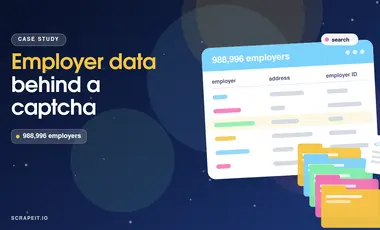
A one-time copy of a public employer directory for a US property-technology startup: 988,996 unique employers, collected through a captcha-gated search form.
Learn More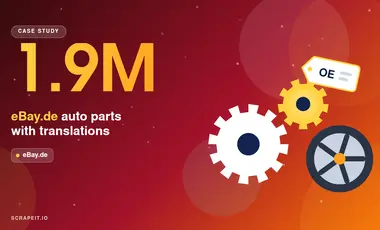
About 1.9 million auto parts listings from eBay.de with brand, OEM, EAN and fitment, plus titles and specs machine-translated for the client's team.
Learn More
A daily apartments.com feed for a US apartment locator: about 3,000 buildings from the client's own list, down to each unit's rent and floor plan.
Learn More
A one-time Housing.com collection for a real-estate company in India: project cards plus every photo and floor plan, uploaded straight to its cloud drive.
Learn More
Since 2022, weekly car rental and, from 2025, hotel prices from Booking.com for a tourism organization comparing its destination with rivals.
Learn More
A one-off Takealot product list for an entrepreneur choosing niches: only products rated 4 stars or higher with at least 50 reviews.
Learn More
Every record comes back with its registry number. Matching on a company name alone fails on branches, renames and punctuation; matching on an identifier does not.

A large part of register content is PDFs and scanned filings. We extract the fields from them rather than handing you a folder of files.

Registers are checked on a schedule and we report what changed - status, officers, address, capital - instead of re-delivering the whole record every time.

You pay for the dataset, not for proxies, browser farms and the engineering time to keep them alive.

Public services are collected slowly and predictably. These are state resources, and hammering them is both rude and the fastest way to lose access.
Learn how to use web scraping to solve data problems for your organization
Leveraging advances in technology, the AI-powered web scraper has skyrocketed in demand and is helping to expand capabilities by automating tedious daily tasks and speeding up data collection from thousands of websites several times over.

Web scraping is a method of obtaining web data by extracting it from pages of web resources with the help of a program, that is, in automatic mode. It is used to syntactically convert web pages into more usable forms.

If you specialize in machine learning, you need to feed large amounts of data to the algorithms. Web scraping is the easiest and the most efficient method of collecting the data from all over the Internet.
Yes. The data in official registers is published because statute requires it to be public. We collect everything a register shows to visitors - entries, statuses, dates, document links and identifiers - legally and without logging in, and any personal data in entries is handled under GDPR.
Because registers were built for one lookup at a time. Search forms are paginated, results are frequently PDFs or scans rather than HTML, some sources gate search behind a challenge, and identifiers are formatted differently in every country.
Yes. A meaningful share of filings exists only as PDFs or scans, so text extraction and, where necessary, recognition are part of the pipeline. We deliver parsed fields and keep a link to the source document.
Whatever the register issues - KRS, NIP and REGON for Poland, EUIPO application numbers for trademarks, cadastral parcel identifiers for land. These are the join keys that let registry data meet your own records.
It varies by source. Some publish daily bulletins, others change only when a filing is made. We set the checking schedule per register and report differences rather than the whole record each run.
CSV, Excel, JSON, JSONLines or XML, delivered through our API, a JSON feed, FTP, SFTP, Amazon S3, Google Cloud Storage, Dropbox, Google Drive or email. An MCP server is available on request. We can also write directly into your database.
Step 1 - Make a Request
You share your needs, expectations, and desired timeframe. We’ll suggest the best solution based on your request and budget.
Step 2 - Configuring Custom Web Crawlers
Our specialists configure the crawlers and extract a sample dataset for your review before proceeding with the full-scale extraction.
Step 3 - Collect and Deliver
Once you approve the sample, we launch the project and start full data collection. We gather, filter, and structure the data for easy use, delivering it on time in your preferred format.
Step 4 - Maintain and Support
Our team manages ongoing processes, monitors website changes, and supports all data extraction cycles. We can also help integrate data into your systems or create dashboards to simplify analysis.

Scrapeit Sp. z o.o.
10/208 Legionowa str., 15-099, Bialystok, Poland
KRS: 0000996672
NIP: 5423457175
REGON: 523384582