
Your Scraper Keeps Getting Blocked
Your scraper worked. Now it returns empty pages, partial rows, or nothing at all. This is not a bug you introduced, and it is not unusual - it is what happens to collectors on a long enough timeline.
Why it breaks later rather than immediately
A collector built against a site as it is today depends on the site staying that way. Two things move underneath it.
The first is the page itself. Redesigns change structures, identifiers and layouts. One source we work with was rebuilt several times over the years, and every rebuild broke assumptions a naive collector would have made.
The second is how the site treats automated traffic. That also changes, and on the same source it changed significantly more than once. A collector that ran fine for months can stop working without anything on your side changing at all.
Why patching stops working
The first fix is quick. The fifth one is a second job. What usually happens is that the script accumulates special cases until nobody wants to touch it, and then a redesign arrives and it is easier to rewrite than to repair.
The deeper problem is that "collect this once" and "collect this every day without supervision" are different engineering targets. Code written for the first almost never survives promotion to the second, because it has no reason to handle partial failure, retries, or the day the source returns something unexpected.
The failure you should worry about
Being blocked outright is the good case: it is loud, and you know. The expensive case is the quiet one, where data keeps arriving but a filter silently stopped applying, or a section is missing, or a field moved. Reports keep landing, decisions keep getting made, and the numbers have been wrong for two weeks.
That is why the practical question is not "can this be unblocked" but "who is watching whether the output is still complete".
What changes when a vendor runs it
Access and protection are handled inside the collection layer, and keeping them working is part of the service rather than something you manage. When the source changes, the collector is adapted on our side, and the dataset keeps arriving in the same shape on the same schedule. On the source that was rebuilt several times, the client never had to do anything about it.
We do not publish methods, and this page deliberately does not describe any. What we can say is what the outcome looks like: in our projects that has included about 200,000 rows a day from a members-only catalogue, and 150,000 lookups a day on a marketplace where sustaining the request volume without interruption was the hardest part of the project.
Handing over an existing project
You do not need to arrive with working code. Most handovers start from a description: which source, which fields, how often, and what the output has to look like. If you already have a schema you rely on, we match it, so whatever consumes the data downstream does not need changing.
Typical build and test time in our projects is 2 to 9 working days, and 12 for the hardest one. Delivery is CSV, Excel or JSON, one-off or scheduled.
If that is the direction, see custom scraper development for how a project runs, the case studies for what it looks like at volume, or just tell us what broke.
Different failure, same morning: Scraper Broke After a Site Redesign.
Running at volume? Scraping at Scale Without Getting Banned.
Frequently asked questions
Why does my scraper work at first and get blocked later?
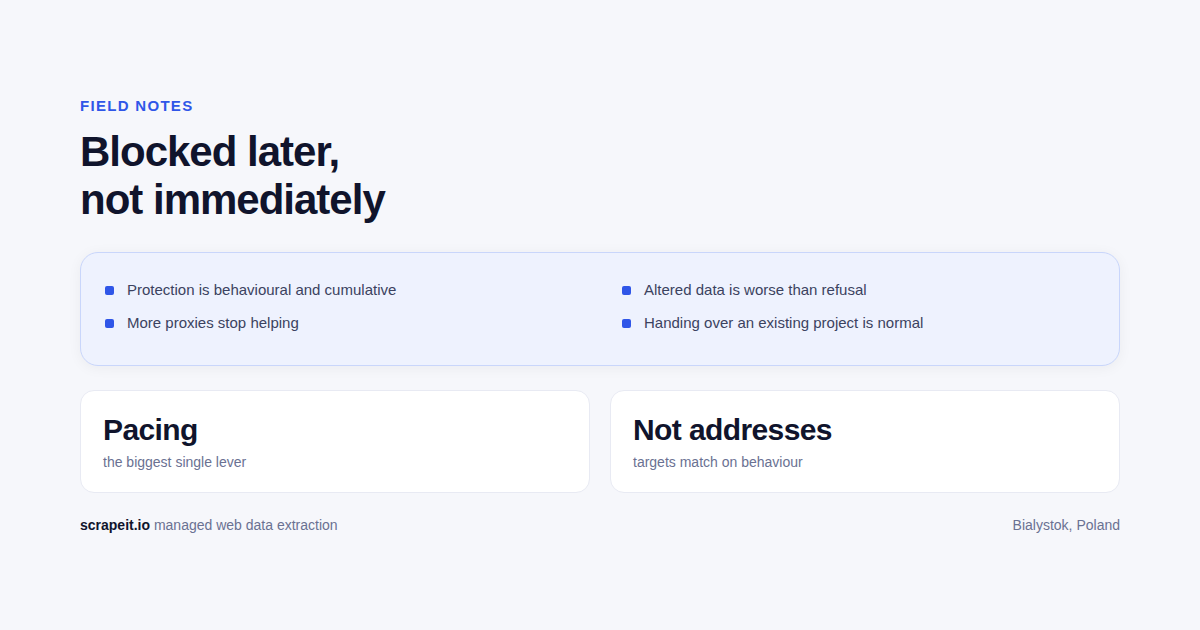
Because most protection is behavioural and cumulative. The first runs look like ordinary traffic, and the pattern only becomes visible to the target once you have made enough requests for it to be measured. That is why the problem appears after the project already feels finished.
Why does adding more proxies stop helping?
Because rotation only changes where the requests come from, not what they look like. Once the target is matching on timing, ordering and session behaviour rather than on addresses, more addresses buy you a short reprieve and a bigger bill.
What failure should worry me more than an outright block?
Being served altered data instead of being refused. A target that returns a thinner page, stale prices or a subset of listings to traffic it distrusts causes far more damage than one that returns an error, because the pipeline keeps running and nobody investigates.
Can you take over a scraper we already built?
Yes. Handing over an existing project is a normal starting point: we take the target list and the field requirements, rebuild collection on our own infrastructure, and check the output against what you were getting before so the change is visible rather than assumed.
Have a target list and a deadline?
Send the sites and the fields you need. You get a scoped answer and a price, not a discovery call.