Employer Data: 988,996 Unique Records from a Captcha-Gated Search
A one-time copy of a public employer directory for a US property-technology startup: 988,996 unique employers, collected through a captcha-gated search form.
Learn More
Tracking events, transit times and published rates from carriers and postal operators, normalised into one status vocabulary instead of thirty different ones.
Plans from €169/month · Free project assessment · Reply within 1 business day

eCommerce Retailers
Marketplaces and Fulfilment Teams
Freight Forwarders
Third Party Logistics Providers
Supply Chain Analysts
Post-Purchase and Tracking Vendors
Customer Service Platforms
Insurance and Claims Teams
Manufacturers and Distributors
Trade and Commodity Researchers

Developers

Customers worldwide

Pages extracted

Hours saved for our clients
Every carrier invents its own status vocabulary. One calls it "in transit", the next "departed facility", the third gives you a numeric code with no legend. The work is not fetching the tracking page, it is mapping thirty vocabularies onto one so exceptions become countable.
Collect tracking events across carriers and postal operators and normalise them into a single status model with consistent timestamps.
Compare promised delivery dates against actual delivery events to see which carrier keeps its word on which lane.
Surface stuck, misrouted and failed-delivery shipments early, by watching for events that stop arriving rather than events that do.
Published rates and transit estimates by origin, destination, weight and dimensions, collected as a grid for comparison.
Schedules, port calls and vessel positions from public AIS sources for container-level visibility.
Which carriers serve which postcodes, and where pickup points and lockers actually are.
Public tariff, duty and restriction data for landed cost calculation.
Tracking output is delivered both raw and normalised: the carrier wording as published, and our unified status next to it.

Expertly customized web scraping services at a fraction of the cost of building and running collection in-house.
€199 / one-time
setup fee - included
€169 / mo
setup fee €499
€229 / mo
setup fee €499
€349 / mo
setup fee €499
€549 / mo
setup fee €799
Delivery: CSV, JSON or XLSX files, our API or a JSON feed. MCP server on request.
Full plan details →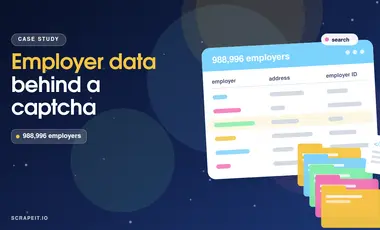
A one-time copy of a public employer directory for a US property-technology startup: 988,996 unique employers, collected through a captcha-gated search form.
Learn More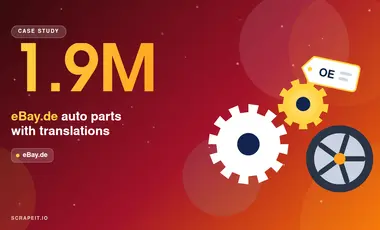
About 1.9 million auto parts listings from eBay.de with brand, OEM, EAN and fitment, plus titles and specs machine-translated for the client's team.
Learn More
A daily apartments.com feed for a US apartment locator: about 3,000 buildings from the client's own list, down to each unit's rent and floor plan.
Learn More
A one-time Housing.com collection for a real-estate company in India: project cards plus every photo and floor plan, uploaded straight to its cloud drive.
Learn More
Since 2022, weekly car rental and, from 2025, hotel prices from Booking.com for a tourism organization comparing its destination with rivals.
Learn More
A one-off Takealot product list for an entrepreneur choosing niches: only products rated 4 stars or higher with at least 50 reviews.
Learn More
Carrier wording is mapped onto a single normalised model, with the original text kept alongside so nothing is lost in translation.

A shipment in trouble usually stops producing events rather than reporting a problem. We flag gaps, not just errors.

Origin, destination, weight and dimensions are collected as a matrix, because a single quote tells you nothing about a lane.

You pay for the dataset, not for proxies, browser farms and the engineering time to keep them alive.

Carrier tracking endpoints are collected at a measured pace. Hammering them is the fastest way to lose access for everyone.
Learn how to use web scraping to solve data problems for your organization

Leveraging advances in technology, the AI-powered web scraper has skyrocketed in demand and is helping to expand capabilities by automating tedious daily tasks and speeding up data collection from thousands of websites several times over.

Web scraping is a method of obtaining web data by extracting it from pages of web resources with the help of a program, that is, in automatic mode. It is used to syntactically convert web pages into more usable forms.

If you specialize in machine learning, you need to feed large amounts of data to the algorithms. Web scraping is the easiest and the most efficient method of collecting the data from all over the Internet.
Use them where you have them - they are better. Scraping covers the gaps: carriers without an API, regional postal operators, contract terms you do not hold, and the published rate pages that APIs often do not expose.
Each carrier words events differently and some emit numeric codes with no public legend. We map them onto one model - accepted, in transit, out for delivery, delivered, exception - and keep the original text next to it.
That is the common request. A troubled shipment usually goes quiet rather than reporting an exception, so we watch for missing events against the expected cadence for that lane and flag the silence.
Published rates and transit estimates, yes, collected as a grid over origin, destination, weight and dimensions. Negotiated contract rates are not public and are not something scraping can produce.
Yes - schedules, port calls and vessel positions from public sources, joined to container or booking references where the carrier publishes them.
CSV, Excel, JSON, JSONLines or XML, delivered through our API, a JSON feed, FTP, SFTP, Amazon S3, Google Cloud Storage, Dropbox, Google Drive or email. An MCP server is available on request. We can also write directly into your database.
Step 1 - Make a Request
You share your needs, expectations, and desired timeframe. We’ll suggest the best solution based on your request and budget.
Step 2 - Configuring Custom Web Crawlers
Our specialists configure the crawlers and extract a sample dataset for your review before proceeding with the full-scale extraction.
Step 3 - Collect and Deliver
Once you approve the sample, we launch the project and start full data collection. We gather, filter, and structure the data for easy use, delivering it on time in your preferred format.
Step 4 - Maintain and Support
Our team manages ongoing processes, monitors website changes, and supports all data extraction cycles. We can also help integrate data into your systems or create dashboards to simplify analysis.

Scrapeit Sp. z o.o.
10/208 Legionowa str., 15-099, Bialystok, Poland
KRS: 0000996672
NIP: 5423457175
REGON: 523384582