Employer Data: 988,996 Unique Records from a Captcha-Gated Search
A one-time copy of a public employer directory for a US property-technology startup: 988,996 unique employers, collected through a captcha-gated search form.
Learn More
Course catalogs, prices, ratings and enrolment signals from learning platforms and university sites - collected per country, because both price and availability change with it.
Plans from €169/month · Free project assessment · Reply within 1 business day

Online Course Platforms
Universities and Business Schools
Corporate Learning Teams
EdTech Startups
Course Aggregators and Marketplaces
Skills and Labour Market Analysts
Publishers and Content Providers
Investment and Research Firms
Student Recruitment Agencies
Curriculum Designers

Developers

Customers worldwide

Pages extracted

Hours saved for our clients
Listed course prices are rarely the prices people pay: the large marketplaces run near-permanent discounts, and the figure differs by country and by the visitor. Any pricing study has to record both the list and the effective price. Related: job market data for the skills side.
Track list price against the discounted price actually shown, by country and over time, on the platforms where discounting never stops.
See which subjects competitors cover and you do not, with the depth of each catalog measured rather than guessed.
Collect ratings, review counts and enrolment numbers where published, as a proxy for demand by topic.
Match course topics against vacancy requirements to see where training supply lags the labour market.
Programmes, entry requirements, tuition fees, intake dates and rankings, collected across institutions for comparison.
Track new releases by instructor or publisher, and how quickly a topic gets covered after it appears.
Metadata from preprint servers and journal indexes for research tooling and literature mapping.
Fields vary between marketplaces and university sites; we confirm the exact list against each source before starting.

Expertly customized web scraping services at a fraction of the cost of building and running collection in-house.
€199 / one-time
setup fee - included
€169 / mo
setup fee €499
€229 / mo
setup fee €499
€349 / mo
setup fee €499
€549 / mo
setup fee €799
Delivery: CSV, JSON or XLSX files, our API or a JSON feed. MCP server on request.
Full plan details →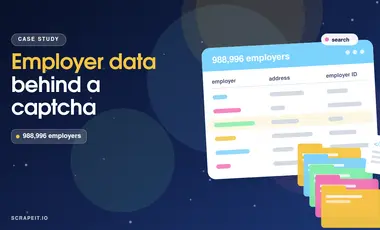
A one-time copy of a public employer directory for a US property-technology startup: 988,996 unique employers, collected through a captcha-gated search form.
Learn More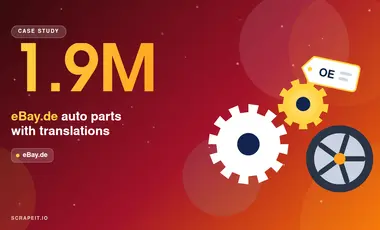
About 1.9 million auto parts listings from eBay.de with brand, OEM, EAN and fitment, plus titles and specs machine-translated for the client's team.
Learn More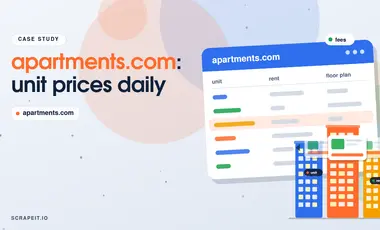
A daily apartments.com feed for a US apartment locator: about 3,000 buildings from the client's own list, down to each unit's rent and floor plan.
Learn More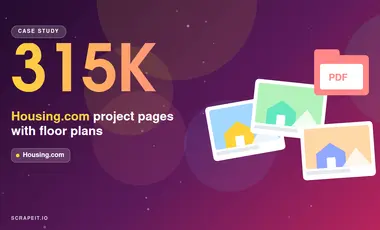
A one-time Housing.com collection for a real-estate company in India: project cards plus every photo and floor plan, uploaded straight to its cloud drive.
Learn More
Since 2022, weekly car rental and, from 2025, hotel prices from Booking.com for a tourism organization comparing its destination with rivals.
Learn More
A one-off Takealot product list for an entrepreneur choosing niches: only products rated 4 stars or higher with at least 50 reviews.
Learn More
Both numbers are captured on the same row, because on the big marketplaces the list price is close to fiction.

Price, availability and even the catalog differ by market, so each one is collected separately instead of being averaged into nonsense.

Not just the course card: modules, workload and prerequisites, which is what gap analysis actually needs.

You pay for the dataset, not for proxies, browser farms and the engineering time to keep them alive.

We watch the platforms for layout changes and fix collectors before your feed breaks.
Learn how to use web scraping to solve data problems for your organization

Leveraging advances in technology, the AI-powered web scraper has skyrocketed in demand and is helping to expand capabilities by automating tedious daily tasks and speeding up data collection from thousands of websites several times over.

Web scraping is a method of obtaining web data by extracting it from pages of web resources with the help of a program, that is, in automatic mode. It is used to syntactically convert web pages into more usable forms.

If you specialize in machine learning, you need to feed large amounts of data to the algorithms. Web scraping is the easiest and the most efficient method of collecting the data from all over the Internet.
Because the large marketplaces run discounts almost permanently, and the crossed-out list price is not what anyone pays. Recording both is the only way to compare platforms honestly.
Yes, and so do prices and currency. Some courses are unavailable in some markets entirely. We collect each market separately and tag every row with the country it was collected for.
Yes - programmes, entry requirements, tuition, intake dates and rankings. University sites are slower to change than marketplaces, so these usually run on a monthly or termly schedule.
No. We collect catalog metadata: titles, syllabus outlines, prices, ratings and dates. Lecture videos and materials are the platform's copyrighted content.
That is a common combined project: course topics from learning platforms on one side, skills named in vacancies on the other, joined on a normalised skill taxonomy.
CSV, Excel, JSON, JSONLines or XML, delivered through our API, a JSON feed, FTP, SFTP, Amazon S3, Google Cloud Storage, Dropbox, Google Drive or email. An MCP server is available on request. We can also write directly into your database.
Step 1 - Make a Request
You share your needs, expectations, and desired timeframe. We’ll suggest the best solution based on your request and budget.
Step 2 - Configuring Custom Web Crawlers
Our specialists configure the crawlers and extract a sample dataset for your review before proceeding with the full-scale extraction.
Step 3 - Collect and Deliver
Once you approve the sample, we launch the project and start full data collection. We gather, filter, and structure the data for easy use, delivering it on time in your preferred format.
Step 4 - Maintain and Support
Our team manages ongoing processes, monitors website changes, and supports all data extraction cycles. We can also help integrate data into your systems or create dashboards to simplify analysis.

Scrapeit Sp. z o.o.
10/208 Legionowa str., 15-099, Bialystok, Poland
KRS: 0000996672
NIP: 5423457175
REGON: 523384582