Employer Data: 988,996 Unique Records from a Captcha-Gated Search
A one-time copy of a public employer directory for a US property-technology startup: 988,996 unique employers, collected through a captcha-gated search form.
Learn More
Menus, item prices, promotions, delivery fees and store availability collected from delivery apps the way a customer sees them - per store, per postcode, per hour.
Plans from €169/month · Free project assessment · Reply within 1 business day
Restaurant Chains
CPG and FMCG Brands
Delivery Marketplaces
Virtual and Dark Kitchen Operators
Grocery and Quick Commerce Retailers
Price Intelligence Vendors
Revenue Management Teams
Market Research Agencies
Investment and Equity Research Firms
POS and Menu Management Vendors

Developers

Customers worldwide

Pages extracted

Hours saved for our clients
The same restaurant shows a different menu, a different price and a different delivery fee depending on the address you order to. That is why food delivery scraping is built around a grid of delivery postcodes rather than a single request per store. See how we handle the same problem for retail catalogues.
Compare your item prices against competitors in the same delivery zone, and against your own dine-in prices. Delivery menus are routinely marked up over in-store prices, and the gap differs by chain and by city.
The same store often lists different prices on different apps. We collect the same store across DoorDash, Uber Eats, Deliveroo and local platforms so parity breaks are visible the day they appear.
Capture discount type, threshold and who funds it - platform-wide campaigns, restaurant-funded offers, free delivery tiers and minimum order values.
Items disappear mid-service and stores go offline at peak. Hourly collection turns that into an availability time series instead of a single snapshot.
One physical kitchen can list under a dozen virtual brands. Matching menus, addresses and photos across listings exposes which brands share a kitchen.
Fees and promised delivery times change by distance, hour and demand. Tracking them across a postcode grid shows where a platform is subsidising and where it is not.
Track new store openings, closures and which chains entered which delivery zones, by scanning the same postcode grid over time.
Every row is tied to the delivery postcode it was collected for, because without it a price on a delivery app means nothing.
Expertly customized web scraping services at a fraction of the cost of building and running collection in-house.
€199 / one-time
setup fee - included
€169 / mo
setup fee €499
€229 / mo
setup fee €499
€349 / mo
setup fee €499
€549 / mo
setup fee €799
Delivery: CSV, JSON or XLSX files, our API or a JSON feed. MCP server on request.
Full plan details →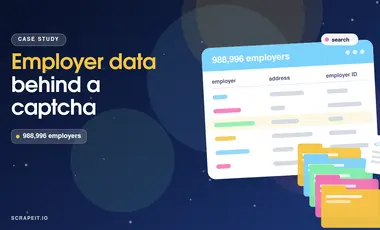
A one-time copy of a public employer directory for a US property-technology startup: 988,996 unique employers, collected through a captcha-gated search form.
Learn More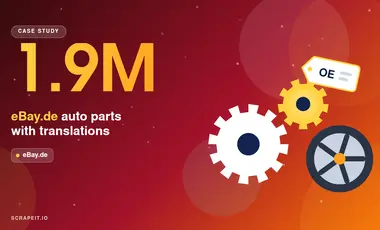
About 1.9 million auto parts listings from eBay.de with brand, OEM, EAN and fitment, plus titles and specs machine-translated for the client's team.
Learn More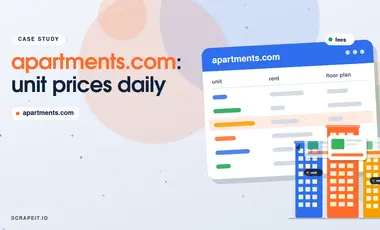
A daily apartments.com feed for a US apartment locator: about 3,000 buildings from the client's own list, down to each unit's rent and floor plan.
Learn More
A one-time Housing.com collection for a real-estate company in India: project cards plus every photo and floor plan, uploaded straight to its cloud drive.
Learn More
Since 2022, weekly car rental and, from 2025, hotel prices from Booking.com for a tourism organization comparing its destination with rivals.
Learn More
A one-off Takealot product list for an entrepreneur choosing niches: only products rated 4 stars or higher with at least 50 reviews.
Learn More
We agree the list of delivery zones with you and collect every store against each of them, so prices and fees are comparable instead of accidental.

The same physical store is matched across delivery apps by address, menu and photos, which is what makes price parity analysis possible at all.

Menus are stable, availability and fees are not. We run different cadences for different fields rather than re-collecting everything at once.

You pay for the dataset, not for proxies, browser farms and the engineering time to keep them alive.

We watch the apps for layout changes and fix collectors before your feed breaks. No dashboards to learn, no scrapers to maintain.
Learn how to use web scraping to solve data problems for your organization

Leveraging advances in technology, the AI-powered web scraper has skyrocketed in demand and is helping to expand capabilities by automating tedious daily tasks and speeding up data collection from thousands of websites several times over.

Web scraping is a method of obtaining web data by extracting it from pages of web resources with the help of a program, that is, in automatic mode. It is used to syntactically convert web pages into more usable forms.

If you specialize in machine learning, you need to feed large amounts of data to the algorithms. Web scraping is the easiest and the most efficient method of collecting the data from all over the Internet.
Use a managed scraping service: we build, run and maintain the scrapers for the apps and postcodes you choose, and deliver menus, prices, fees and availability on your schedule, with no code on your side. We cover 29 food delivery sites and collect each store per delivery postcode, so prices stay comparable between runs and platforms. A one-time dataset of up to 100,000 rows costs EUR 199 and comes as CSV, Excel or JSON. Monthly plans cost from EUR 169 a month plus a one-off EUR 499 setup fee that includes the sample dataset and the first month, and can also deliver through our API or as a JSON feed. First data usually arrives in 1-10 days.
Because a delivery app has no single price for a store. Menu contents, item prices, delivery fee and estimated time all depend on the address the customer orders to. Without a fixed grid of postcodes the numbers are not comparable between runs, let alone between platforms.
Yes, and that is the most common request. We match a physical store across platforms by address, menu overlap and photos, then deliver one row per store per platform so price parity breaks are visible.
Very often. Many chains apply a delivery markup, and the size of it varies by brand and city. We can collect both the delivery listing and the chain website so the gap is measurable rather than assumed.
One kitchen frequently operates under many brand names. We flag listings that share an address, and additionally compare menu structure and images, which catches cases where the address is deliberately generic.
Menus and store lists usually daily. Availability, delivery fees and estimated times are worth collecting several times a day, since they change with demand. We set the cadence per field rather than re-collecting everything on the same schedule.
CSV, Excel, JSON, JSONLines or XML, delivered through our API, a JSON feed, FTP, SFTP, Amazon S3, Google Cloud Storage, Dropbox, Google Drive or email. An MCP server is available on request. We can also write directly into your database.
Step 1 - Make a Request
You share your needs, expectations, and desired timeframe. We’ll suggest the best solution based on your request and budget.
Step 2 - Configuring Custom Web Crawlers
Our specialists configure the crawlers and extract a sample dataset for your review before proceeding with the full-scale extraction.
Step 3 - Collect and Deliver
Once you approve the sample, we launch the project and start full data collection. We gather, filter, and structure the data for easy use, delivering it on time in your preferred format.
Step 4 - Maintain and Support
Our team manages ongoing processes, monitors website changes, and supports all data extraction cycles. We can also help integrate data into your systems or create dashboards to simplify analysis.

Scrapeit Sp. z o.o.
10/208 Legionowa str., 15-099, Bialystok, Poland
KRS: 0000996672
NIP: 5423457175
REGON: 523384582