
How Much Does Web Scraping Cost
There is no honest price list for web scraping, only a price for your project. What follows is what actually moves the number, so you can estimate before you ask.
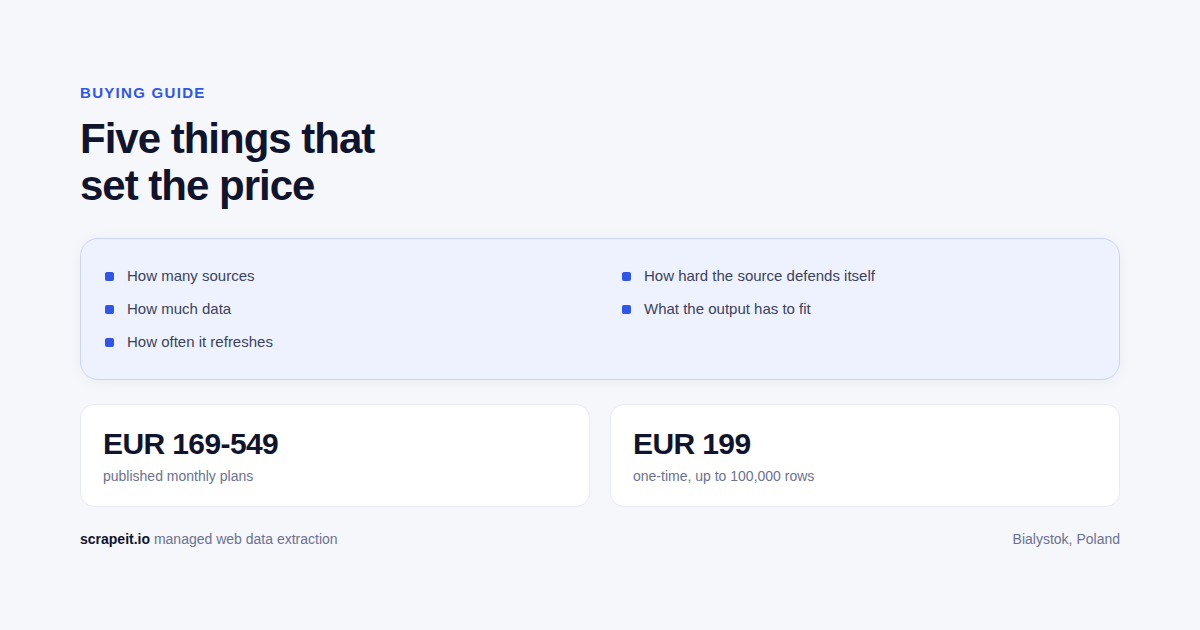
The five things that set the price
How many sources. One site is one set of page structures to learn. Five sites is five, plus the work of making their output comparable. In one project we monitored five European property portals, and the harder half of the job was not collection at all but bringing five different ways of describing a property into one structure the client's analytics pipeline could read.
How much data. Volume drives infrastructure and time. Our projects have ranged from about 13,000 rows a day to just over 400,000, and one runs about 200,000 rows every day from a single catalogue.
How often. A single complete extraction and a daily feed that has to land before the client's working day are different products. The second one costs more because it has to keep working unattended.
How difficult the source is. Some sites are straightforward. Others need a login, guard themselves against automated traffic, or hide the data behind interactions rather than links. That difference shows up in the build time: our fastest launch was 2 working days, a typical project lands in 4 to 9, and one with heavy protection and 150,000 lookups a day took 12 working days of development and testing.
What the output has to fit. A CSV you open in Excel is cheaper than a feed that has to arrive in your database through an API on a schedule. Both are normal requests; they are just not the same amount of work.
Why price per row is a bad unit
Per-row pricing suggests the cost is in the volume. On easy sources it roughly is. On difficult ones almost all of the cost is in getting reliable access to the first page, and the millionth row after that is nearly free.
That is why a plan with a row limit works for predictable sources, and why anything unusual gets quoted as a project. Our published plans start at 169 EUR per month with a limit of 100,000 rows per month, run up to 549 EUR per month, and anything above the listed tiers is quoted individually. The current tiers are on the pricing page.
What the price includes besides collection
The part people forget when comparing quotes:
- Keeping up with the source. Sites get redesigned. One platform in our portfolio went through several major updates over the years, including significant changes to how it handles automated traffic, and the client kept receiving the same dataset in the same shape throughout. That work happens on our side.
- Structure that stays stable. If the columns move every month, the data is not usable for history.
- Delivery. Files in real projects have gone out as CSV, Excel and JSON, by email on a schedule, and straight into a client database through an API.
- Support. Response time in our plans is 48 to 72 hours.
How to get a real number
Send us the sources, the fields and the frequency. That is enough for a scope, a timeline and a price. If the target is one of the roughly 185 sources we already cover, the answer comes back faster: browse them from popular sites.
If you would rather see the output before discussing budget, order a data sample: a real extraction from a live source in CSV, JSON and XLSX for 9.99 EUR. It answers the question a quote cannot, which is whether the fields you need are actually there.
For anything non-standard, custom development is the route, and a couple of lines about your target is all we need to start.
Counting the cost of doing it yourself? The Hidden Costs of In-House Web Scraping.
Comparing providers? How to Choose a Web Scraping Vendor.
Frequently asked questions
How much does web scraping cost per page?
At scale the marginal cost per page is fractions of a cent, but that number is misleading on its own because almost none of the real cost is per page. The cost sits in building the scraper, handling the target site's defences, and repairing it every time the markup changes. A realistic way to budget is per target site per month. ScrapeIt publishes EUR 199 for a one-time extract of up to 100,000 rows and EUR 169 to EUR 549 per month for recurring plans between 250,000 and 3,000,000 rows.
Is it cheaper to build a scraper or buy a service?
For one simple, undefended site, building is cheaper. For anything recurring across several targets, buying is almost always cheaper once you count engineering time honestly. The decisive number is not the initial build but the maintenance: target sites change markup several times a year, and each change is unplanned work that lands on a developer who was doing something else.
Why do web scraping vendors charge a setup fee?
The setup fee covers the work that happens once: analysing the target, mapping the fields you asked for, handling pagination and anti-bot behaviour, and validating the first output against reality. It is real engineering, and vendors who hide it usually recover it through a higher monthly rate or a longer minimum term.
What makes one website more expensive to scrape than another?
Five things, roughly in order of impact: how aggressively the site blocks automated access, whether content requires a login, how much of the page is rendered by JavaScript, how deep the pagination goes, and how often the layout changes. A static catalogue with clean pagination is cheap. A single-page application behind a bot-detection vendor with infinite scroll is not.
Have a target list and a deadline?
Send the sites and the fields you need. You get a scoped answer and a price, not a discovery call.