
Grainger Data: 3 MRO Catalogs with UNSPSC, 250K Products from Cromwell
Full MRO catalogs from Grainger, Fastenal and Cromwell for a product content company: UNSPSC, EAN, every attribute and a taxonomy sheet.
Case study
A US property-technology startup needed its own copy of a public employer directory. The directory can only be read through a search form: type at least three letters, pass a captcha, page through the results ten at a time. The client wanted every record in a local database, so its product could run the same search in real time, faster and with no captcha in the way.
The brief: collect every employer once, with name, address and the directory's own employer ID, as a CSV with one line per employer. The client suggested the route itself: every three-letter combination from AAA to ZZZ, 17,576 searches, each paged to the end.
The directory has no other protection, but a captcha comes with every new query typed into the search box, while paging through an open query needs none. We handled access on our side.
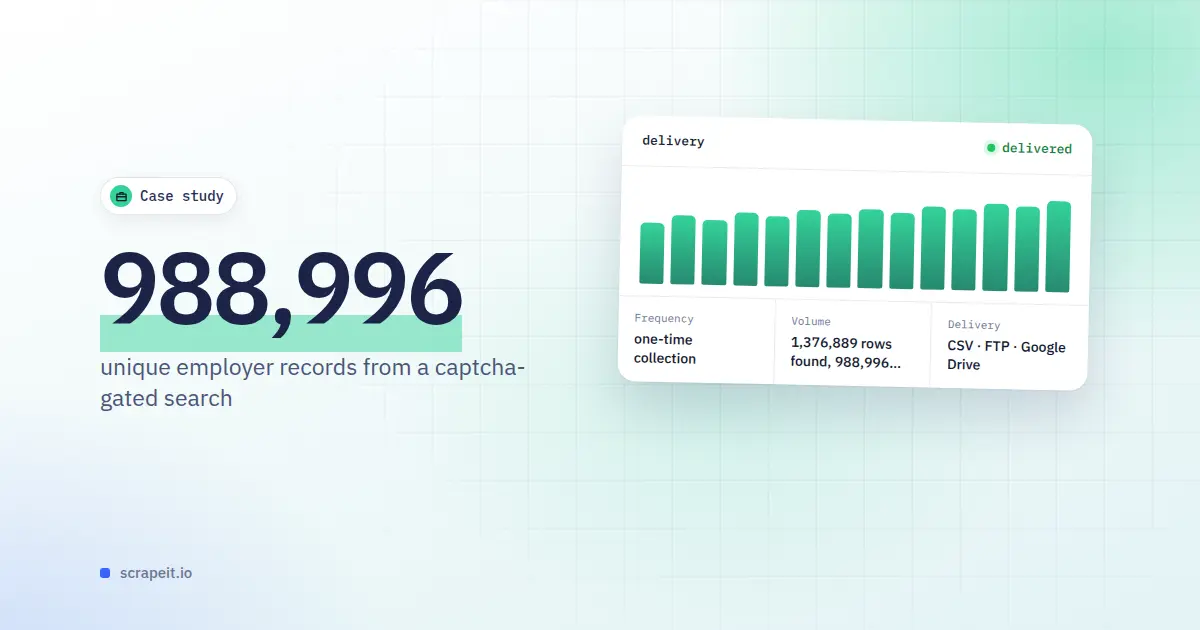
The search matches three letters at the start of any word in an employer's name, so one employer turns up under many queries, and the run found 1,376,889 rows. Rows with the same name and the same employer ID count as one record, which left 988,996 unique employers.
Some queries ran past 300 result pages. The letter A alone gave 118,797 employers. Once every result page found had been collected, the CSV went out the same day.
So the client could check any record against the live search itself, we then delivered the full set before duplicate removal, with three new columns: the search that returned the row, the page number and the collection time in UTC. Every page holds ten rows except the last, so a gap shows at once.
Later the client asked about one search that now showed employers not in the file. Only three of the ten employers on its first page were still there from our copy, so we collected that search again.
Fifteen days after the first message, the client had a local copy of the directory: 988,996 unique employer records with name, address and the directory's own employer ID, collected in eight days through a captcha on every new search. A second file shows which search and page each row came from and when, so the copy can be checked against the live directory.
See our lead and B2B data scraping and more real estate data projects; data can also come through our API or as a JSON feed. To scope a full copy of a directory that sits behind a search form, contact our team.
Full MRO catalogs from Grainger, Fastenal and Cromwell for a product content company: UNSPSC, EAN, every attribute and a taxonomy sheet.
A paid pilot for a regional airport in Scandinavia: direct charter departures from 12 Danish tour operator sites, sampled in two weeks.
Every seller shop on bol.com with its trade name, business address, KvK and VAT number, collected once: 72,961 shops in 18 days.
Let us take your work with data to the next level and outrank your competitors.
You tell us which website(s) to scrape, what data to capture, how often to repeat etc.
An expert analyzes the specs and proposes a lowest cost solution that fits your budget.
We configure, deploy and maintain jobs in our cloud to extract data with highest quality. Then we sample the data and send it to you for review.
If you are satisfied with the quality of the dataset sample, we finish the data collection and send you the final result.
Tell us more about you and your project information.