Custom Web Scraper Development
Most scraping problems are not solved by a tool. They are solved by someone reading the target site, working out how its data is actually structured, and building a collector that keeps running after the site changes. That is what we do: scrapers built to order, for the sources and fields you name.
What "custom" means in practice
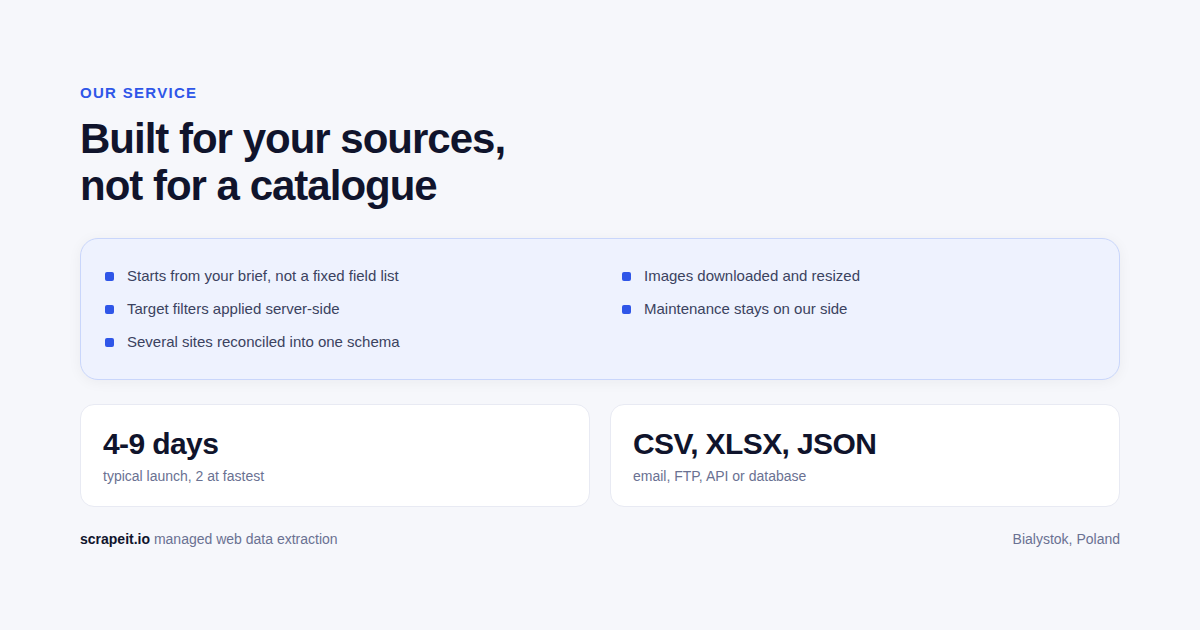
A ready-made scraper gives you whatever fields its author decided to expose. A custom one starts from your brief. In our projects that has meant things a generic tool cannot do:
- Applying the target site's own filters so the server returns only the rows you need, instead of collecting everything and discarding most of it.
- Reconciling five different sites into one schema, so the data arrives ready for a single analytics pipeline rather than as five integration problems.
- Separating private sellers from agencies that publish as private, which is a classification task on top of collection.
- Downloading and resizing every image behind a listing, not just recording its URL.
- Searching a list of 150,000 identifiers supplied fresh every morning and returning the lowest price for each.
Every one of those came from a real project. You can read them in our case studies.
How a project runs
We start from the target and the fields. You tell us which sources, which sections, which filters and what the output has to look like. We come back with scope, timeline and price before any code is written.
Then we build, test on live data, and hand over the agreed structure. Setup and launch in our projects has ranged from 2 working days for a single well-behaved source to 3 weeks for a five-site project with a unified output schema. Most land in the middle: 4 to 9 working days.
After launch the collector is our responsibility, not yours. Sites get redesigned, structures move, protections change. Keeping the same dataset arriving on the same schedule through all of that is the part you are actually buying.
What you get
- Files in CSV, Excel or JSON, structured to fit your database or pricing tool.
- One-off collection or a schedule: daily, weekly or monthly.
- Delivery the way your systems expect it. In one project the report lands by email every workday at 7 a.m. and the same data goes into the client's database through an API.
- A dataset that stays comparable over time, so repeat runs can be used for history and not just a snapshot.
Where custom development pays off
It pays off when the source is difficult, when the volume is real, or when the output has to fit something you already run. Some numbers from projects we have delivered:
- Just over 400,000 rows a day across two automotive portals, with every technical parameter a vehicle listing carries.
- About 230,000 rows a day across five European property sites, normalised into one structure.
- 226,000 properties and 3.4 million images from a single German portal, images downloaded and resized.
- 41,000 rows covering one brand across eight Amazon marketplaces, with search position recorded down to page and slot.
- About 200,000 rows a day from a members-only fashion catalogue.
If your target is one of the sources we already work with, there is a page for it: browse them from popular sites.
Cost and how to start
Pricing depends on the number of sources, the volume and the frequency, which is why we quote per project rather than per row. See our pricing for the current tiers.
If you want to see the output before committing to a project, order a data sample: a real extraction from a live source, in all three formats, for 9.99 EUR.
Otherwise tell us what you need. Which sites, which fields, how often. A couple of lines is enough to get a scope and a timeline back.
Common questions
Do you build one-off scrapers or ongoing ones?
Both. Some clients need a single complete dataset, others need the same dataset refreshed on a schedule for years. The second case is the more common one.
What if the site changes?
We adapt the collector. That is included in an ongoing project: the changes happen on our side, and the dataset keeps arriving in the same shape.
Can you work with sources that need a login or have strong protection?
Yes, and several of our projects did. Access and protection are handled inside the collection layer rather than being something you manage.
Who owns the data and the code?
The dataset is yours. Tell us at the scoping stage if you also need the collector itself handed over, and we will account for it in the quote.
Comparing providers? How to Choose a Web Scraping Vendor.
Frequently asked questions
How long does a custom scraper take to build?
Setup and launch in our projects has ranged from 2 working days for a single well-behaved source to 3 weeks for a five-site project with a unified output schema. Most land in the middle, at 4 to 9 working days. You get scope, timeline and price before any code is written.
What do I actually receive?
Files in CSV, Excel or JSON, structured to fit the database or pricing tool you already run. One-off collection or a schedule: daily, weekly or monthly. Delivery the way your systems expect it, which in one project means a report by email every workday at 7 a.m. and the same data going into the client database through an API.
Who maintains the scraper after launch?
We do. Sites get redesigned, structures move, protections change. Keeping the same dataset arriving on the same schedule through all of that is the part you are actually buying, and it does not become your problem after handover.
When is a custom scraper worth it over a ready-made one?
When the source is difficult, when the volume is real, or when the output has to fit something you already run. A ready-made scraper gives you whatever fields its author decided to expose. A custom one starts from your brief, which is what makes tasks like reconciling five sites into one schema or classifying sellers possible at all.
Have a target list and a deadline?
Send the sites and the fields you need. You get a scoped answer and a price, not a discovery call.