Apartments.com Data: Unit Prices for 3,000 Buildings Every Day
A daily apartments.com feed for a US apartment locator: about 3,000 buildings from the client's own list, down to each unit's rent and floor plan.
Learn More
Opendoor buys the houses it sells, so an Opendoor scrape returns one company's own book of homes - list price, days on market, the fixed 1 percent buy-direct discount - not a national listings index.
Plans from €169/month · Free project assessment · Reply within 1 business day
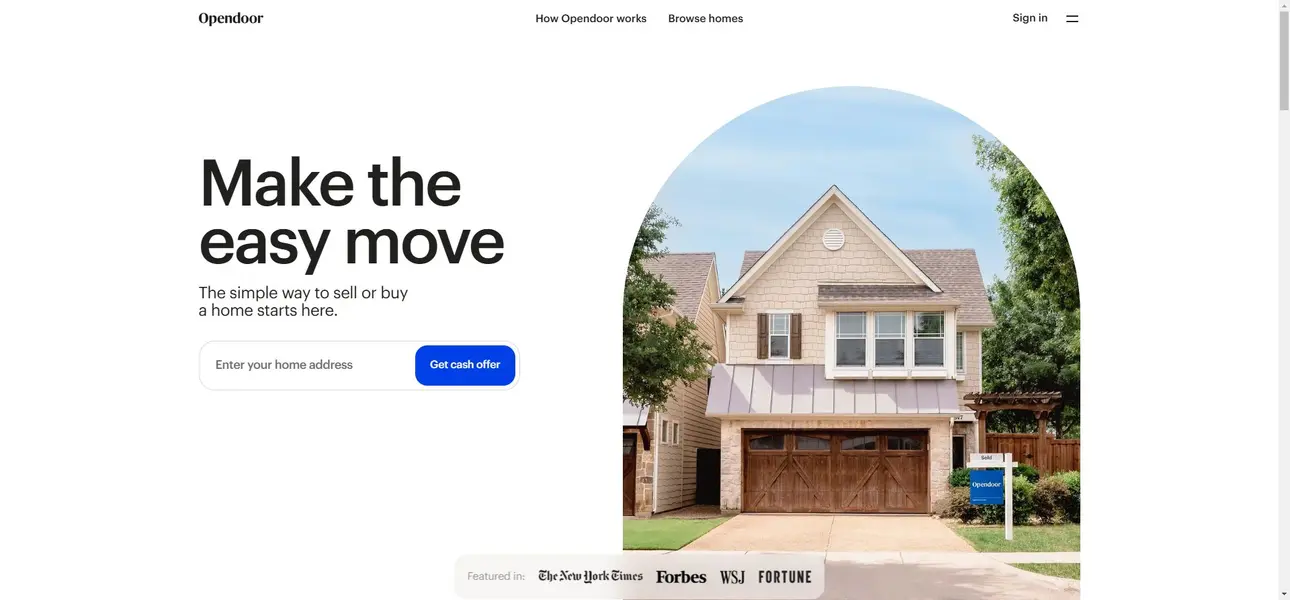
Opendoor scraping runs as a managed service. You name the markets, the fields and the cadence; we build the crawler, operate it and repair it when the markup moves. Anti-bot handling, proxy rotation and CAPTCHA solving are ours to run, not a separate purchase on your side, and the crawl is paced so the site stays comfortable. Nothing behind a login is touched, and app-only surfaces such as tour slots, checkout and saved searches stay out of scope because they are not public.
Delivery is CSV, JSON, XLSX or a hosted API, or a push into S3, a database, Google Sheets or a BI tool. Runs go daily, weekly or on demand, deduplicated on the address id, with changed rows flagged so a price move surfaces without a full diff on your side. A sample comes first, and priced work follows volume and frequency.
A property page sits at /properties/[address-slug]/aid_[uuid]. The uuid is the key and the slug is decorative: request a valid id behind a wrong address and Opendoor rewrites the URL to the canonical one. Most address ids are version-5 UUIDs derived from the address itself, so they hold still between runs and make a clean join key, while a minority are random version-4 ids. Prices arrive in cents in the page payload and in dollars on screen.
Search cards hold a thinner cut of the same record: address id, full address, beds, baths, living area, list price in cents, dwelling type as HOUSE, TOWNHOUSE, CONDO or OTHER, neighborhood, self-tour flag and a photo. Listings also carry schema.org markup typed as SingleFamilyResidence and Product. Read it as a cross-check, never as the source: the floorSize it declares is the lot area, not the living area, and a parser that trusts it sizes every house wrong.
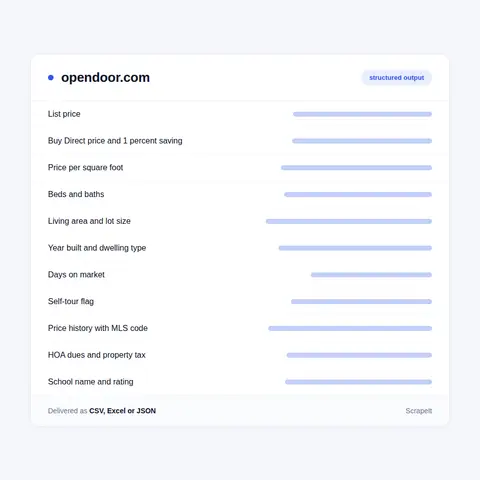
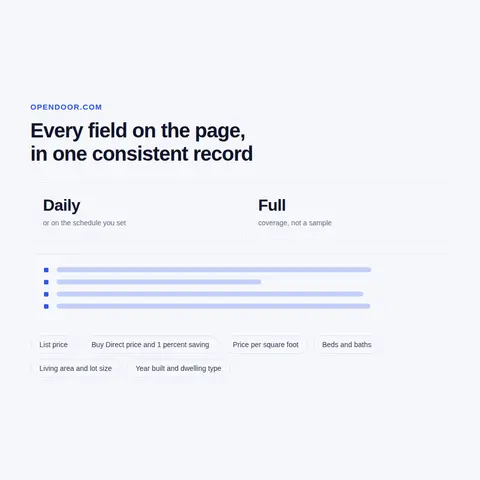
Self-tour is the visible edge of ownership. Opendoor lets buyers into its own houses with no agent present: booking happens in the Opendoor app, a one-time identity check runs first, and the door opens on a six-digit keypad code valid only inside the booked slot. Tours run seven days a week in windows of roughly thirty to sixty minutes, and an open-house badge here just means self-touring, with nobody there to meet you. The flag is public; the slot calendar is not.
The seller side carries a market layer worth as much as the homes. Each city page prints a weekly pulse - new listings, homes on market, homes delisted, homes sold, each with a percentage move and a date - then three tables from what Opendoor calls its first-party MLS data: homes sold, median sale price, month-over-month change, median days on market and sale-to-list by month; median days on market and median price by ZIP for ZIP codes with at least twenty-five closed sales; and new listings against sales, with a sold-to-new ratio that shows when housing inventory is building. Those city pages sit outside the sitemap.
One limit. A price cut is not published as its own history row, so cut size and cadence come from repeat collection. We collect only publicly available data - everything a visitor can see on Opendoor - and we collect it legally. We work only with pages any visitor can open, never sign in, and exclude personal data on owners and agents.
Opendoor is an iBuyer. It does not run a classifieds board and it does not sell leads to agents. The company makes a cash offer on a house, buys it, repairs it and puts it back on the market under its own name. That one fact changes what Opendoor data is: a portal publishes whatever brokers upload, while Opendoor publishes a balance sheet you can walk through room by room. Anyone who has already built against Zillow, Redfin or Realtor.com should expect a different shape of file here, not a fourth copy of the same one.
The site has two halves. The seller half takes an address and returns a cash offer. The buy half, under /homes and /properties, is a marketplace that carries Opendoor's own houses beside homes it does not own. In early September 2026 that marketplace held about 3,100 for-sale homes across 91 markets with live inventory, so a full Opendoor scrape is a census rather than a sample - the whole for-sale set fits in a few thousand rows and can be swept in a single pass.
Browse navigation lists 140 market pages. Forty-seven are state-level catch-alls named like alabama_other, and the rest are metros: phoenix, dallas, atlanta, raleigh, sf_bay_area, new_york_new_jersey. Ask for /homes with no market at all and the site answers with Phoenix, the metro where the company started. Opendoor put its own buying footprint at about 51 markets in mid-2022, when Boston, Albuquerque and Cincinnati went live; the browse list today is wider than the buying list precisely because it also shows homes Opendoor never bought. Everything is United States, English and US dollars, with no country versions and no translated pages to crawl.
Get a Quote
Developers

Customers worldwide

Pages extracted

Hours saved for our clients
€199 / one-time
setup fee - included
€169 / mo
setup fee €499
€229 / mo
setup fee €499
€349 / mo
setup fee €499
€549 / mo
setup fee €799
Delivery: CSV, JSON or XLSX files, our API or a JSON feed. MCP server on request.
Full plan details →The reason to scrape Opendoor is not coverage. It is that one company's inventory, priced by one model, sits on public display. Opendoor price data reads as a position rather than a feed: what the firm bought into, what it is asking now, and how long it has been asking.
Three things in the file do the work. Days on market is printed per home, so a book of houses can be aged without reconstructing it from listing dates. The Buy Direct discount is a fixed 1 percent rather than a negotiation, which keeps the headline number clean and makes any deviation meaningful. And the price history sits on the same page as the current asking price, so the spread over the last arm's-length sale is one subtraction away; where that sale is weeks rather than years old, the two rows read as purchase against resale on the same address.
The self-tour flag then splits every market into houses Opendoor holds the keys to and houses it merely lists, and the ratio is anything but stable. Currently it runs at roughly 79 percent in San Antonio, 77 in Houston and 73 in Dallas, against 30 in Atlanta, 11 in Nashville and none at all in Columbia. Tracked month over month, that ratio is a local inventory signal no portal publishes, because no portal owns anything. The people who buy this dataset are iBuyer analysts, single-family rental funds, AVM teams calibrating against a real book, brokerages watching a competitor, and equity desks following the listed company.
A daily apartments.com feed for a US apartment locator: about 3,000 buildings from the client's own list, down to each unit's rent and floor plan.
Learn More
A one-time Housing.com collection for a real-estate company in India: project cards plus every photo and floor plan, uploaded straight to its cloud drive.
Learn More
A one-time 30-day history of Sahibinden car and SUV listings for a startup building an AI deal finder, delivered as JSON through our API.
Learn MoreLearn how to use web scraping to solve data problems for your organization

Real estate teams work in a fragmented data landscape. The sites that drive demand in Boston look nothing like the ones that matter in Berlin, São Paulo, Dubai, or Mumbai.

Real estate teams are operating in a data environment that is bigger, faster, and more fragmented than ever. Listings go live and disappear in hours, price cuts happen quietly, and the portals that matter most in each country are rarely the same global “top 5.”

Six jobs that scraped property data does, each backed by a ScrapeIt project: seller leads, listing monitoring, image datasets, weekly market supply, sold records and unit-level rentals. For every use case - the fields it needs and how often to refresh them.
ScrapeIt is a managed web scraping agency. Not a tool you have to learn, not a proxy plan with a ticket queue attached: we take the brief, write the extraction, run the infrastructure and hand back validated data in the format and on the schedule you asked for, with a named engineer when something needs changing.
Tell us the markets and the volume and you get a sample file and a quote, usually inside one working day.
Yes. The ScrapeIt Opendoor API returns the address id, list price, days on market, the self-tour flag and the price history rows as JSON from an endpoint we host, refreshed on the schedule you set. The same data also comes as CSV or XLSX files or straight into your database.
By the self-tour flag. Keypad access is granted only to houses the company owns, so a listing that can be self-toured is Opendoor inventory and one that needs an agent to open the door is not. The flag rides on both the search card and the property page, which means the split can be measured for an entire market in a handful of requests. Across the whole marketplace it runs near 40 percent, and by market it swings from nothing at all to nearly four in five.
Yes, through repeat collection. Opendoor prints the current asking price and the date the listing went live, but a reduction does not appear as a separate history row, so cut size and frequency come from comparing snapshots rather than from reading one page. Daily is the usual cadence for cut tracking on an inventory this size, the city market tables move weekly, and the for-sale set is small enough to sweep in full every day instead of sampling it.
Browse navigation lists 140 market pages, 47 of them state-level catch-alls and the rest metros. About 91 carried live inventory in early September 2026, holding roughly 3,100 homes in total: houses, townhouses and condos, priced from about $70,000 to $3.5 million, with a median near $350,000 and a median living area close to 1,800 square feet. Atlanta, Dallas, Charlotte and Phoenix were the largest. We can take the whole set or a named list of markets, ZIP codes or price bands.
CSV, JSON, XLSX or a hosted API endpoint, or a push straight into S3, a database, Google Sheets or a BI tool. On the legal side, yes: we collect only publicly available data - everything a visitor can see on Opendoor - and we collect it legally. We work only with openly published pages, never sign in, keep the request rate polite and exclude personal data.
Step 1 - Make a Request
You share your needs, expectations, and desired timeframe. We’ll suggest the best solution based on your request and budget.
Step 2 - Configuring Custom Web Crawlers
Our specialists configure the crawlers and extract a sample dataset for your review before proceeding with the full-scale extraction.
Step 3 - Collect and Deliver
Once you approve the sample, we launch the project and start full data collection. We gather, filter, and structure the data for easy use, delivering it on time in your preferred format.
Step 4 - Maintain and Support
Our team manages ongoing processes, monitors website changes, and supports all data extraction cycles. We can also help integrate data into your systems or create dashboards to simplify analysis.
Opendoor data from €169/month. Free project assessment, reply within 1 business day.

Scrapeit Sp. z o.o.
10/208 Legionowa str., 15-099, Bialystok, Poland
KRS: 0000996672
NIP: 5423457175
REGON: 523384582