Homegate Data: A Daily Snapshot of Two Cantons with 46K Photos
Every day, a full snapshot of all active Homegate listings in one Swiss region, with photos and PDFs, for a company's own listing-history database.
Learn More
Trulia and Zillow run on one inventory and one property id, so the reason to scrape Trulia is the neighborhood layer sitting on top of the same homes.
Plans from €169/month · Free project assessment · Reply within 1 business day
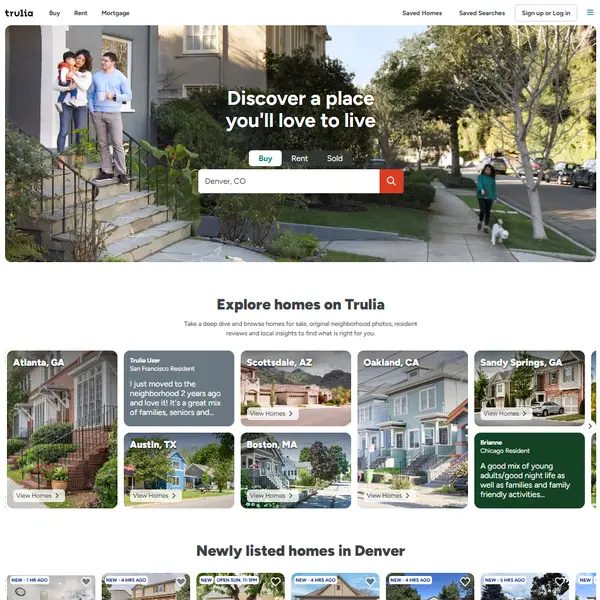
Trulia defends its listing and search pages with PerimeterX at the CloudFront edge, which answers ordinary clients with a captcha document instead of the page. The XML sitemaps, by contrast, stay open to the same client, so URL discovery is cheap and page fetching is the work.
Handling that is our side of the job, not yours. A Trulia scraper we operate uses rotating residential proxies, real browser sessions, CAPTCHA solving and pacing tuned per run, and we adapt when the defence changes. We do not promise a perfect capture rate on every cycle, we report the rate we achieved, and we do not touch anything behind a login. Scraping runs at a request rate that keeps the site comfortable.
A Trulia detail page is assembled from an MLS or landlord feed plus Trulia's own layers. The detail tables are named on the page itself - Property Information, Price and Status, Location, Agent Information, Lot Information, Interior Features, Exterior Features, Water and Sewer, Miscellaneous - and a normal export flattens them into columns:
Listing pages also embed schema.org JSON-LD as RealEstateListing, Product, Offer and PostalAddress, which we use as a cross-check on the parsed values rather than as the only source.
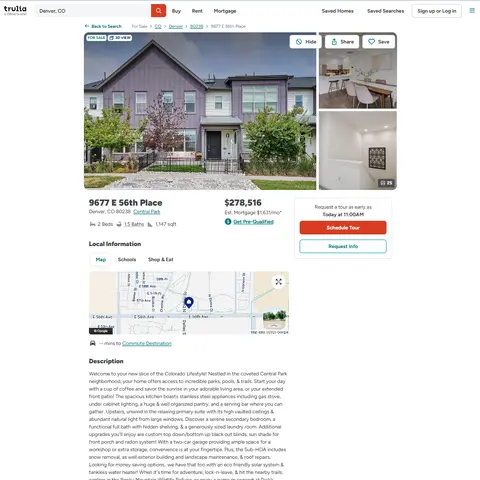
What Locals Say is the part of Trulia with no equivalent on the other US portals. It is a set of resident poll results shown as percentages against fixed statements - lines such as 86 percent say there are sidewalks, 78 percent say parking is easy, 55 percent say people would walk alone at night, 48 percent say it is quiet. Trulia prints the minimum number of voters behind the block, so each row arrives with its own confidence signal. Below it sit free-text resident comments, filtered into tabs for Community, Dog Owners, Parents and Commute.
Alongside it: GreatSchools ratings out of 10 with grade span, enrolment and district for each assigned school, a commute tool returning minutes to an address you supply, and a Shop and Eat panel. Trulia labels the source on each block, and those figures are third party, not its own.
One correction. Trulia stopped publishing neighborhood crime data from 2022 on fair housing grounds, and we found no crime layer and no Walk Score on any 2026 listing page we examined. The neighborhood guide pages still offer a Low Crime sort, but the San Francisco guide we read is stamped last updated 4/30/19, so treat that surface as an archive.
On personal data: our output is limited to listing and commercial fields. Agent names, phones and brokerages are published on listings, and we exclude those columns on request. Resident review authors are not identified in what we deliver - we carry the text, the date and the poll percentages, and drop the display name.
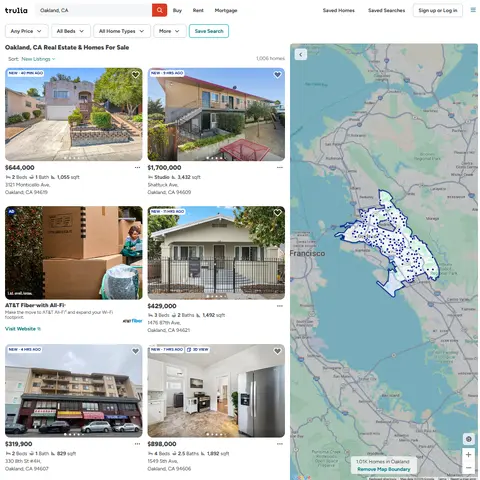
Trulia launched in 2005 and has been part of Zillow Group since the acquisition closed in 2015. The consequence that matters most to anyone planning to scrape Trulia is that the two brands do not hold separate inventories. A Trulia listing URL ends in a number, and that number is the Zillow property id. On the for-sale page /home/0-15th-st-n-guin-al-35563-463826969, the embedded page data carries zPID: 463826969 - the same digits, unchanged. The page also keeps a legacy Trulia identifier called maloneID and a separate listingID, bundled into a composite id, but the key the URL exposes is Zillow's.
So a buyer scoping both portals should plan for the same homes twice, not twice the coverage. That is not an argument against Trulia. It is an argument for knowing what you are buying: identical properties behind a different front end, wrapped in a neighborhood layer Zillow does not publish in the same form, and carrying an id that joins the two sets row for row without any address matching.
Trulia covers residential for-sale, for-rent and off-market property across the United States and prices in US dollars. It is not English only. Listing pages declare hreflang alternates for en and es-US and mirror themselves under an /es/ path prefix, and a separate Spanish search sitemap index sits next to the English one.
Get a Quote
Developers

Customers worldwide

Pages extracted

Hours saved for our clients
€199 / one-time
setup fee - included
€169 / mo
setup fee €499
€229 / mo
setup fee €499
€349 / mo
setup fee €499
€549 / mo
setup fee €799
Delivery: CSV, JSON or XLSX files, our API or a JSON feed. MCP server on request.
Full plan details →Two fields on the page deserve a careful read before you build a model on them. The first is Days on Market, which Trulia phrases in its own terms, for example: Days on Market, under 1 day on Trulia. That clock starts when the listing reached Trulia, not when the agent entered it at the MLS, so it measures portal exposure and not true market time. The second is the price history Source column, which names the MLS behind each event and lets you separate a genuine price cut from a relist under a new listing number.
Trulia also prints a per-city market block with an as-of month, a buyer or seller market label, average sale price, sale-to-list ratio, price per square foot, available listings and a month-over-month change. Pulled on a schedule, that block gives a clean city-level series with no aggregation work on your side. Most teams scraping Trulia for market work take the city block weekly and the listings daily.
Off-market and sold homes stay addressable at the same /home/ URL as active ones, and Trulia publishes a dedicated newest-off-market sitemap built from that same URL shape. A property does not vanish when it sells, so Trulia data supports a longitudinal view of an address rather than a snapshot of whatever happens to be live today.
Every day, a full snapshot of all active Homegate listings in one Swiss region, with photos and PDFs, for a company's own listing-history database.
Learn More
A real-estate analytics company got two portals archived listing by listing: the saved page, a JSON file and every photo, 420K+ listings in all.
Learn More
US real-estate investors get agent lists for their markets from MLS portals under their own 2FA logins, plus realtor.com and Zillow directories.
Learn MoreLearn how to use web scraping to solve data problems for your organization

Real estate teams work in a fragmented data landscape. The sites that drive demand in Boston look nothing like the ones that matter in Berlin, São Paulo, Dubai, or Mumbai.

Real estate teams are operating in a data environment that is bigger, faster, and more fragmented than ever. Listings go live and disappear in hours, price cuts happen quietly, and the portals that matter most in each country are rarely the same global “top 5.”

Six jobs that scraped property data does, each backed by a ScrapeIt project: seller leads, listing monitoring, image datasets, weekly market supply, sold records and unit-level rentals. For every use case - the fields it needs and how often to refresh them.
ScrapeIt is a managed data company. We build the crawler, run it on your schedule, watch it when Trulia changes its markup, and hand over CSV, JSON, XLSX or an API endpoint. You never see the proxy pool or the parser.
The usual sequence: you describe the geography, the fields and the frequency, we return a sample for review before any full run, and we reply to a request within one business day. A paid sample of Trulia data is available for 9.99 EUR if you want to inspect the schema before committing.
Yes. The ScrapeIt Trulia API returns the zpid, list price, price history, beds and baths, listing agent and brokerage, and the What Locals Say poll percentages as JSON from an endpoint we host, refreshed on the schedule you set. The same data also comes as CSV or XLSX files or straight into your database.
Usually you should not, at least not for coverage. The inventory is the same and the property id is the same zpid, so a second crawl mostly returns duplicates. Scrape Trulia when you want the neighborhood layer - the resident polls, the school block, the commute figures - or when you want a second rendering of the same record to check field-level agreement. If the goal is simply more addresses, one of the two is enough.
Yes. Sold and off-market properties keep the same /home/ URL and the same zpid they had while active, and Trulia maintains a sitemap of the newest off-market listings. We can follow a defined set of addresses through listing, price change and sale, or sweep a geography on a schedule and hold the history on our side.
Trulia sits behind PerimeterX at a CloudFront edge and turns ordinary clients away; we handle that. We use rotating residential proxies, browser-level sessions, CAPTCHA solving and per-run pacing, and we revise the approach when the defence changes. No vendor should promise a flawless capture rate on a site defended this way. We report the completion rate for each run and re-queue what failed.
We reproduce what Trulia publishes, and Trulia shows MLS listings with a notice stating that the information is deemed reliable but not guaranteed. We do not correct the source. We do validate schema, flag missing fields and compare parsed values against the JSON-LD on the page. Refresh runs from one-off to several times a day. Daily suits most listing monitoring, and the neighborhood layer moves slowly enough that weekly or monthly is usually sufficient.
Step 1 - Make a Request
You share your needs, expectations, and desired timeframe. We’ll suggest the best solution based on your request and budget.
Step 2 - Configuring Custom Web Crawlers
Our specialists configure the crawlers and extract a sample dataset for your review before proceeding with the full-scale extraction.
Step 3 - Collect and Deliver
Once you approve the sample, we launch the project and start full data collection. We gather, filter, and structure the data for easy use, delivering it on time in your preferred format.
Step 4 - Maintain and Support
Our team manages ongoing processes, monitors website changes, and supports all data extraction cycles. We can also help integrate data into your systems or create dashboards to simplify analysis.
Trulia data from €169/month. Free project assessment, reply within 1 business day.

Scrapeit Sp. z o.o.
10/208 Legionowa str., 15-099, Bialystok, Poland
NIP: 5423457175
REGON: 523384582