Homegate Data: A Daily Snapshot of Two Cantons with 46K Photos
Every day, a full snapshot of all active Homegate listings in one Swiss region, with photos and PDFs, for a company's own listing-history database.
Learn More
We build and run the Auction.com scraper, then deliver clean foreclosure, trustee sale and bank-owned auction records on the schedule you set.
Plans from €169/month · Free project assessment · Reply within 1 business day
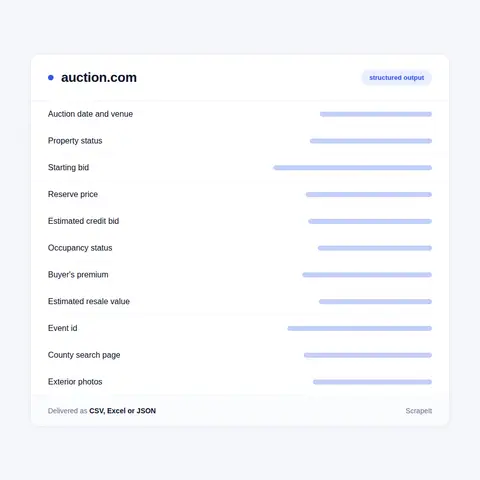
You pick the format and the cadence. CSV, JSON, XLSX, or a REST API we host and keep running. Common shapes for this dataset:
Schema, field names and null handling are agreed before we start, so the first file loads into your pipeline without rework.
Field coverage depends on sale type. A trustee sale record and a bank-owned record do not carry the same columns, so we deliver both with a sale type flag and leave inapplicable fields empty.
We do not invent a value to fill a column. If a page shows no reserve, the reserve field is null.
Auction.com is served behind Imperva Incapsula. The site sits behind Incapsula and turns automated clients away, so access is handled on our side. The site cannot be treated as a static document set. We run the collection as a managed service with conservative request rates, monitoring, and repair when the markup changes. Proxy rotation and CAPTCHA handling are part of that service.
Auction.com publishes a sitemap index at /sitemaps/sitemapindex.xml. That index, captured 14 June 2025, separates inventory into REO, trustee sale and a third set, with detail-page sitemaps chunked at 5,000 URLs each. A county search sitemap captured 7 March 2023 listed 2,089 county pages and the matching state sitemap listed 52. We agree the scope with you in writing before the first run.
A free Auction.com account unlocks alerts, saved searches, a dashboard and bidding. We collect only what is publicly visible without an account, so anything that requires registration stays out of scope. Foreclosure records concern identifiable homeowners, and we collect property and auction data rather than borrower or occupant details.
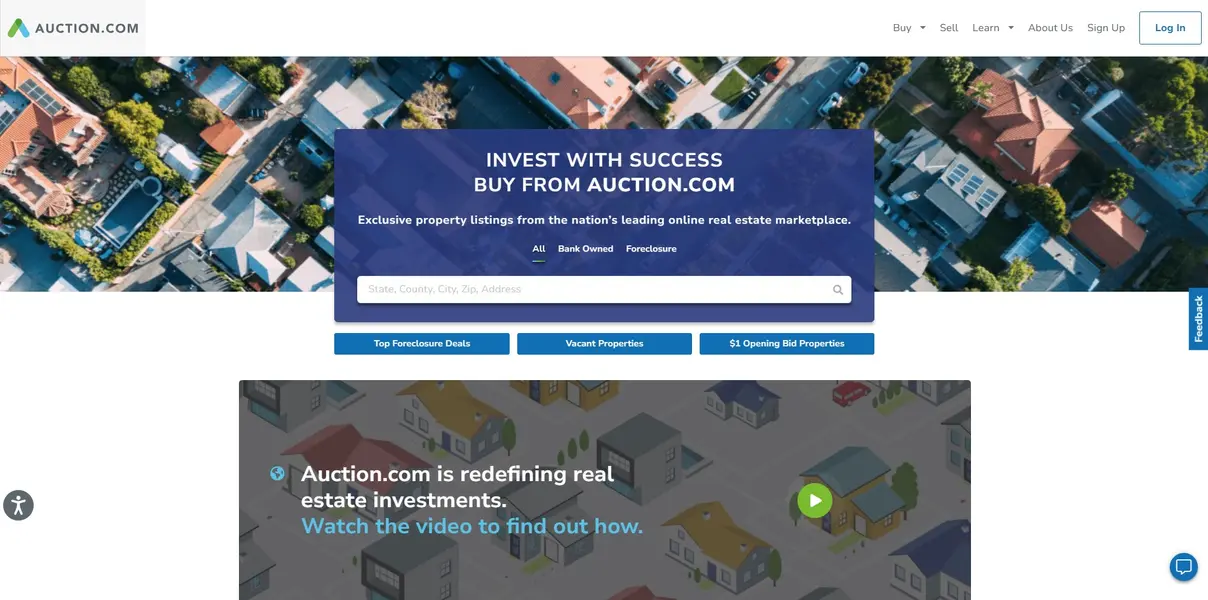
Auction.com is a United States marketplace for distressed residential property. The inventory splits into tracks that behave differently in a database. A foreclosure or trustee sale is an auction run by a trustee or a county officer on a date set by the foreclosure process, not by a seller; Auction.com states that most live sales are held at county courthouses or hotels, and some are run online. A bank-owned or REO property has already reverted to the lender after a failed foreclosure auction or a deed in lieu, and is sold in an online auction under a reserve. Short sales appear as a third posture, where the lender may need to approve a price below the balance owed.
The difference matters when you model the data. A trustee sale record is built around a scheduled event that may not happen. It can be cleared for auction, postponed or cancelled, and Auction.com says plainly that it is not privy to the reasons behind a postponement or a cancellation. An REO record is built around a listing that stays live until it sells, with a reserve price the seller may or may not disclose. The same address can travel between the two tracks, first as a scheduled foreclosure sale, later as bank-owned inventory.
Public pages are organised by geography. Search pages exist per state at /residential/{state}/, per county at /residential/{state}/{county}-county/, and per city with a _ct suffix. Individual property pages sit under /details/ with an address slug and a numeric identifier.
Get a Quote
Developers

Customers worldwide

Pages extracted

Hours saved for our clients
€199 / one-time
setup fee - included
€169 / mo
setup fee €499
€229 / mo
setup fee €499
€349 / mo
setup fee €499
€549 / mo
setup fee €799
Delivery: CSV, JSON or XLSX files, our API or a JSON feed. MCP server on request.
Full plan details →The value here is movement, not the snapshot. A scheduled foreclosure sale is a claim about the future, and the useful signal is what happens to that claim.
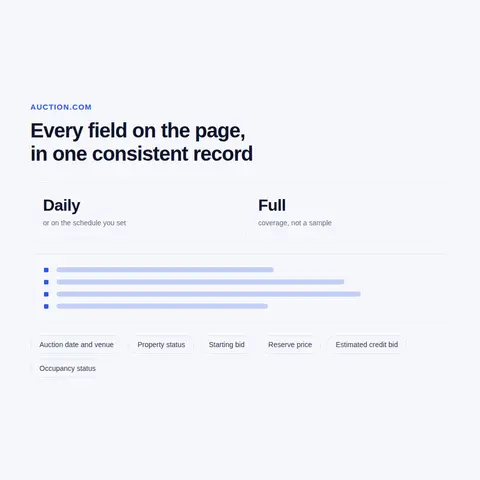
Daily collection turns the auction calendar into a time series. You see which sales clear, which slip to a new date, and how many times the same property has slipped before. Postponement chains are ordinary in this inventory, and a property that has moved four times reads differently from one scheduled for the first time. You also see opening bid revisions, reserve reductions on REO, occupancy flipping from occupied to vacant, and the moment a property stops appearing as a scheduled foreclosure sale and returns as bank-owned.
Counts aggregated by county and month work as a market signal. Inventory volume, the share of records marked occupied, and the ratio of cleared sales to cancellations describe local distress in a way one listing never can. Lenders, servicers, title and escrow firms, single-family rental operators, valuation teams and property data vendors all build on those series.
One record collected once is worth little. The same record collected every day for a year is a history, and history is what the auction calendar hides.

Every day, a full snapshot of all active Homegate listings in one Swiss region, with photos and PDFs, for a company's own listing-history database.
Learn More
A real-estate analytics company got two portals archived listing by listing: the saved page, a JSON file and every photo, 420K+ listings in all.
Learn More
US real-estate investors get agent lists for their markets from MLS portals under their own 2FA logins, plus realtor.com and Zillow directories.
Learn MoreLearn how to use web scraping to solve data problems for your organization

Real estate teams work in a fragmented data landscape. The sites that drive demand in Boston look nothing like the ones that matter in Berlin, São Paulo, Dubai, or Mumbai.

Real estate teams are operating in a data environment that is bigger, faster, and more fragmented than ever. Listings go live and disappear in hours, price cuts happen quietly, and the portals that matter most in each country are rarely the same global “top 5.”

Six jobs that scraped property data does, each backed by a ScrapeIt project: seller leads, listing monitoring, image datasets, weekly market supply, sold records and unit-level rentals. For every use case - the fields it needs and how often to refresh them.
ScrapeIt is a managed web scraping agency. We build the crawler, run it on our own infrastructure, watch it, and fix it when the site changes. You receive data on a schedule, not a repository to maintain. Scope, fields, cadence and delivery format are agreed up front, and the same engineers stay on the project afterwards. Send us the counties, the sale types and the fields you need, and we will tell you what is publicly available and what is not.
Yes. The ScrapeIt Auction.com API returns sale type, auction date and status, opening and current bid, reserve price where disclosed, occupancy and property attributes as JSON from an endpoint we host, refreshed on the schedule you set. The same Auction.com data also comes as CSV or XLSX files or straight into your database.
A foreclosure or trustee sale record describes a scheduled auction that has not happened yet, so it carries an auction date, a venue, a status such as cleared for auction, and figures like the estimated credit bid and estimated debt. A bank-owned record describes property the lender already owns, so it carries a reserve price, a starting bid, an online auction window and, on part of the inventory, an interior access flag. We deliver both in one schema with a sale type column, and the fields that do not apply stay null.
Yes. We snapshot every property on your list on each run and write the status with the date we saw it, so a postponement produces a new row rather than overwriting the old date. That gives you the full chain when a sale moves repeatedly. Auction.com states that it is not privy to the reasons behind a postponement or a cancellation, so we record the status change and the dates and do not attribute a cause.
Occupancy is collected wherever the page shows it: occupied, vacant, tenant-occupied, and the Now Vacant marker for REO that recently changed state. Interior photos are a different matter. Auction.com offers interior access only on part of the bank-owned inventory, and its own guidance for occupied property says a buyer can do everything except see the inside. Expect exterior imagery on most records and treat an interior photo set as the exception, not the norm.
The site sits behind a commercial bot-protection service that turns automated clients away. We handle that the way a managed service should: conservative request rates, monitoring, and engineers who repair the crawler when the markup or the protection changes. Proxy rotation and CAPTCHA handling are part of the service, and we do not collect anything that requires an account. If a page is only reachable after registration, it is out of scope and we say so before you sign.
Step 1 - Make a Request
You share your needs, expectations, and desired timeframe. We’ll suggest the best solution based on your request and budget.
Step 2 - Configuring Custom Web Crawlers
Our specialists configure the crawlers and extract a sample dataset for your review before proceeding with the full-scale extraction.
Step 3 - Collect and Deliver
Once you approve the sample, we launch the project and start full data collection. We gather, filter, and structure the data for easy use, delivering it on time in your preferred format.
Step 4 - Maintain and Support
Our team manages ongoing processes, monitors website changes, and supports all data extraction cycles. We can also help integrate data into your systems or create dashboards to simplify analysis.
Auction.com data from €169/month. Free project assessment, reply within 1 business day.

Scrapeit Sp. z o.o.
10/208 Legionowa str., 15-099, Bialystok, Poland
NIP: 5423457175
REGON: 523384582