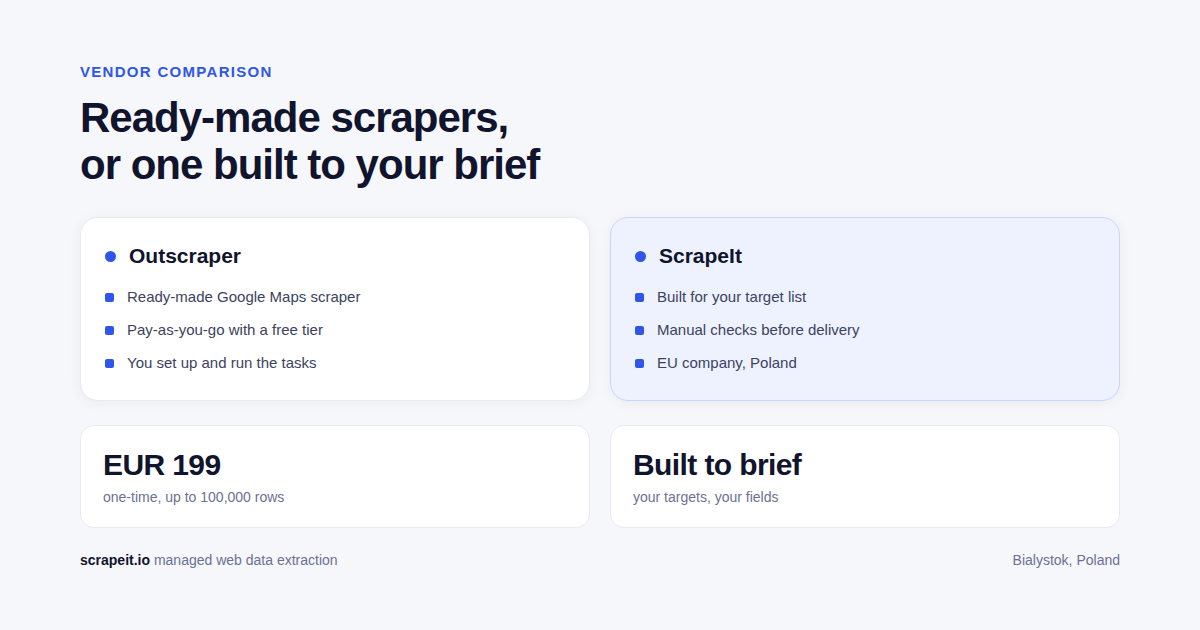
Outscraper and ScrapeIt both end with a file of data and reach it from opposite directions. Outscraper is a self-serve platform of ready-made scrapers and APIs with Google Maps as its headline source: you set the queries, run the task in its cloud and pay as you go for the records extracted. ScrapeIt is a managed service where an engineering team builds a scraper for your target list, runs it and delivers the dataset, with nothing for you to operate.
Choose Outscraper if
- Your source is already in its catalogue
- You want a file today, starting on a free tier
- You are happy to set up and run the tasks yourself
Choose ScrapeIt if
- No ready-made scraper covers your target sites
- You need your own fields, checked before delivery
- Nobody on your side has time to run and watch tasks
What each company actually is
Outscraper
Outscraper describes itself as a business data and enrichment platform. Its catalogue holds ready-made scrapers for maps listings, reviews, search results, product pages and contact enrichment, offered in a web app and through an API with official SDKs in six languages. Tasks run on Outscraper's servers, can be scheduled and export to CSV, Excel, JSON or Parquet. Billing is pay-as-you-go, with a free tier and usage tiers that reset every 30 days. It also offers a universal AI-powered scraper for other pages and a done-for-you lead generation service by inquiry.
ScrapeIt
Scrapeit Sp. z o.o., registered in Bialystok, Poland and trading since 2021. No catalogue, no console and no self-serve product. An engineer scopes your target list and fields, builds the scraper, runs it and repairs it when the target changes, and the output is checked by hand before delivery. The price list is published: EUR 199 for a one-time extract of up to 100,000 rows, and subscriptions from EUR 169 to EUR 549 per month, the top one with three deliveries a day.
Side by side
When Outscraper is the better choice
- Your source is in its catalogue. For business listings and reviews from Google Maps the scraper exists and its columns are documented. Commissioning a build for the same data is slower and usually costs more.
- You want data today. Sign up, enter a query, download a file. ScrapeIt's first delivery typically takes one to ten days.
- Your volume is small or irregular. Paying per record, starting on a free tier, suits a few thousand rows now and none next month better than a subscription.
- You are a developer feeding an app. The API, the SDKs and the webhooks are made for that. ScrapeIt has no self-serve product.
When ScrapeIt is the better choice
- Your targets are in nobody's catalogue. Regional portals, niche marketplaces and industry directories need a scraper written for them. That is all ScrapeIt does.
- You need your own field list. A ready-made scraper returns the columns it was designed for. A brief sets the fields and the delivery format your system expects.
- Nobody on your side will run it. Outscraper tasks can be scheduled, but someone still writes the queries, sets limits and filters and checks each result. A managed service takes that over.
- You want the invoice known in advance. Outscraper shows an estimate and lets you cap a task, but the exact record count is known only after the run. A plan price is fixed before the work starts.
- You need an EU processor and paperwork. ScrapeIt is an EU company acting as data processor, with a mutual NDA as standard and a DPA when the project involves personal data.
The honest summary
If the data you need is local business listings, reviews or contacts from a source Outscraper already covers, use Outscraper. The tool exists, pricing is published per service, the free tier lets you test it on your own queries and the file can be ready the same day. A scraper built to order cannot match that, and it would be dishonest to claim otherwise.
ScrapeIt starts where a catalogue ends: sites nobody has packaged, field lists that do not fit a ready-made export, recurring deliveries that someone has to watch, and buyers who want an EU counterparty for the whole job. The two also combine well: a self-serve tool for maps data, a managed vendor for the sources it does not carry.
How to decide in one pass
- List your sources and check each one against Outscraper's list of services. If all are there, start on its free tier.
- Run one real query and open the file. Check that columns, coverage and duplicates suit the system the data goes into.
- For every source that is missing and every field the export lacks, decide who builds and maintains that scraper. If it is not your team, that part goes to a managed vendor.
- Put a name next to "runs the tasks and checks the output every week". If there is no name, choose the managed route for recurring work.
Keep reading
Is ScrapeIt an Outscraper alternative?
Yes, when the job is a custom dataset and not a run of a ready-made tool. Outscraper is a self-serve platform: you pick one of its scrapers, set the queries and run the task yourself. ScrapeIt builds the scraper to your brief, runs it, repairs it when the target changes and delivers data checked by hand.
When is Outscraper the better choice?
When your source is already in its catalogue, above all business listings and reviews from Google Maps. The scraper exists, billing is pay-as-you-go with a free tier, and results usually arrive within minutes of a request. ScrapeIt builds every scraper to order, so its first delivery typically takes one to ten days.
Does ScrapeIt have a ready-made Google Maps scraper I can run myself?
No. ScrapeIt has no catalogue, no console and no self-serve product, and every scraper is built to a brief. When a ready tool already covers your target that is a disadvantage, and Outscraper is the shorter route. A brief makes sense when you need sources, fields or checks that a ready-made export does not give you.
How do ScrapeIt and Outscraper prices compare?
They are priced in different units. Outscraper lists prices per service and bills pay-as-you-go for the records or requests you use. ScrapeIt publishes fixed plans: EUR 199 for a one-time extract of up to 100,000 rows, and subscriptions from EUR 169 to EUR 549 per month. For small or irregular volumes from a source in Outscraper's catalogue, pay-as-you-go will usually cost less.