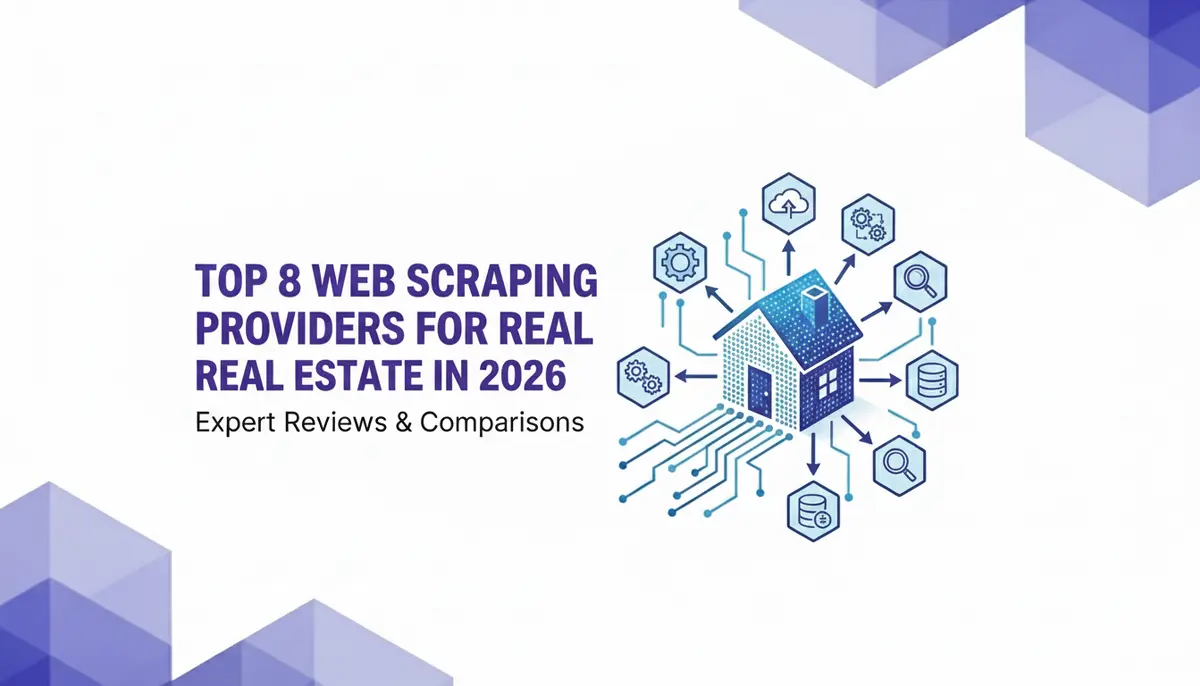
Top 8 Web Scraping Providers for Real Estate in 2026
Top 8 Web Scraping Providers for Real Estate in 2026
Posted
Aug 24, 2026
Real estate teams are operating in a data environment that is bigger, faster, and more fragmented than ever. Inventory shifts by the hour, price cuts happen silently, and the portals that matter most in each city often sit outside the global “top 5” websites. If you want reliable market intelligence in 2026 - whether you’re a PropTech founder, an investor, a brokerage network, or a research team - you need an automated way to collect listings, prices, and changes at scale.
The good news is that real-estate scraping has matured. You no longer have to build and maintain crawlers in-house unless that’s a strategic choice. Today’s market offers three proven paths:
Fully-managed scraping providers who deliver clean, ready-to-use datasets (best when you want outcomes, not tooling).
Scraper APIs & data platforms that your developers plug into pipelines (best for data teams).
Marketplace / no-code ecosystems for fast pilots or niche sources.
This guide reviews the top eight providers you can rely on in 2026, with clear “best-for” positioning, strengths, tradeoffs, and the kinds of portals they can extract from.
Why real estate web data matters in 2026
Web data from property platforms supports use cases that directly drive revenue and risk management:
Market monitoring & forecasting: Track inventory, rent/sale ratios, days on market, new builds, and neighborhood trends. ScrapeIt positions this as real-time market tracking for national and international trends.
Price intelligence: Detect price changes, delistings, and under-the-radar discounts across competitors.
Deal sourcing: Identify undervalued listings, motivated sellers, or emerging micro-markets ahead of the pack.
Lead enrichment: Collect agent/broker details and listing owners where permitted.
Model training: AVMs, yield prediction, vacancy analytics, and demand signals require consistent structural data.
In practice, the alpha comes from coverage + freshness + cleanliness. Not the number of pages your crawler can hit, but the number of listings you can trust and how quickly you get their changes.
A quick buyer’s guide: which device belongs in your stack?
Before choosing a provider, anchor on your operating model.
Managed service
You describe the websites, fields, filters, and frequency. The provider builds and maintains crawlers and delivers datasets to your storage or inbox. ScrapeIt and other managed vendors sell exactly this “done for you” outcome. Choose this if: you want fast time-to-data, don’t want scraping engineers, or need guaranteed delivery.
Scraper API / data platform
You send structured requests and get clean HTML/JSON back. Oxylabs, Bright Data, Zyte, and ScraperAPI are leading examples. Choose this if: you have a data/engineering team and want DIY control.
Marketplace / no-code ecosystem
You pick ready scrapers (often called “actors”) for specific portals, run them in the cloud, and download results. Apify dominates this approach for real estate sources. Choose this if: you’re piloting or you need a long tail of niche sources quickly.
Disclosure: this comparison is published by ScrapeIt, and ScrapeIt is one of the eight providers listed. We describe every provider by what it actually offers and say plainly where a competitor is the better fit - several of them are, depending on what you need. Judge the list on the detail, not on the order.
The Top 8 real estate web scraping providers for 2026
1. ScrapeIt.io - Best overall managed provider for real estate teams
Best for: brokerages, PropTech startups, investors, analysts who want reliable datasets without building tooling.
ScrapeIt offers a fully-managed real estate scraping service: you submit targets and fields, their team builds custom crawlers, and you receive structured data on your schedule. Their real estate category highlights listings, prices, agents, and market-trend extraction - delivered clean and analysis-ready.
Key strengths:
Outcome-first delivery. You get datasets, not a dashboard or scripts to babysit.
Flexible update cadence. Real estate feeds can be hourly, daily, weekly, or on demand.
Starter-friendly pricing. Plans for custom scraping projects start from the low hundreds of euros, which is unusually accessible for managed services.
High-change maintenance handled for you. Portal layout changes, anti-bot upgrades, and CAPTCHA shifts are on ScrapeIt’s side, not yours.
Tradeoffs:
Less “self-serve” control than APIs. You trade internal engineering work for speed and reliability.
“
ScrapeIT.io's work has saved the client hundreds of hours and tens of thousands of dollars.
Max Malinovsky,
CEO, Malinovsky Digital Agency
Where ScrapeIt shines:
Regional or fragmented markets where you need many sources unified into one schema.
Any scenario requiring delta/trend tracking rather than one-off dumps.
Best for: engineering-driven PropTechs that need high success rates at scale.
Oxylabs provides a Real Estate Scraper API built specifically for property portals, returning raw HTML or structured outputs through an API. Their documentation explicitly names top portals like Zillow, Redfin, and Zoopla as supported targets.
Key strengths:
Real-estate-tuned endpoints. Designed around listing searches, paginated results, and parameterized queries.
Anti-bot coverage baked in (residential proxy backbone, JS rendering, retries).
Predictable unit economics. Pricing is typically per 1,000 successful results.
Tradeoffs:
You still need to build parsing, normalization, and QA in-house.
When Oxylabs is the right choice:
You have a stable engineering team and want to own the full pipeline.
You’re scraping a small set of portals at high volume.
Best for: large data programs needing both scraping infrastructure and ready datasets.
Bright Data offers real-estate-specific scrapers and a dataset marketplace model. Their Real Estate Scraper supports portals such as Zillow, Zoopla, Apartments.com, and regional sites, and includes both API and no-code modes.
Key strengths:
Multiple acquisition modes: API, browser/unlocker layers, and no-code flows in one platform.
Pay for successful records. Good for bursty workloads.
Huge proxy footprint for hard-to-reach portals.
Tradeoffs:
Typically higher price point and more platform complexity than smaller providers.
Best fit:
Enterprise PropTech, hedge funds, or aggregators with global reach and very high throughput.
4. Zyte API - Best compliance-forward scraping partner
Best for: organizations that must demonstrate strong legal/compliance posture.
Zyte positions its API as a full-stack, ban-avoidance solution suitable for real estate markets, combining unblocking, browser rendering, and extraction into one toolkit.
Key strengths:
Unified “all-in-one” API for hard portals with minimal configuration.
Long-standing legal/compliance capabilities often referenced as a differentiator in enterprise deals.
Strong at JS-heavy interfaces and protected sites.
Tradeoffs:
Pricing can be premium compared with more barebones APIs.
Best fit:
If your stakeholders care as much about risk mitigation and governance as they do about raw coverage.
5. Apify - Best marketplace for portal-specific real estate scrapers
Best for: fast pilots and long-tail source coverage.
Apify has a dedicated real estate category with many ready “Actors” for portals worldwide. Examples include Zillow scrapers, Rightmove scrapers, and multi-source aggregators that deduplicate listings.
Key strengths:
Massive library of ready scrapers. Great for niche portals.
Cloud execution + export to CSV/JSON/Excel out of the box.
Flexible for customizations if you’re comfortable modifying actors.
Tradeoffs:
Actor quality varies by author; you may need QA and occasional maintenance.
Best fit:
Early-stage teams wanting to test 10-20 sources quickly.
Projects where you expect frequent “source churn”.
6. ScrapeHero - Best high-support managed provider with QA depth
Best for: teams that want managed delivery with enterprise-grade validation.
ScrapeHero is a long-standing managed scraping vendor, emphasizing large-scale crawling, self-healing tech, and automated QA. Their real estate vertical covers listings, agents, and housing signals.
Key strengths:
Strong data quality processes (automated + manual checks).
Infrastructure scaled for millions of pages daily, including JS and CAPTCHA handling.
Good for buyers who want a hands-off pipeline.
Tradeoffs:
Generally oriented toward mid-market to enterprise engagements.
“
Good experience overall. Completely hassle-free. We're satisfied with the overall levels of service and definitely recommended.
Philip P.,
Consultant, Marketing & Advertising
Best fit:
If reliability and accuracy are more important than DIY control.
7. PromptCloud - Best enterprise managed data partner for global programs
Best for: large, multi-country real estate data operations.
PromptCloud is frequently listed among top scraping companies and offers a dedicated real estate industry solution with clean, analysis-ready feeds.
Key strengths:
SLA-backed delivery and enterprise support.
Designed for high-volume, multi-source aggregation.
Proven experience in real estate case work.
Tradeoffs:
Typically slower onboarding and less “starter” pricing than ScrapeIt.
Best fit:
If you’re a global player needing a long-term data partner with compliance coverage.
8. ScraperAPI - Best budget-friendly API for real estate scraping
Best for: small/medium engineering teams that want simplicity.
ScraperAPI is a general web scraping API that handles proxies, rendering, and CAPTCHA bypass for you. It’s widely used for “send URL → get page/JSON” workflows, including real estate portals.
Key strengths:
Very low setup burden. No proxy rotation or browser management needed.
Good success on protected portals via residential proxy routing and CAPTCHA handling.
Strong for teams that want a simple universal fetch layer.
Tradeoffs:
Not real-estate-specialized; you must implement extraction and normalization yourself.
“
Thanks to ScraperAPI we can focus on extracting data and forget about IP rotations, CAPTCHAs, headers, etc.
Diego S.,
Software Engineer & Co-founder
Best fit:
If you already have parsers or want to experiment before upgrading to a more specialized platform.
Real estate portals worth scraping in 2026
A strong provider matters, but your source strategy defines the value you’ll extract. Here’s a practical way to group targets and think about coverage. Note that global portals like Zillow, Redfin, Zoopla, and other leaders are explicitly supported by several providers above.
International / global leaders
These are high-volume and widely scraped, but still essential for benchmarks:
Global classifieds with strong housing verticals: Craigslist, Facebook Marketplace housing, etc.
Europe-focused portals
Where you see high signal because sources are fragmented:
Germany (ImmoScout24, Immowelt), France (SeLoger, Leboncoin, Bien’ici), Netherlands (Funda), Nordics (Hemnet, Finn.no, Etuovi), CEE local leaders (Otodom, Sreality.cz, imot.bg).
Especially valuable for cross-border model training and yield comparisons.
Asia & APAC
Fast growth, many country-specific leaders:
SEA (PropertyGuru, 99.co), India (MagicBricks, 99acres), Australia (Domain, realestate.com.au), Japan, Korea, and China equivalents.
MENA
Often under-scraped relative to market size:
UAE (Bayut, Property Finder, Dubizzle housing)
Saudi and broader GCC platforms.
LATAM & Africa
Very local and high-alpha:
Brazil (VivaReal, ZAP Imóveis, Imovelweb, OLX Imóveis), Mexico (Inmuebles24, Propiedades.com, Vivanuncios, Lamudi), Argentina leaders (Zonaprop, Properati) plus OLX-style housing verticals.
South Africa and pan-Africa portals such as Property24, PrivateProperty, plus strong country leaders like BuyRentKenya, Jumia House, MaMaison (Senegal), Qefira (Ethiopia), and ZoomTanzania.
Rule of thumb: scrape the global players for context, then prioritize local champions for competitive edge.
How to choose among these providers
If you want a quick definition:
Pick ScrapeIt.io if you want clean, reliable real-estate datasets fast, without managing a scraping team.
Pick Oxylabs or Zyte if you have engineers who want a real-estate-ready API with top-tier anti-bot performance.
Pick Bright Data if you’re scaling to enterprise volume with mixed data acquisition modes.
Pick Apify if you’re piloting a lot of portals or need niche sources quickly.
Pick ScrapeHero or PromptCloud if you want managed delivery with deep enterprise QA/SLA layers.
Pick ScraperAPI if you want a lightweight universal scraping layer and will own parsing/QA.
Final thoughts
Real estate web scraping in 2026 is no longer about “can we technically scrape this portal?” It is about who can deliver consistent, compliant, use-ready data with minimal operational drag.
If your priority is speed, coverage across international and local portals, and datasets you can plug directly into analytics or AVMs, ScrapeIt.io is the strongest overall fit. Start with a single source or region, validate the feed, then scale into a multi-portal monitoring system with delta updates and standardized fields.
When you’re ready, describe your target portals and required fields, and ScrapeIt will provide a sample dataset and rollout plan tailored to your frequency and volume needs.
FAQ
What data can I scrape from real estate portals? Typical fields include listing title, price/rent, address or geolocation, property attributes (beds, baths, area), photos, agent/broker info, listing status, and historical changes (price cuts, delistings, relistings).
What’s the difference between a managed scraping service and a scraping API? Managed services (like ScrapeIt, ScrapeHero, PromptCloud, DataHen) deliver ready-to-use datasets and handle maintenance. Scraping APIs (like Oxylabs, Bright Data, Zyte, ScraperAPI) provide infrastructure; your team builds extraction, normalization, and QA.
Which provider is best if I don’t have an in-house scraping team? Choose a fully-managed provider. You define sources, fields, and frequency, and they deliver cleaned data on schedule without engineering overhead.
How often should real estate data be updated? It depends on your use case. Price intelligence and deal sourcing often need daily or even hourly updates, while market research or trend baselines can be weekly or monthly.
Can these providers scrape JS-heavy or anti-bot protected portals? Yes. The listed providers support JavaScript rendering, proxy rotation, and anti-bot handling. Managed services also monitor and fix breakages when portals change layouts or defenses.
Is scraping real estate websites legal? Scraping publicly available data can be legal, but compliance depends on the site’s terms, local laws, and how you use the data. Many providers offer guidance and can align delivery to your compliance needs.
Keep reading
More on getting data out of the sources we work with
Web scraping in eCommerce is a fundamental tool that helps retailers collect data on what people are searching for online, analyze trends, and uncover opportunities for online promotions. This way, you can focus on using marketing strategies that align with what your customers actually want.
With millions of products online, finding them for sale can seem like a daunting task. Therefore, there are many analytical and research tools available to help narrow down your search for profitable products in order to speed up the process.
In fact, Google sheets can be seen as a basic web scraper. Without knowledge of programming languages, you can gather any website information like stock prices, site analytics, etc.
Talk to us to find out how we can help you
Let us take your work with data to the next level and outrank your competitors.
How does it Work?
1. Make a request
You tell us which website(s) to scrape, what data to capture, how often to repeat etc.
2. Analysis
An expert analyzes the specs and proposes a lowest cost solution that fits
your budget.
3. Work in progress
We configure, deploy and maintain jobs in our cloud to extract data with
highest quality. Then we sample the data and send it to you for review.
4. You check the sample
If you are satisfied with the quality of the dataset sample, we finish the data collection and send you the final result.
Get in Touch with Us
Tell us more about you and your project information.