Federal Reserve scraper for statistical releases and FOMC data

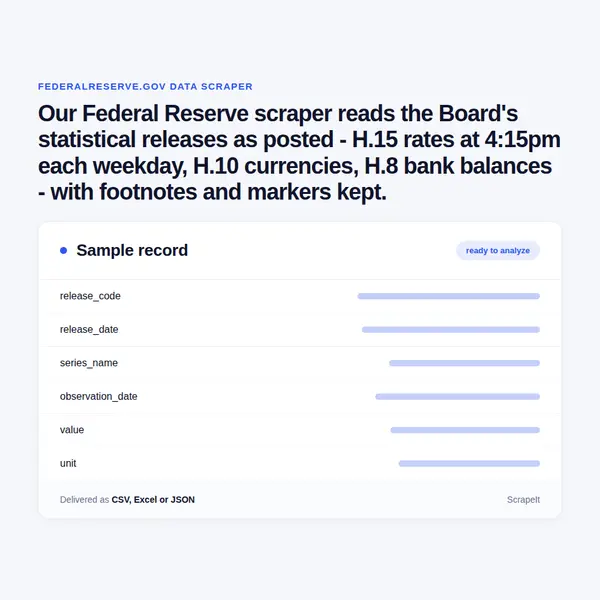
Our Federal Reserve scraper reads the Board's statistical releases as posted - H.15 rates at 4:15pm each weekday, H.10 currencies, H.8 bank balances - with footnotes and markers kept.

Plans from €169 a month · Free project assessment · Reply within 1 business day

CSV · Excel · JSON · XML · FTP · SFTP · Amazon S3 · Google Cloud

federalreserve.gov
Federal Reserve scraper for statistical releases and FOMC data
federalreserve.govwhat you get
Typical fields for financial sites
tickerpricechange_pctvolumemarket_capupdated_at
Delivery

API, JSON feed or CSV, XLSX and JSON files

Schedule

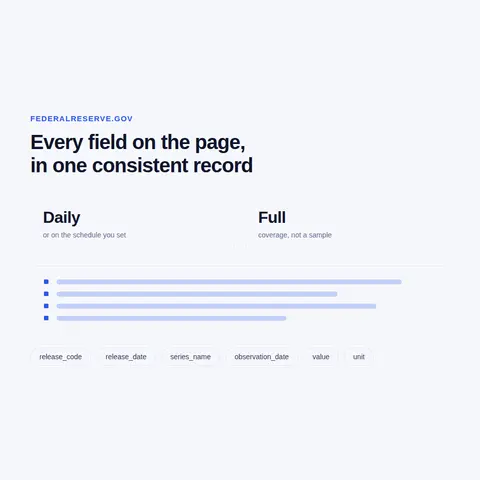
One-time, monthly, weekly, daily or 3 times a day

Scrape Federal Reserve releases without maintaining parsers

  1. You send

    Federal Reserve pages, filters, fields and a schedule

  2. We run the scrapers

    Built, monitored and repaired by our team

  3. You receive the data

    API, JSON feed or CSV, XLSX and JSON files

Tell us the releases and series you need - a few H.15 maturities, the full H.10 currency table, the weekly H.4.1 balance sheet, FOMC documents - and how often. We build the crawler, schedule it around each release's posting time and repair it when the Board reorganises a table. Rendering, pacing and proxy rotation are part of the service, not a task left to you.

Release pages mix values with markers - n.a. for not available, ND for no data, an asterisk for a day markets were closed, p and r for preliminary and revised figures. We keep them as flags next to the number instead of turning them into zeros or blanks, and the field documentation explains each one. Plans start from EUR 169 a month, or EUR 199 for a one-time extract.

Federal Reserve interest rate data and other fields

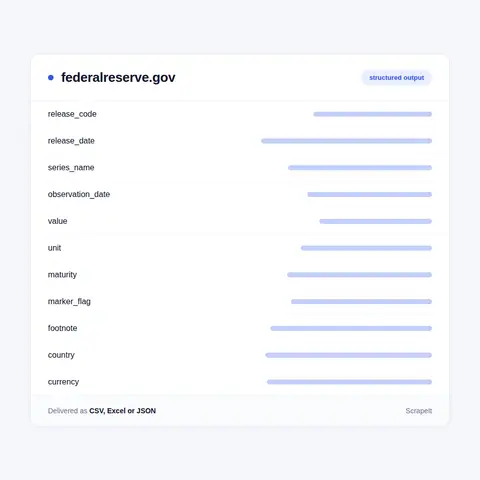
Each statistical release is a table with its own layout, so the dataset is normalised to one row per series, date and value, with the release code and release date attached. The fields we collect:

  • H.15 Selected Interest Ratesfederal funds (effective), nonfinancial and financial commercial paper at 1, 2 and 3 months, bank prime loan, discount window primary credit, Treasury bills in the secondary market, Treasury constant maturities from 1 month to 30 years, inflation-indexed yields and the inflation-indexed long-term average.
  • H.10 Foreign Exchange Ratescountry, currency, daily rate and its quoting direction (currency units per dollar, or dollars per unit for the asterisked currencies such as the euro and the pound), plus the Broad, AFE and EME dollar indexes.
  • Bank balance sheetsH.8 assets and liabilities of commercial banks in the United States: bank credit, securities, loans and leases, seasonally adjusted or not.
  • Reserves and moneyH.4.1 Reserve Bank credit and securities held outright, Wednesday levels and weekly averages with their changes; H.6 money stock M1, M2 and the monetary base.
  • Credit and activityG.19 consumer credit, revolving and nonrevolving; G.17 industrial production and capacity utilization.
  • Markers and notesnot-available, no-data, markets-closed, preliminary and revised flags, and the footnote attached to each series.
  • Provenancerelease code, release date, observation date, unit and source URL.

Field names follow the Board's own row labels, so a column in your file can be matched to the published table at a glance.

Federal Reserve interest rate data and other fields
A Federal Reserve database across releases, FOMC and banks

A Federal Reserve database across releases, FOMC and banks

Release pages show a short window - H.15 lists the latest business days, H.10 the latest week - and move on with the next posting. Scheduled runs keyed on series and observation date turn those windows into a continuous Federal Reserve interest rates tracker, and the release date stored with each value records what was known on which day, which matters for G.19 and G.17, where figures are marked preliminary or revised.

Monetary policy material follows its own calendar. For each FOMC meeting we capture the dates, the statement, the implementation note, the press conference page, projection materials at meetings with a Summary of Economic Projections, and the minutes with their release date. The Beige Book adds commentary from each of the twelve Districts eight times a year.

Banking structure pages add entity data: the quarterly U.S. Domestically Chartered Commercial Banks table ranks every bank by consolidated assets, with its holding company, Bank ID, headquarters, charter type, domestic assets and branch counts. Enforcement actions come with effective and termination dates, banking organization and action type; names of individuals are left out by default.

About Federal Reserve data releases on federalreserve.gov

Source
federalreserve.gov
Category
financial sites
Delivery
API, JSON feed, CSV, XLSX
Plans
From €169 a month
Get a quote

federalreserve.gov is the site of the Board of Governors of the Federal Reserve System, the central bank of the United States, based in Washington. It is separate from the twelve regional Reserve Banks, whose districts the Beige Book reports on. For data work the core is the Data section, where statistical releases are grouped into Bank Assets and Liabilities, Bank Structure Data, Business Finance, Exchange Rates and International Data, Financial Accounts, Household Finance, Industrial Activity, Interest Rates, and Money Stock Measures.

When Federal Reserve data releases go out depends on the release. Each one has a short code - H.15, H.10, H.8, H.4.1, H.6, G.19, G.17, Z.1 for the Financial Accounts of the United States - and the same set of pages: the current release, a release-dates calendar, an About page and announcements of methodology changes. H.15 posts Monday to Friday at 4:15pm and is not posted on holidays or when the Board is closed; H.10 and H.4.1 are weekly, G.19 and G.17 monthly.

Monetary Policy holds the FOMC calendars, with eight regularly scheduled meetings a year and minutes released three weeks after each decision. Supervision and Regulation holds enforcement actions and the banking structure tables.

25Developers
500+Customers
1.5BPages extracted
15,000+Hours saved for our clients

Federal Reserve scraping plans and pricing

Airplane

€199one-time

Setup fee included

100,000
One-time
Up to 5 days
7 days

Helicopter

€169/ mo

Setup fee €499

250,000
Monthly
Up to 5 days
14 days

Glasses

€229/ mo

Setup fee €499

1,000,000
Weekly
Up to 5 days
30 days

Microscope popular

€349/ mo

Setup fee €499

2,000,000
Daily
Same day
60 days

DNA

€549/ mo

Setup fee €799

3,000,000
3 times daily
Same day
90 days

Delivery: CSV, JSON or XLSX files, our API or a JSON feed. MCP server on request.

Full plan details

Why build a Federal Reserve interest rates tracker

The H.15 table is the reference set for US dollar rates. Treasury desks mark curves against the constant maturities, lenders price off the bank prime loan, and finance teams compare the effective federal funds rate with commercial paper to read short-term funding conditions. With the H.10 currency table beside it, one file covers rates and dollar exchange rates for revaluation, invoicing and hedge reporting.

The slower releases answer other questions. H.8 loans and leases show how bank credit is growing, H.4.1 tracks the size of the Fed's balance sheet week by week, G.19 measures household borrowing and G.17 industrial output. Text sources work as event data: FOMC statement dates and minutes for event studies around decisions, Beige Book districts for regional sentiment, enforcement actions for bank due diligence. The bank ranking table gives a ready list of US commercial banks by size for market sizing. Our job is the data; what it means for a position is your call.

About ScrapeIt

ScrapeIt is a managed scraping service. We write the crawlers, run them on the schedule you choose and fix them when a source changes, so central bank pages arrive as files your models can read. Release calendars, series codes and revision markers are the details we watch on sources like federalreserve.gov. The first step is a free project assessment, and a sample of the series you need can be ordered before you commit.

FAQ

Still unsure? Write to info@scrapeit.io

Do you offer a Federal Reserve API for H.15 and H.10 series?

Yes. The ScrapeIt Federal Reserve API returns series name, release code, observation date, value, unit and marker flags as JSON from an endpoint we host, refreshed on the schedule you set - daily after the 4:15pm H.15 posting, for example. The same data also comes as CSV, XLSX or JSONLines files, or straight into your database.

Is it legal to scrape the Federal Reserve?

Yes. Statistical releases, FOMC statements and minutes, and enforcement actions are posted on federalreserve.gov for any visitor. We collect only publicly available data - everything a visitor can see on the Federal Reserve Board's site - and we collect it legally.

How often does the Federal Reserve publish interest rate data and other series?

H.15 interest rates post every weekday at 4:15pm except holidays, H.10 exchange rates and the H.4.1 and H.8 tables come weekly, and G.19 and G.17 monthly. We match each run to the release calendar, so a series is collected once it is posted rather than on a fixed clock.

Which Federal Reserve datasets can you deliver besides interest rates?

Exchange rates and dollar indexes from H.10, bank balance sheets from H.8, reserve balances from H.4.1, money stock from H.6, consumer credit from G.19, industrial production from G.17, FOMC documents, the Beige Book, the commercial bank ranking and enforcement actions. You choose the releases; we bring them into one schema.

Can you keep FOMC statements and minutes linked to meeting dates?

Yes. Each record holds the meeting dates, whether the meeting carried a Summary of Economic Projections, the statement and implementation note text, and the minutes with the date they were released, three weeks after the decision. That makes the set ready for event studies around policy announcements.

How it works

  1. 1

    Make a request

    You share your needs, expectations, and desired timeframe. We'll suggest the best solution based on your request and budget.

  2. 2

    We configure the crawlers

    Our specialists configure the crawlers and extract a sample dataset for your review before proceeding with the full-scale extraction.

  3. 3

    Collect and deliver

    Once you approve the sample, we launch the project and start full data collection. We gather, filter, and structure the data for easy use, delivering it on time in your preferred format.

  4. 4

    Maintain and support

    Our team manages ongoing processes, monitors website changes, and supports all data extraction cycles. We can also help integrate data into your systems or create dashboards to simplify analysis.

Request a quote

Tell us which sites, which fields and how often. A couple of lines is enough to start.

  • We reply within 1 business day
  • A sample dataset before the full run
  • We sign an NDA on request
  • Delivery by API, JSON feed or files
Which sites, which fields, how often. A couple of lines is enough.

This form is protected by Google reCAPTCHA, which loads when you start filling it in; the Google Privacy Policy and Terms of Service apply. If you prefer not to use it, email us at info@scrapeit.io. Privacy & Cookie Policy

We reply within 1 business day. No obligation.

Federal Reserve data from €169/month. Free project assessment, reply within 1 business day.