PubMed Data Collection for Literature Metadata at Scale

PubMed asks crawlers for a one second delay and blocks the API path in robots. Read that as instructions rather than an obstacle and the source becomes easy.

PubMed Scraper
Solutions

Managed literature data, run end to end by us

ScrapeIt builds and runs the pipeline as a managed service. You define the corpus by subject terms, journals, authors, institutions or date range; we retrieve through the official interfaces at the rate they ask for, resolve authors and affiliations, keep the subject indexing structured, and hand back CSV, JSON, Excel or a push into your warehouse.

We are explicit that this is a compliant integration rather than a crawl. The library publishes programmatic access and asks for a one second delay; we use the former and honour the latter. That is why access here stays stable, and it is why we can quote a schedule we will actually keep.

Citation metadata is public and meant to be used. Abstracts and full text carry publisher rights that vary article by article, so we deliver text only where the licence allows it and record the licence status on every row rather than leaving you to find out later. Bring the use case to your own counsel before the project starts.

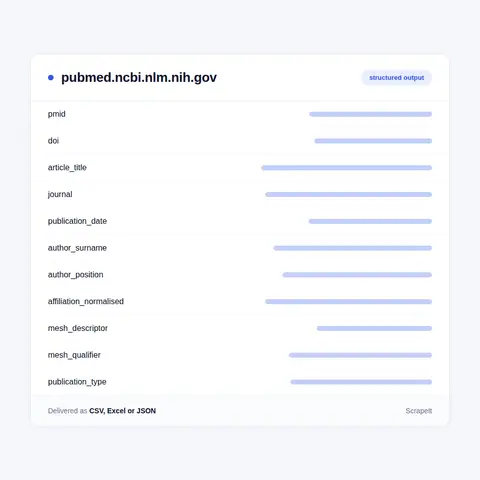
PubMed fields in every export

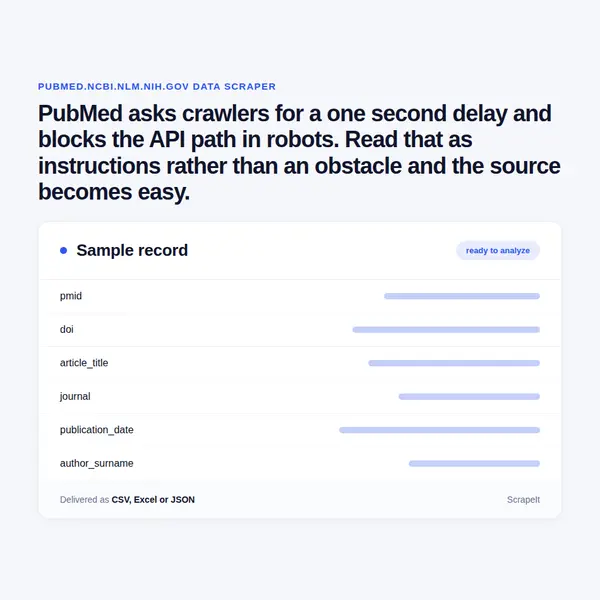
The citation record covers PubMed identifier, DOI where present, article title, abstract, journal title and abbreviation, ISSN, volume, issue, pagination, publication date and the electronic publication date where they differ, publication type, and language.

Authors come as rows rather than a string. Each carries surname, given name, initials, position in the author list, corresponding author flag where marked, and the affiliation as published. Author position matters: first and last author carry very different meaning in biomedical publishing, and a flattened author field throws that away.

Subject indexing is delivered structured. MeSH descriptors and qualifiers are kept as separate terms with their major topic flags intact, which is what makes precise selection possible. Filtering a corpus by a controlled vocabulary term is a categorically better operation than matching words in a title, and this source is one of the few where that vocabulary exists.

Identifiers that connect outward are extracted deliberately: trial registration numbers, grant and funding identifiers, and full text links including PubMed Central identifiers where the article is open. Those are the fields that let a literature dataset join to a trial registry, to a funder database or to the text itself.

Affiliations are normalised to institutions with the raw string preserved, and every row carries the retrieval timestamp.

PubMed fields in every export
Trial links, funding, full text and update handling

Trial links, funding, full text and update handling

Trial registration numbers appear in a good many clinical papers and are the bridge to a registry dataset. Extracted properly, they let you ask what a trial actually reported rather than only what it planned, and they are the reason clients usually buy this alongside clinical trial collection.

Grant and funding identifiers support a different question: what a funder produced, and where. They need the same institutional normalisation as affiliations before they aggregate sensibly.

Full text availability is recorded rather than assumed. Where an article is open access with a PubMed Central identifier, that is captured and the text can be included where its licence permits. Where it is not, we record the link and stop, because collecting publisher full text without a licence is a different activity and not one we do.

Records change after publication. Indexing is added, corrections and retractions are issued, and a retraction that your dataset never noticed is a genuine hazard in medical analysis. We re-check records on a schedule and deliver update and retraction status as fields, so a corpus stays honest instead of quietly ageing.

How PubMed expects to be used, and why that matters

PubMed is the National Library of Medicine index of biomedical literature: citations and abstracts across tens of millions of records, with subject indexing, author affiliations and links out to full text where it exists.

Unusually among large sources, it is explicit about how it wants to be accessed. The site publishes E-utilities, a documented programmatic interface for search and retrieval, and it offers bulk downloads. Its robots file asks automated clients for a one second crawl delay and disallows the interface path to crawlers, which is not an obstacle so much as a signposted instruction: use the tools provided, at a civil rate, rather than crawling result pages.

We follow that, and we say it plainly because the alternative gets people blocked and deserves to. Our pipelines here are built on the official interfaces, paced as asked, with an API key where one applies. Page level collection is reserved for the handful of things the interfaces genuinely do not expose, and even then at the requested rate.

The work, therefore, is not access. It is everything after retrieval: resolving authors who share names, normalising institutional affiliations that are written forty different ways, keeping the subject indexing usable, and joining records to trials, grants and full text. That is where a literature pipeline succeeds or fails.

Get a Quote
dev_w
25

Developers

customers
500+

Customers worldwide

pages
1 500 000 000+

Pages extracted

stime
15000+

Hours saved for our clients

Plans

Airplane

€199 / one-time

setup fee - included

Data limits100,000
Frequencyone-time
Run timeup to 5 days
Data storing7 days

Helicopter

€169 / mo

setup fee €499

Data limits250,000
Frequencymonthly
Run timeup to 5 days
Data storing14 days

Glasses

€229 / mo

setup fee €499

Data limits1,000,000
Frequencyweekly
Run timeup to 5 days
Data storing30 days

DNA

€549 / mo

setup fee €799

Data limits3,000,000
Frequency3 times daily
Run timesame day
Data storing90 days

Why author names and affiliations are the real problem

Anyone can retrieve PubMed records. The reason literature projects stall is that the records do not join to each other cleanly, and the two fields that break are the ones everybody assumes are simple.

Author names collide constantly. Common surnames with a single initial can cover hundreds of distinct researchers, and the same researcher appears with and without a middle initial, with a maiden name, and with the given name spelled two ways. Counting publications per researcher without disambiguation produces numbers that are confidently wrong. We disambiguate using co-authorship networks, affiliation history, subject overlap and identifiers where the article carries them, and we mark confidence rather than pretending it is certain.

Affiliations are worse, because they are free text. One university appears as its English name, its local name, an abbreviation, a department first, a hospital that belongs to it, and several misspellings. Institutional analysis is impossible until those collapse to one entity, and doing it after the data has landed is far harder than doing it during the pipeline.

The third problem is the corpus definition itself. A keyword search returns a pile with unclear edges. Selection through the controlled vocabulary, with the qualifiers and major topic flags intact, gives a corpus somebody else can reproduce, which is what any serious analysis requires.

The fourth is joining outward. A literature record is most useful when it is attached to a trial, a grant or a full text. Those identifiers are present in the source and routinely dropped by naive pipelines.

Our Blog

Reads Our Latest News & Blog

Learn how to use web scraping to solve data problems for your organization

How Artificial Intelligence Is Used In Web Scraping

How Artificial Intelligence Is Used In Web Scraping

Leveraging advances in technology, the AI-powered web scraper has skyrocketed in demand and is helping to expand capabilities by automating tedious daily tasks and speeding up data collection from thousands of websites several times over.

What is Web Scraping and What is it Used For?

What is Web Scraping and What is it Used For?

Web scraping is a method of obtaining web data by extracting it from pages of web resources with the help of a program, that is, in automatic mode. It is used to syntactically convert web pages into more usable forms.

Web Scraping for Machine Learning

Web Scraping for Machine Learning

If you specialize in machine learning, you need to feed large amounts of data to the algorithms. Web scraping is the easiest and the most efficient method of collecting the data from all over the Internet.

scrapeit logo

Who builds and keeps your literature feed

ScrapeIt is a managed extraction company, not a tool you have to learn. Our team builds the pipeline, watches it as interfaces and record formats change, and repairs it before your analysis goes stale.

You see a sample first, in your format, over your corpus definition, with authors disambiguated and affiliations normalised so you can judge the hard part on real records.

FAQ

Is scraping PubMed allowed?

The library publishes programmatic access and asks automated clients for a one second crawl delay, and its robots file directs crawlers away from the interface path. We read that as instructions and follow them: retrieval goes through the official interfaces at the requested rate, with an API key where one applies. Page level collection is reserved for the few things those interfaces do not expose. That is why access here stays stable.

How do you handle two researchers with the same name?

With disambiguation rather than hope. We use co-authorship networks, affiliation history, subject overlap and any author identifiers the article carries, then mark each assignment with a confidence level. Publication counts per researcher built without this step are confidently wrong, and common surnames with a single initial can cover hundreds of distinct people.

Can you normalise institutional affiliations?

Yes, and it is usually the most valuable part of the job. Affiliations are free text: one university appears under its English name, its local name, several abbreviations, a department, an affiliated hospital and a few misspellings. We collapse them to one institution, keep the raw string on the row, and deliver both so any aggregate can be audited.

Do you deliver abstracts and full text?

Abstracts where they are published in the record, and full text only where the licence permits, such as open access articles. The licence status is recorded on every row rather than left for you to discover downstream. Collecting publisher full text without rights is a different activity and not one we do.

How do you handle corrections and retractions?

By re-checking records on a schedule and delivering update and retraction status as fields. A retracted paper sitting unmarked in a medical corpus is a real hazard, and indexing is also added after initial publication, so a set retrieved once and never refreshed quietly ages into something misleading.

How does it Work?

Step 1 - Make a Request

You share your needs, expectations, and desired timeframe. We’ll suggest the best solution based on your request and budget.

Step 2 - Configuring Custom Web Crawlers

Our specialists configure the crawlers and extract a sample dataset for your review before proceeding with the full-scale extraction.

Step 3 - Collect and Deliver

Once you approve the sample, we launch the project and start full data collection. We gather, filter, and structure the data for easy use, delivering it on time in your preferred format.

Step 4 - Maintain and Support

Our team manages ongoing processes, monitors website changes, and supports all data extraction cycles. We can also help integrate data into your systems or create dashboards to simplify analysis.

Request a Quote

Tell us more about you and your project information.
Which sites, which fields, how often. A couple of lines is enough.

We reply within 1 business day. No obligation.

scrapiet

Scrapeit Sp. z o.o.
10/208 Legionowa str., 15-099, Bialystok, Poland
NIP: 5423457175
REGON: 523384582