Practo Scraper for Doctor Listings, Fees and Availability

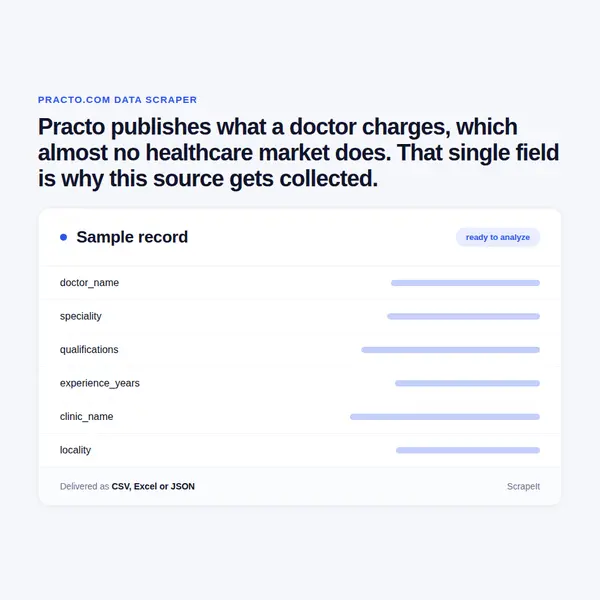
Practo publishes what a doctor charges, which almost no healthcare market does. That single field is why this source gets collected.

Practo Scraper
Solutions

Managed Practo collection, run end to end by us

ScrapeIt runs the collector as a managed service. You name the cities and specialities; we build the pipeline, run it on your cadence and hand back CSV, JSON, Excel or a push into your warehouse, with fees per clinic, addresses parsed and hours structured.

We work within the crawl rules the site publishes. Its robots file disallows search paths and query parameter searches while leaving city and speciality listings open, so that is exactly where we collect: listings and profiles, never search endpoints. Requests are paced.

Practitioner profiles are personal data even when professional and published, so the default output is professional attributes without personal contact details, and we ask for a lawful basis before anything beyond that. Patient feedback is delivered in aggregate only. Platform content is copyrighted and the terms restrict automated collection and reuse, so the dataset is for analysis rather than republication. Bring the use case to your own counsel before the project starts.

Practo fields in every export

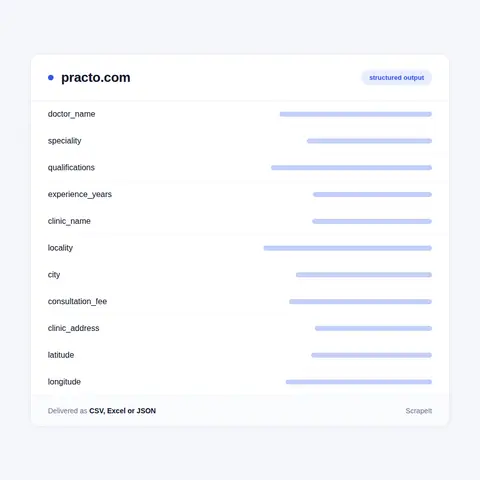
The practitioner record covers name, speciality and sub-speciality, qualifications as listed, years of experience, registration details where published, clinic and hospital affiliations, city and locality, consultation fee, and the profile URL.

Fees are collected per clinic rather than per doctor, because a practitioner working at three clinics can have three different charges, and a single fee column flattens that into something wrong. Each fee row carries the clinic, the locality and the collection date, which is what makes any price comparison across a city meaningful.

Clinic records carry the clinic name, full address, locality and city, coordinates where published, the specialities offered, the practitioners associated, and opening hours where shown, structured by day rather than left as a string.

Availability and feedback are collected as published: the aggregate patient recommendation figure and the count of feedback entries, plus availability indicators where the profile shows them. We do not collect individual patient feedback text tied to any identity, and we say so before anybody asks.

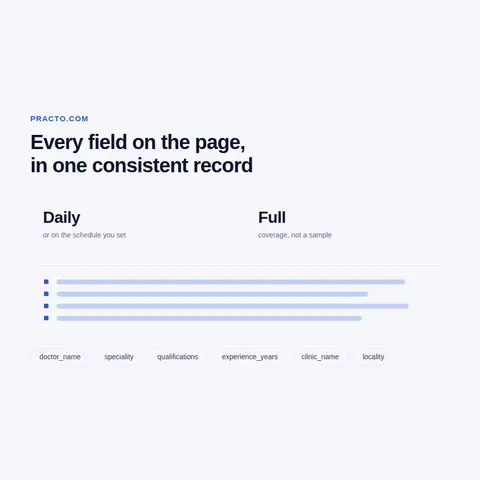
Every row carries the city, the speciality and the collection timestamp, so a market snapshot can be reconstructed exactly rather than approximately.

Practo fields in every export
Personal data, coverage limits and repeat collection

Personal data, coverage limits and repeat collection

Doctors are people, and a doctor profile is personal data even though it is professional and published. We treat it accordingly. Our default output carries professional attributes: name as published, speciality, qualifications, experience, affiliation, clinic address and fee. We do not collect personal contact details, and we do not build a practitioner dataset for marketing purposes without the client stating a lawful basis. India's data protection regime applies to this material, and we would rather scope the project around it at the start than deliver a file that becomes a liability.

Patient feedback is handled with the same restraint. Aggregate recommendation figures and counts are collected. Individual feedback text tied to a patient is not, because a health complaint attached to a person is sensitive by any reading and no legitimate analysis needs it.

Coverage limits are stated rather than buried. This is the largest platform of its kind in the market and it is still a platform: it holds the practitioners who list on it. City coverage is uneven, with metropolitan areas far better represented than smaller ones. Any provision map built from this should be described as platform coverage, not as the health system.

Repeat collection is where the value compounds. Fees move, affiliations change, practitioners appear and disappear from listings. A quarterly market snapshot with changes flagged is considerably more useful than a single pull, and it is how most clients here end up running it.

How Practo lists doctors, clinics and cities

Practo is India's largest healthcare discovery and booking platform. Patients search by city and speciality, compare practitioners and book appointments, and the listing pages behind that are where the data lives.

The addressing scheme is straightforward and stable: a city combined with a speciality gives a listing page, and each practitioner and clinic has its own profile. That structure is what makes systematic collection across a market practical, because coverage can be enumerated city by city and speciality by speciality rather than crawled blindly.

The crawl rules are specific and worth reading before scoping a project. The site disallows its search paths and query parameter searches, along with several application paths, while the city and speciality listing pages themselves remain open. We work within that: listings and profiles yes, search endpoints no. It is a clean line and it keeps the collection stable.

What sets this source apart from most healthcare directories is the fee. Consultation charges are published on profiles, alongside qualifications, years of experience, clinic affiliations, and patient feedback. In most healthcare markets, price is the field nobody publishes; here it is on the page.

Get a Quote
dev_w
25

Developers

customers
500+

Customers worldwide

pages
1 500 000 000+

Pages extracted

stime
15000+

Hours saved for our clients

Plans

Airplane

€199 / one-time

setup fee - included

Data limits100,000
Frequencyone-time
Run timeup to 5 days
Data storing7 days

Helicopter

€169 / mo

setup fee €499

Data limits250,000
Frequencymonthly
Run timeup to 5 days
Data storing14 days

Glasses

€229 / mo

setup fee €499

Data limits1,000,000
Frequencyweekly
Run timeup to 5 days
Data storing30 days

DNA

€549 / mo

setup fee €799

Data limits3,000,000
Frequency3 times daily
Run timesame day
Data storing90 days

Why published consultation fees change what is possible

In most healthcare markets, price discovery is impossible from public sources. Fees are negotiated, insured or simply not published, and any analysis of what care costs relies on surveys and estimates. India is a partial exception, and this platform is why: consultation charges sit on the profile page.

That makes real questions answerable. What a cardiologist consultation costs in one city against another. How fees vary by years of experience within one speciality. Which localities are underserved at a given price point. Whether a hospital group is charging above or below the market for the same speciality in the same neighbourhood. None of those need a survey when the data is on the page.

The second use is provision mapping. Because listings enumerate by city and speciality, coverage is measurable: how many practitioners in a speciality serve a locality, where the gaps are, how concentrated provision is around a few hospital groups. For anyone planning a clinic network, a diagnostics chain or a telehealth launch, that map is the first slide.

The third is competitive tracking for provider groups. Which practitioners are affiliated with which chains, where the affiliations shift, how a competitor's footprint changes across a market over quarters. Affiliations move more often than anybody expects and the movement is visible only through repeated collection.

The fourth is the caveat that has to sit alongside all of it: this is one platform, not the whole market. Practitioners who are not listed do not appear, and the coverage is stronger in large cities than in small ones. We say what the dataset covers rather than letting it be mistaken for a census.

Our Blog

Reads Our Latest News & Blog

Learn how to use web scraping to solve data problems for your organization

How Artificial Intelligence Is Used In Web Scraping

How Artificial Intelligence Is Used In Web Scraping

Leveraging advances in technology, the AI-powered web scraper has skyrocketed in demand and is helping to expand capabilities by automating tedious daily tasks and speeding up data collection from thousands of websites several times over.

What is Web Scraping and What is it Used For?

What is Web Scraping and What is it Used For?

Web scraping is a method of obtaining web data by extracting it from pages of web resources with the help of a program, that is, in automatic mode. It is used to syntactically convert web pages into more usable forms.

Web Scraping for Machine Learning

Web Scraping for Machine Learning

If you specialize in machine learning, you need to feed large amounts of data to the algorithms. Web scraping is the easiest and the most efficient method of collecting the data from all over the Internet.

scrapeit logo

Who builds and keeps your Practo feed

ScrapeIt is a managed extraction company, not a tool you have to learn. Our team builds the pipeline, watches it as the site changes, and repairs it before your market snapshot goes stale.

You see a sample first, in your format, over the cities and specialities you actually cover, with fees split by clinic so you can judge the pricing data on real profiles.

FAQ

Can you really get consultation fees?

Yes, where the profile publishes them, and it is the reason most clients collect this source at all. Fees are captured per clinic rather than per practitioner, because a doctor working at three clinics often charges three different amounts and a single fee column would flatten that into something wrong. Each fee row carries the clinic, the locality and the date collected.

Is this the whole Indian healthcare market?

No, and it should never be described that way in a report. It is the largest platform of its kind, and it holds the practitioners who list on it. Metropolitan coverage is much stronger than coverage of smaller cities. Anything built from it is platform coverage, not a census of the health system, and we state that alongside the numbers.

Doctor profiles are personal data. How do you handle that?

Carefully, because they are, even though the information is professional and published. The default output carries professional attributes: name, speciality, qualifications, experience, affiliation, clinic address and fee. We do not collect personal contact details and we do not build practitioner lists for marketing without the client stating a lawful basis. India's data protection regime applies and we scope around it at the start.

Do you collect patient reviews?

Aggregate recommendation figures and counts only. Individual feedback text tied to a patient is health information about an identifiable person, and no legitimate analysis of a provider market needs it. If a brief asks for it, we will say why we are not delivering it.

Does the site's robots file allow this?

It draws a clear line and we stay on the right side of it. Search paths and query parameter searches are disallowed, along with several application paths; city and speciality listing pages are open, and that is where we collect, along with the profiles they link to. Working within published crawl rules is also why access on this source stays stable.

How does it Work?

Step 1 - Make a Request

You share your needs, expectations, and desired timeframe. We’ll suggest the best solution based on your request and budget.

Step 2 - Configuring Custom Web Crawlers

Our specialists configure the crawlers and extract a sample dataset for your review before proceeding with the full-scale extraction.

Step 3 - Collect and Deliver

Once you approve the sample, we launch the project and start full data collection. We gather, filter, and structure the data for easy use, delivering it on time in your preferred format.

Step 4 - Maintain and Support

Our team manages ongoing processes, monitors website changes, and supports all data extraction cycles. We can also help integrate data into your systems or create dashboards to simplify analysis.

Request a Quote

Tell us more about you and your project information.
Which sites, which fields, how often. A couple of lines is enough.

We reply within 1 business day. No obligation.

scrapiet

Scrapeit Sp. z o.o.
10/208 Legionowa str., 15-099, Bialystok, Poland
NIP: 5423457175
REGON: 523384582