eBay Data: 1.9M Auto Parts Listings from eBay.de, Specs Translated
About 1.9 million auto parts listings from eBay.de with brand, OEM, EAN and fitment, plus titles and specs machine-translated for the client's team.
Learn More
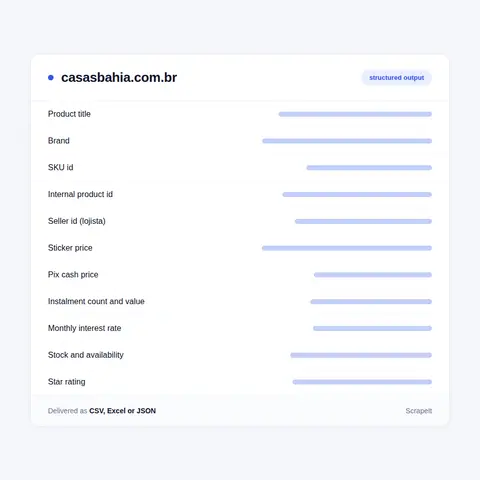
On Casas Bahia the same item carries a cash price, a lower Pix price and an instalment plan with its own total. We collect every tier, with the seller behind it.
Plans from €169/month · Free project assessment · Reply within 1 business day
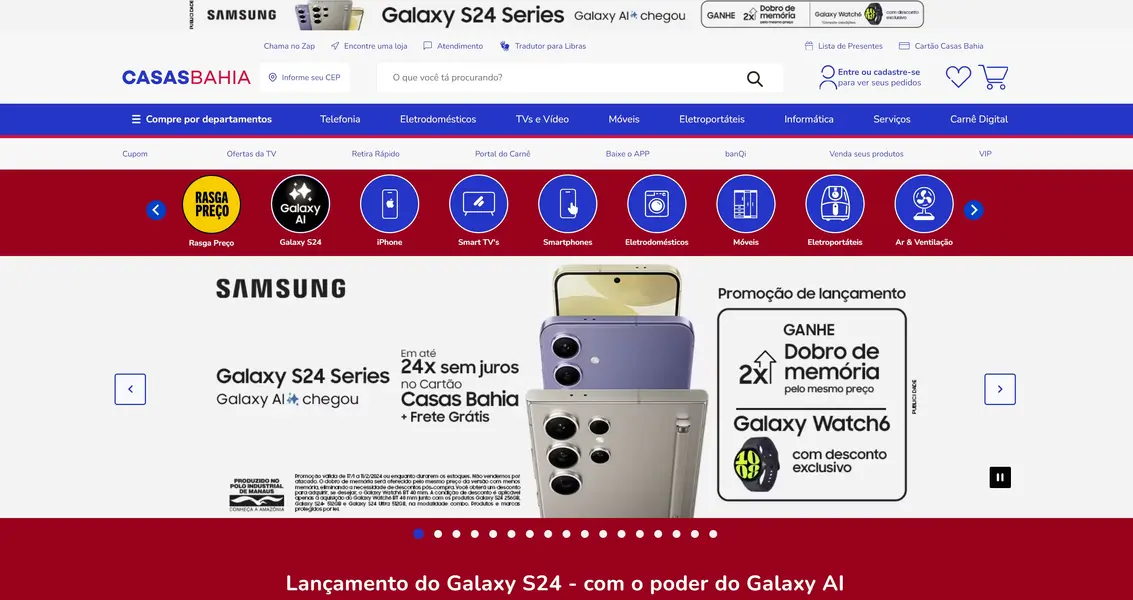
Scope comes first: which departments, category branches or search terms, which fields, which postcodes and how often. Then we build the Casas Bahia scraper, run it on your schedule and keep it working when the site moves underneath it.
These pages are actively defended, and product and keyword-search routes are guarded harder than category listings, so anti-bot handling, proxy rotation and CAPTCHA solving are part of the service rather than knobs you configure. We stay on public pages, take nothing that sits behind a login and keep request rates modest.
Delivery is CSV, JSON, XLSX or a REST API, pushed to S3, Google Cloud Storage, an SFTP drop or an endpoint you name. Daily suits price and stock work, hourly fits a narrow watchlist, and weekly fits assortment and seller tracking.
Category and listing pages are server-rendered and carry their state as JSON inside the page, so a Casas Bahia scraper reads structured records instead of guessing at rendered markup. Offer economics load separately, so price and catalogue must be joined rather than read in one pass.
We normalise the Brazilian number format, keep each payment tier in its own column and stamp the seller id on every row. Reviewer names are personal data, so we leave them out by default.
Categories live at /c/ plus department, subcategory and leaf slugs, with a filtro parameter repeating the numeric chain: categoria-c13_c14_c143 is two-door fridges under refrigerators under appliances. The category sitemap lists 3,522 such addresses across 44 departments - our frontier. Facet tokens follow the same grammar: marca for brand, preco for price bands, desconto for discount bands, avaliacao for star buckets, lojistas for sellers, caracteristica for spec filters. Spec facets differ by department - door count, defrost type and capacity for fridges; screen size, memory and operating system for phones - and every facet value ships with its own result count.
One number decides coverage: the result set stops at ten thousand items however many match. In September 2026 the furniture department reported more than 560 thousand matches while serving twenty per page up to that ceiling, so a sweep must be cut by subcategory, brand, price band and discount band rather than paged through. Keyword landing pages sit at /term/b with their own sitemap index, and product addresses span more than 1,800 sitemap files.
Delivery and availability are computed from the buyer's CEP, the Brazilian postcode. The site asks for one before showing a region-correct list, offers are resolved per region, and freight is quoted from an origin CEP at the warehouse to a destination CEP at the buyer. There is therefore no single national delivery time: we agree a postcode list up front and return a row per product per CEP.
Casas Bahia is the flagship storefront of Grupo Casas Bahia S.A., a Brazilian retailer of appliances, consumer electronics and furniture that also operates a large third-party marketplace. The company took its present name in 2023, after trading as Via and, before that, as Via Varejo; its shares list on B3 under the ticker BHIA3. The same group runs the Ponto and Extra.com.br storefronts, and a single marketplace sits behind all three, which is why a seller id met on casasbahia.com.br can reappear on the sibling sites.
The retail model is what makes this catalogue unusual as a data source. The chain grew up selling durable goods on instalments to shoppers without bank credit, and that machinery is still in the product: the Cartao Casas Bahia store card, the Carne Digital (a digital version of the old instalment booklet) and CDC consumer credit appear as separate payment tracks next to the cash figure. Physical stores double as fulfilment points, so listings carry pickup promises such as Retira Rapido and a two-hour collect option alongside home delivery.
The catalogue spans 44 top-level departments, from eletrodomesticos (major appliances) and moveis (furniture) through games, pet shop and ferramentas (tools) to a department named Marketplace. Bartira, the group's own furniture factory, supplies part of the furniture range, while independent lojistas (marketplace sellers) list against the same category tree. After a restructuring the company books as a R$4.6 billion debt reduction in 2024, it is running a plan built on credit, logistics and marketplace monetisation, and each of those levers moves prices on the site.
Get a Quote
Developers

Customers worldwide

Pages extracted

Hours saved for our clients
€199 / one-time
setup fee - included
€169 / mo
setup fee €499
€229 / mo
setup fee €499
€349 / mo
setup fee €499
€549 / mo
setup fee €799
Delivery: CSV, JSON or XLSX files, our API or a JSON feed. MCP server on request.
Full plan details →A price here is not a single number, and that is the trap most Brazilian price monitoring projects fall into. The same offer shows a sticker figure, a lower a vista figure once the Pix instant-payment discount applies, and an instalment plan whose monthly payment is what shoppers actually compare. Pix discounts on first-party stock run in the region of five to seven percent, while marketplace offers frequently carry none at all. Take the sticker number alone and you overstate what buyers pay; take the Pix number alone and you understate the shelf price of everything a lojista sells.
The instalment side has its own structure. Three credit tracks sit side by side - the card brand plan, other cards, and CDC, the store credit that descends from the paper carne - and each carries its own count of payments, payment value and monthly interest rate. Plans of six, ten, twelve and twenty-four payments all appear, and the store card is promoted with twenty-four instalment flags. Where the monthly rate is zero the plan is labelled sem juros and the payments add up to the cash figure; where it is not, the sum of the payments exceeds the cash figure for the same item. Storing the rate is what lets you tell those two cases apart afterwards.
Prices also move by seller and by region, so a Casas Bahia price feed that drops the seller id or the region compares things that were never comparable.
About 1.9 million auto parts listings from eBay.de with brand, OEM, EAN and fitment, plus titles and specs machine-translated for the client's team.
Learn More
A one-off Takealot product list for an entrepreneur choosing niches: only products rated 4 stars or higher with at least 50 reviews.
Learn More
Trendyol product data for an e-commerce startup reselling Turkish fashion: 27 categories in JSON on FTP, with in-stock status for every size.
Learn MoreLearn how to use web scraping to solve data problems for your organization
If you sell online, run a marketplace, or advise e-commerce clients, you already know why eBay matters: it’s one of the few places where big retailers compete side by side with thousands of small merchants and private sellers.

E-commerce teams do not just need “some” competitor data anymore. They need a continuous stream of real prices, discounts, stock levels, reviews, and seller behavior from the platforms that actually shape their markets.
Amazon provides valuable information gathered in one place: products, reviews, ratings, exclusive offers, news, etc. So scraping data from Amazon will help solve the problems of the time-consuming process of extracting data from e-commerce.
ScrapeIt is a managed web scraping service. You do not run crawlers or maintain selectors; we do that and hand over clean, deduplicated data on the cadence you set.
Every project starts with a sample so you can check the fields against live pages before committing. When a layout or the page data changes, repairing it is our job rather than a ticket you have to raise. Cost follows volume and frequency, and the scope is written down before the first run.
Yes. The ScrapeIt Casas Bahia API returns the sticker price, the Pix cash price, instalment plans per credit track, the seller id, availability and the EAN barcode as JSON from an endpoint we host, refreshed on the schedule you set. The same data also comes as CSV or XLSX files or straight into your database.
As separate columns, never merged into one figure. A row carries the sticker price, the struck-through reference it came down from, the Pix cash price with its percentage, and one block per credit track holding the number of payments, the payment value and the monthly interest rate. That lets you compare a rival's cash price against a cash price, see when a discount was tied to a payment method, and work out what a plan really costs over its term.
Yes. Every offer carries a seller id, and first-party stock uses one fixed id that the site surfaces as a seller filter labelled CB Full. Third-party offers put the lojista id and a 3P seller-type value into the product address. Because the marketplace matches incoming listings on the EAN barcode, several sellers can end up sharing a single product page, so we return one row per seller per product rather than collapsing them into one price.
Yes, and it is the main reason two extracts of the same catalogue can disagree. Availability, delivery time and freight are calculated from the buyer's CEP against the warehouse or store that would ship the item, and an offer can be national, regional or pickup-only. We agree a list of postcodes covering the regions you care about, usually one per state capital, and return a row per product per CEP so the delivery fields carry meaning.
It depends on how many pages the job covers. A watchlist of a few thousand products can run several times a day; a sweep of whole departments with facet slicing usually runs daily or weekly. Output is CSV, JSON, XLSX or a REST API, delivered to S3, Google Cloud Storage, SFTP or an endpoint you name, with a stable schema so your loader does not break between runs. We size the schedule to your list and to a polite request rate, then put it in writing.
Step 1 - Make a Request
You share your needs, expectations, and desired timeframe. We’ll suggest the best solution based on your request and budget.
Step 2 - Configuring Custom Web Crawlers
Our specialists configure the crawlers and extract a sample dataset for your review before proceeding with the full-scale extraction.
Step 3 - Collect and Deliver
Once you approve the sample, we launch the project and start full data collection. We gather, filter, and structure the data for easy use, delivering it on time in your preferred format.
Step 4 - Maintain and Support
Our team manages ongoing processes, monitors website changes, and supports all data extraction cycles. We can also help integrate data into your systems or create dashboards to simplify analysis.
Casas Bahia data from €169/month. Free project assessment, reply within 1 business day.

Scrapeit Sp. z o.o.
10/208 Legionowa str., 15-099, Bialystok, Poland
KRS: 0000996672
NIP: 5423457175
REGON: 523384582