The Entire Iherb Supplements Catalog, Captured End-to-End in 3 Days
Scraping supplement products from iHerb.com with full details, including descriptions and packaging variations.
Learn More
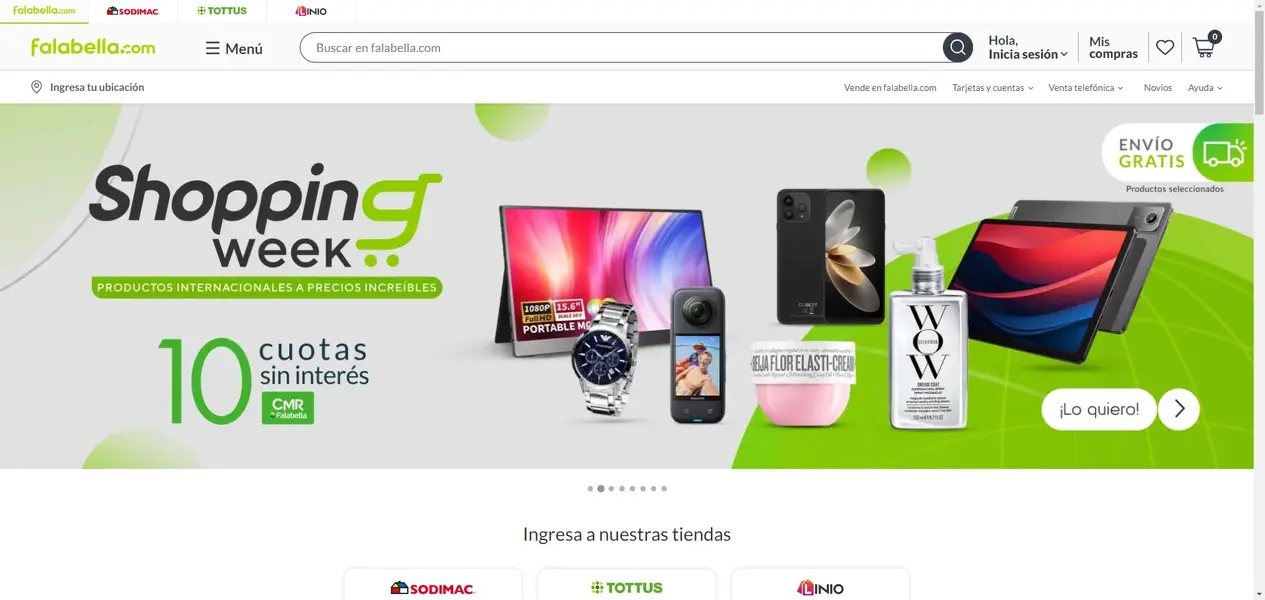
Falabella shows several price tiers on the same product and mixes its own range with Sodimac and marketplace sellers. We extract all of it on your schedule.
Plans from €169/month · Free project assessment · Reply within 1 business day
We agree the scope first: which countries, which categories or search terms, which fields, and how often. Then we build the crawler, run it and keep it working when the site changes.
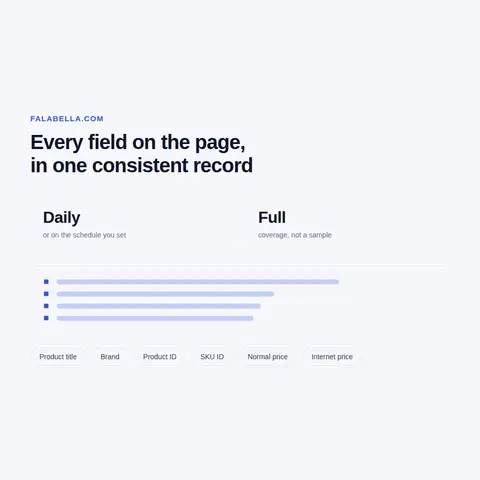
Delivery is CSV, JSON, XLSX or a REST API, pushed to S3, Google Cloud Storage, an SFTP drop or an endpoint you name. Daily is the common cadence for price work; hourly is possible for a narrow watchlist, and weekly suits catalogue and assortment tracking.
Typical jobs are competitor price monitoring across the three tiers, assortment and share-of-shelf reporting, marketplace seller tracking, brand compliance checks, and review collection for a defined product set.
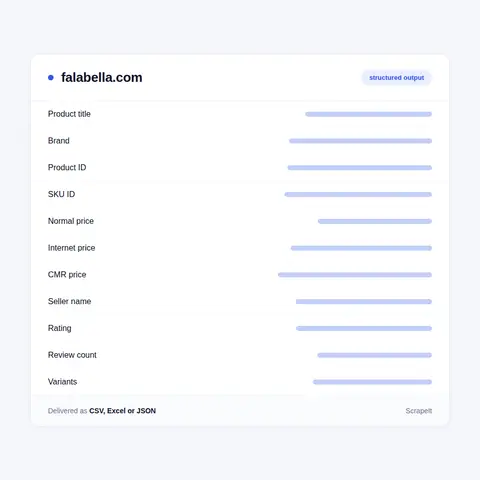
Listing and product pages carry their data as JSON in a __NEXT_DATA__ script block inside the HTML. That payload sits in the markup of a Chilean category page. Each product record holds the fields below.
Prices arrive as formatted strings with a full stop as the thousands separator, and the price array can hold two values when a listing spans variants at different prices. We normalise both before delivery.
Categories sit at /falabella-cl/category/ followed by a cat-prefixed numeric id and a name, for example cat720161 for smartphones. Editorial groupings use /collection/ with a text slug and no numeric id. Seller storefronts sit at /seller/ keyed by the seller's display name rather than by sellerId, so the name has to be URL-encoded. Site search uses the Ntt query parameter, a leftover from an older search stack.
Listings paginate with a page parameter. One page returned 48 organic products plus 8 sponsored ones, reported as separate counts. Deep page numbers returned no products at all, so a crawl that walks pages until it runs out will stop short of a large category. We split categories using the facet parameters, which are prefixed f.product. and cover brand and attributes.
The Chilean site publishes sitemap indexes for products, categories, brands, collections and sellers; on 27 August 2026 the product index pointed to 63 child files carrying lastmod timestamps, and the seller sitemap listed 6,091 storefronts. Those give us a reliable frontier to crawl from.
Access is not uniform across countries. The Chilean host serves full HTML, while the Peruvian host answers with a challenge page. We build for the posture each host presents, with rendering and proxy rotation where a host needs them, and keep request rates modest.
Falabella started as a Chilean department store chain and now runs falabella.com as one storefront for the group's retail and marketplace business. Chile sits on www.falabella.com behind a /falabella-cl/ path prefix. Colombia runs on www.falabella.com.co under /falabella-co/, and Peru on www.falabella.com.pe under /falabella-pe/. The country is encoded in the host and the path prefix together, so a config that swaps only the domain will point at nothing.
Country coverage has moved, and it is worth confirming at the start of a project rather than assuming. Falabella closed its last Argentine department stores in April 2021 and stopped selling online there on 31 May 2021. In August 2026, www.falabella.com.ar no longer serves its own catalogue and redirects to the Chilean site. In Mexico the group closed the Linio site on 8 April 2024 and put its money into physical Sodimac stores instead.
The same storefront carries far more than Falabella's own range. Sodimac, Tottus and Linio were folded into falabella.com alongside independent marketplace sellers, so one search can return a department store item, a home improvement item and a third-party listing next to each other. Any useful Falabella data set has to record which of those a row came from, because a price only means something once you know who is selling.
Get a Quote
Developers

Customers worldwide

Pages extracted

Hours saved for our clients
€199 / one-time
setup fee - included
€169 / mo
setup fee €499
€229 / mo
setup fee €499
€349 / mo
setup fee €499
€549 / mo
setup fee €799
Delivery: CSV, JSON or XLSX files, our API or a JSON feed. MCP server on request.
Full plan details →Chilean retail prices are quoted in tiers, and Falabella is the clearest example. A single product can show a precio normal (list price) struck through, a precio internet (online price) below it, and a lower figure again for holders of the CMR card, the group's own store card. Reading only the largest number on the page gives you the list price. Reading only the smallest gives you a price most shoppers cannot get. Comparing a competitor's shelf price against the CMR tier is not a like-for-like comparison at all.
The tiers also move as a set. During campaigns the internet tier is replaced by an eventPrice entry, so a crawler that hard-codes internetPrice will quietly return nothing for exactly the products that changed. That matters most around the two Chilean online sales events run by the Santiago Chamber of Commerce: Cyber Day, held 1 to 3 June 2026, and Cyber Monday, scheduled for 5 to 7 October 2026. Buyers who care about those weeks usually want a price series that starts well before them, because reference prices are often walked upwards in the run-up so the discount looks larger.
Seller mix moves too. Marketplace listings appear and disappear, and the seller behind a given product can change without the product page changing.

Scraping supplement products from iHerb.com with full details, including descriptions and packaging variations.
Learn More
Daily scraping of lowest prices for 150K products on Allegro.pl to support marketplace pricing and margin optimization.
Learn More
Regular monitoring of Ralph Lauren clothing, footwear, and accessories sold across Amazon subdomains: AE, DE, ES, FR, IT, NL, PL, UK.
Learn MoreLearn how to use web scraping to solve data problems for your organization

If you sell online, run a marketplace, or advise e-commerce clients, you already know why eBay matters: it’s one of the few places where big retailers compete side by side with thousands of small merchants and private sellers.

E-commerce teams do not just need “some” competitor data anymore. They need a continuous stream of real prices, discounts, stock levels, reviews, and seller behavior from the platforms that actually shape their markets.
Amazon provides valuable information gathered in one place: products, reviews, ratings, exclusive offers, news, etc. So scraping data from Amazon will help solve the problems of the time-consuming process of extracting data from e-commerce.
ScrapeIt is a managed web scraping service. You do not run a crawler or maintain selectors; we do that and hand over clean, deduplicated data on the schedule you set.
Every project starts with a sample so you can check the fields against live pages before committing. Layout changes are our problem to fix, not a support ticket you have to raise. We collect only publicly available data - everything a visitor can see on Falabella - and we collect it legally. We keep our load light.
Yes. The ScrapeIt Falabella API returns productId, skuId, the normal, internet and CMR prices, the seller name and ratings as JSON from an endpoint we host, refreshed on the schedule you set. The same data also comes as CSV or XLSX files, pushed to S3, Google Cloud Storage or an SFTP drop, or straight into your database.
As of a check on 27 August 2026, Chile on www.falabella.com, Colombia on www.falabella.com.co and Peru on www.falabella.com.pe are live, each behind its own path prefix. Argentina redirects to the Chilean site after Falabella left that market in 2021, and the group closed its Linio operation in Mexico in April 2024. We confirm which hosts are serving before quoting, because catalogues, category ids and seller lists differ by country and cannot be reused across them.
We keep them as separate columns rather than collapsing them into one price. A row can carry the normal price, the internet price, the CMR card price and, during a campaign, the event price, each with the flag that told us which tier it was. That way you can compare like with like, and you can see when a discount was card-linked rather than open to everyone.
Yes. Each listing carries a seller id and a seller name, and the id is the reliable one. Falabella's own range uses a fixed first-party value, group siblings such as Sodimac use their own named values, and independent sellers use short generated codes. We deliver both fields so you can filter to first-party stock, to a single marketplace seller, or to everything selling a given product.
It depends on how many pages the job covers. A focused watchlist of a few thousand products can run several times a day. A full category sweep across several countries usually runs daily or weekly. We size the schedule to your list and to a request rate that stays polite, then agree it in writing before the first run.
Step 1 - Make a Request
You share your needs, expectations, and desired timeframe. We’ll suggest the best solution based on your request and budget.
Step 2 - Configuring Custom Web Crawlers
Our specialists configure the crawlers and extract a sample dataset for your review before proceeding with the full-scale extraction.
Step 3 - Collect and Deliver
Once you approve the sample, we launch the project and start full data collection. We gather, filter, and structure the data for easy use, delivering it on time in your preferred format.
Step 4 - Maintain and Support
Our team manages ongoing processes, monitors website changes, and supports all data extraction cycles. We can also help integrate data into your systems or create dashboards to simplify analysis.
Falabella data from €169/month. Free project assessment, reply within 1 business day.

Scrapeit Sp. z o.o.
10/208 Legionowa str., 15-099, Bialystok, Poland
NIP: 5423457175
REGON: 523384582