eBay Data: 1.9M Auto Parts Listings from eBay.de, Specs Translated
About 1.9 million auto parts listings from eBay.de with brand, OEM, EAN and fitment, plus titles and specs machine-translated for the client's team.
Learn More
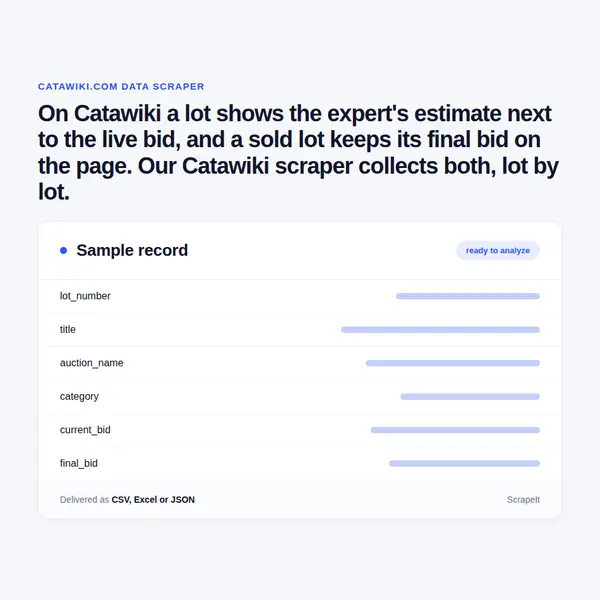
On Catawiki a lot shows the expert's estimate next to the live bid, and a sold lot keeps its final bid on the page. Our Catawiki scraper collects both, lot by lot.
Plans from €169/month · Free project assessment · Reply within 1 business day
Tell us which Catawiki categories, auctions, keywords or sellers you follow and how close to the end you need the numbers; we build the crawler, run it on that schedule and repair it when lot pages change. Catawiki screens automated traffic, so anti-bot handling, proxy rotation and CAPTCHA handling are included.
Because the lots of one auction close one after another at short intervals, runs are timed to closing times rather than to the clock. Results come as CSV, Excel, JSON or XML, by e-mail, to Dropbox or Amazon S3, or through our API, documented field by field. Plans start from EUR 169 a month, or EUR 199 for a one-time extract.
A Catawiki lot page is unusually complete, and our Catawiki scraper reads it field by field. Each lot has a number, shown on the page after No. and repeated in the address after /l/; the same number opens the lot in every language version, so it is the key for every row.
The experts who select lots and the curators of auctions are named on the page. They are natural persons, so their names are left out by default.
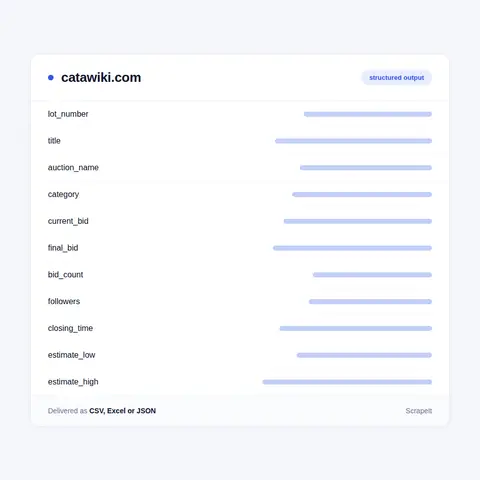
Coverage on Catawiki is built from auctions rather than shops. Each auction is a themed sale with a date range, an object count and a curator, often part of a series - a Zenith sale belongs to its Zenith Watches line - and its page lists every lot; after the sale ends, sold lots stay listed there with their final bid. That is the most direct way to scrape Catawiki sold prices: follow the auctions of a category through their closing day and the final bids arrive in order.
Keyword search pages add related search terms, a count of related objects and a deep filter set: Reserve price, Shipping, Closing date, Budget, Location, Brand, Condition, Period, plus category facets such as watch movement or case diameter. To scrape Catawiki search results completely, we split a broad query by these filters and merge the slices on lot number. The seller block on each lot links to everything else that seller has in auction.
Repeated runs turn the current bid into a price history per lot: the opening level, how the bid count grows and how much happens in the final hours.
Catawiki was founded in 2008 and is run by Catawiki B.V. from Amsterdam. It is a curated marketplace: sellers submit objects, in-house experts accept or turn them down, and accepted objects go into themed online auctions that usually run seven to ten days. The site works in 17 languages under one domain, and bids are placed in euros.
The top-level categories show the range: Art, Interiors, Jewellery, Watches, Fashion, Coins & Stamps, Comics, Cars & Bikes, Wine & Spirits, Asian & Tribal, Trading Cards, Toys & Models, Archaeology, Sports, Music, Movies & Cameras, and Books & History. Classic cars and fine wine sit beside comic albums and sports cards.
Three things set its data apart from an ordinary auction site. Lots carry a non-binding value estimate from the expert who selected them. Sellers may set a reserve price that stays hidden, and the lot page tells bidders only whether it has been reached. And buyers pay a Buyer Protection fee and shipping on top of the final bid, so the final bid is not the full cost of the object.
Get a Quote
Developers

Customers worldwide

Pages extracted

Hours saved for our clients
€199 / one-time
setup fee - included
€169 / mo
setup fee €499
€229 / mo
setup fee €499
€349 / mo
setup fee €499
€549 / mo
setup fee €799
Delivery: CSV, JSON or XLSX files, our API or a JSON feed. MCP server on request.
Full plan details →An expert estimate paired with a public final bid is rare in online auctions, and it is the part of Catawiki auction data buyers use most.
About 1.9 million auto parts listings from eBay.de with brand, OEM, EAN and fitment, plus titles and specs machine-translated for the client's team.
Learn More
A one-off Takealot product list for an entrepreneur choosing niches: only products rated 4 stars or higher with at least 50 reviews.
Learn More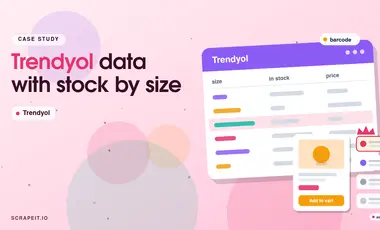
Trendyol product data for an e-commerce startup reselling Turkish fashion: 27 categories in JSON on FTP, with in-stock status for every size.
Learn MoreLearn how to use web scraping to solve data problems for your organization
If you sell online, run a marketplace, or advise e-commerce clients, you already know why eBay matters: it’s one of the few places where big retailers compete side by side with thousands of small merchants and private sellers.

E-commerce teams do not just need “some” competitor data anymore. They need a continuous stream of real prices, discounts, stock levels, reviews, and seller behavior from the platforms that actually shape their markets.
Amazon provides valuable information gathered in one place: products, reviews, ratings, exclusive offers, news, etc. So scraping data from Amazon will help solve the problems of the time-consuming process of extracting data from e-commerce.
ScrapeIt builds and operates crawlers for clients who want auction and marketplace data delivered, not a tool to run. Auction work is mostly about timing - Catawiki lots close in sequence, so our schedules follow closing times and read each lot again once its final bid is in. Personal data falls under GDPR: bidder aliases, expert names and private sellers' details are left out by default, and we do not profile individuals. You can start with a free assessment and a sample.
Yes. The ScrapeIt Catawiki API delivers lot number, title, current or final bid, bid count, estimate range and reserve status as JSON from an endpoint we host, on whatever refresh cycle you set. The same data is available as CSV or XLSX files, a JSON feed or a load into your database.
Yes. Lot pages, current bids, estimates and the final bids of sold lots are visible on Catawiki without signing in. We collect only publicly available data - everything a visitor can see on Catawiki - and we collect it legally.
It means the bidding has not yet reached the minimum the seller set, and the figure itself stays hidden. We record the reserve line on every run next to the current bid, so the moment it changes is part of the history, and lots offered with No reserve price get their own value in the column.
Yes, by combining search pages with auction pages. Search returns active objects for a keyword with filters for reserve, closing date, budget and brand, while each auction lists its lots including the closed ones, so live and sold lots end up in one table.
Lots in one auction close one after another at short intervals, on the last day of a sale that usually runs seven to ten days. We typically collect once a day while the auction is open and again right after each closing slot, which captures the final bid and the full bid count.
Step 1 - Make a Request
You share your needs, expectations, and desired timeframe. We’ll suggest the best solution based on your request and budget.
Step 2 - Configuring Custom Web Crawlers
Our specialists configure the crawlers and extract a sample dataset for your review before proceeding with the full-scale extraction.
Step 3 - Collect and Deliver
Once you approve the sample, we launch the project and start full data collection. We gather, filter, and structure the data for easy use, delivering it on time in your preferred format.
Step 4 - Maintain and Support
Our team manages ongoing processes, monitors website changes, and supports all data extraction cycles. We can also help integrate data into your systems or create dashboards to simplify analysis.
Catawiki data from €169/month. Free project assessment, reply within 1 business day.

Scrapeit Sp. z o.o.
10/208 Legionowa str., 15-099, Bialystok, Poland
KRS: 0000996672
NIP: 5423457175
REGON: 523384582