Beauty Price Monitoring on Notino and Douglas in 15+ Countries, in English
A cosmetics company got monthly prices and promotions from 40+ beauty stores in 15+ countries, translated to English and fed into its existing import.
Learn More
Wayfair sells furniture and home goods across four storefronts, and the same item carries a different SKU on each one. Our Wayfair scraper reads them all and lines the records up for you.
Plans from €169/month · Free project assessment · Reply within 1 business day
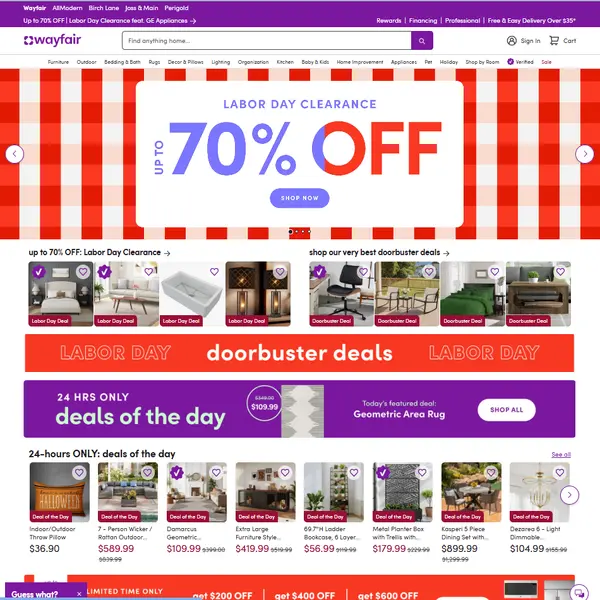
Wayfair scraping runs here as a managed service. You name the categories, the storefronts, the postcodes and the fields; we build the crawler, run it and keep it working when the layout moves. Wayfair fronts its pages with a commercial bot-management layer that challenges automated traffic, so anti-bot handling, proxy rotation and CAPTCHA solving are part of what you buy rather than your problem. Nothing behind a login or a checkout is touched.
Delivery is CSV, JSON, XLSX, a hosted Wayfair API endpoint you poll, or a push to S3, SFTP, a database or a BI tool. Schedules run daily, weekly or on demand, with deduplication on SKU and changed prices flagged. A sample comes first, so you can check the columns against your schema.
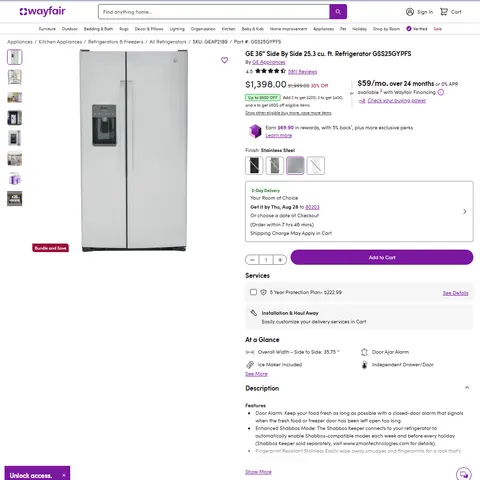
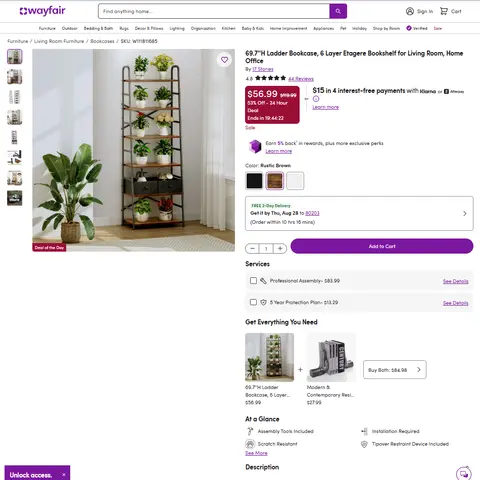
A Wayfair scraper reads the product page. These are the fields that sit on it.
The specification block is supplier-written and category-specific, so a rug listing and a dishwasher listing share almost no attribute names. Across a department, Wayfair product data lands as a wide, sparse table: we flatten the columns you name and keep the rest as raw key-value pairs.
The catalogue shape matters as much as the listings. Wayfair addresses browse pages in tiers: /cat/ for department and category, then sb0 for a plain category, sb1 for one applied facet and sb2 for two. Facets go into the address as ids - an attribute with its value, a price band with its bounds - so style, material, colour, size, shape, seat count, brand, sale status and in-stock-only are all addressable, and one attribute can carry two values. In early September 2026 the US site published roughly 338,000 product addresses, about 399,000 two-facet browse pages and roughly 461,000 saved keyword searches. Coverage comes from slicing the category and facet tree, not from paging deep.
One Wayfair habit shapes every matching job: the same physical item is often listed more than once - by a different supplier, under a different house brand, with a different title and its own SKU. The SKU is storefront-specific too: Wayfair-issued codes open with W in the United States, C in Canada, U in Britain and I in Ireland, while supplier-issued codes keep one fixed letter prefix everywhere. Matching across markets or across duplicates therefore needs title, brand, dimensions and images together, and each match carries a confidence score.
Reviewer names, profile links and review text stay out of the default output; we take the aggregate rating and the review count instead.
Wayfair sells furniture, rugs, lighting, decor, bedding, kitchenware, appliances, home improvement parts and outdoor goods. It is a retailer rather than a marketplace: suppliers ship the goods, but a listing names a brand, never a seller. Wayfair reported roughly 40 million products from more than 20,000 suppliers across its portfolio at the end of 2025.
Wayfair dates to 2002, runs out of Boston, and folded its roughly 200 niche shopping sites into one brand in 2011. Sister storefronts sit on their own domains - AllModern, Birch Lane, Joss & Main and the luxury tier Perigold - alongside Wayfair Professional for trade accounts. Inside wayfair.com sit hundreds of house brands: Wayfair Basics, Sand & Stable, Latitude Run, Red Barrel Studio, 17 Stories, Mercury Row and Wade Logan. Those are Wayfair name-plates on supplier goods, not manufacturers, so brand alone will not say who made an item.
Wayfair closed its German business in 2025 and currently trades in four markets: wayfair.com in dollars, wayfair.ca in Canadian dollars, wayfair.co.uk in pounds and wayfair.ie in euros. The catalogues are not copies of each other. The product sitemap on the US site runs to 677 files; Canada has 170, Britain 75 and Ireland 11.
Get a Quote
Developers

Customers worldwide

Pages extracted

Hours saved for our clients
€199 / one-time
setup fee - included
€169 / mo
setup fee €499
€229 / mo
setup fee €499
€349 / mo
setup fee €499
€549 / mo
setup fee €799
Delivery: CSV, JSON or XLSX files, our API or a JSON feed. MCP server on request.
Full plan details →Wayfair price data moves constantly, and it moves by location. The arrival window and the shipping promise are quoted against a ZIP or postal code, so a feed built from one location is a feed about that location. We set the location per run and stamp it on every row, which is what makes competitor price tracking on Wayfair comparable week to week.
What buyers do with it:
Ratings and review counts add a demand signal on top of the catalogue snapshot.

A cosmetics company got monthly prices and promotions from 40+ beauty stores in 15+ countries, translated to English and fed into its existing import.
Learn More
A consultancy working for a fragrance brand owner got sellers, official-store flags and USD prices for 25 fragrances on about 30 marketplaces in 12 countries.
Learn More
Three Amazon US lighting categories collected in full for a lighting manufacturer, with description text and images from brand content blocks.
Learn MoreLearn how to use web scraping to solve data problems for your organization
If you sell online, run a marketplace, or advise e-commerce clients, you already know why eBay matters: it’s one of the few places where big retailers compete side by side with thousands of small merchants and private sellers.

E-commerce teams do not just need “some” competitor data anymore. They need a continuous stream of real prices, discounts, stock levels, reviews, and seller behavior from the platforms that actually shape their markets.
Amazon provides valuable information gathered in one place: products, reviews, ratings, exclusive offers, news, etc. So scraping data from Amazon will help solve the problems of the time-consuming process of extracting data from e-commerce.
ScrapeIt is a managed web scraping agency. We write the crawlers, run them, watch them and hand back files - you get a named engineer, not a dashboard and a ticket queue. Before a Wayfair job starts we agree in writing which storefronts, categories and fields are in scope and which are dropped, so the deliverable is settled before the first run. Wayfair data can be merged with the other retailers we already collect.
Yes. The ScrapeIt Wayfair API returns SKU, title, current price, was price, discount percent, arrival window and star rating as JSON from an endpoint we host, refreshed on the schedule you set. The same Wayfair price data also comes as CSV or XLSX files or straight into your database.
Yes, and you should ask for it. Wayfair quotes the arrival window and the shipping promise against a location, so the same SKU can show a different delivery date depending on where the shopper is. We set the location per run, record it on every row, and can push the same list of SKUs through several locations so you see the spread instead of one sample.
Not on the SKU, because Wayfair issues a different one per storefront - W in the United States, C in Canada, U in Britain, I in Ireland. Supplier-issued SKUs keep the same letter prefix across markets and join cleanly. The rest we match on title, brand, dimensions, images and specification rows together, and every match carries a confidence score so your analysts can set their own threshold rather than inherit ours.
We return the star rating and the review count from each listing by default. Reviewer names, reviewer profiles and review text are personal data and stay out of scope unless you have a documented lawful basis and tell us what it is. Customer photos are not downloaded.
Daily suits price monitoring, weekly suits assortment work, and hourly is workable on a short SKU list. Bot management sets the practical ceiling on very large runs, so a full-department sweep is scheduled across hours rather than minutes. We tell you the achievable refresh rate for your list before you commit, and we stamp first-seen and last-seen on every record so your price history survives after a listing is pulled.
Step 1 - Make a Request
You share your needs, expectations, and desired timeframe. We’ll suggest the best solution based on your request and budget.
Step 2 - Configuring Custom Web Crawlers
Our specialists configure the crawlers and extract a sample dataset for your review before proceeding with the full-scale extraction.
Step 3 - Collect and Deliver
Once you approve the sample, we launch the project and start full data collection. We gather, filter, and structure the data for easy use, delivering it on time in your preferred format.
Step 4 - Maintain and Support
Our team manages ongoing processes, monitors website changes, and supports all data extraction cycles. We can also help integrate data into your systems or create dashboards to simplify analysis.
Wayfair data from €169/month. Free project assessment, reply within 1 business day.

Scrapeit Sp. z o.o.
10/208 Legionowa str., 15-099, Bialystok, Poland
NIP: 5423457175
REGON: 523384582