eBay Data: 1.9M Auto Parts Listings from eBay.de, Specs Translated
About 1.9 million auto parts listings from eBay.de with brand, OEM, EAN and fitment, plus titles and specs machine-translated for the client's team.
Learn More
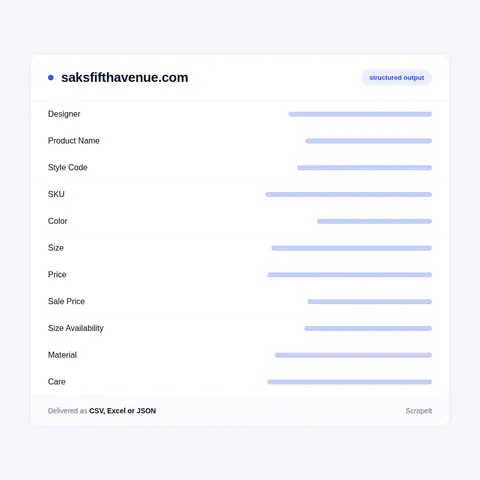
Saks Fifth Avenue puts the designer above the product name and prints a style code under every item, so one Balenciaga or Brunello Cucinelli run stays joinable season after season.
Plans from €169/month · Free project assessment · Reply within 1 business day

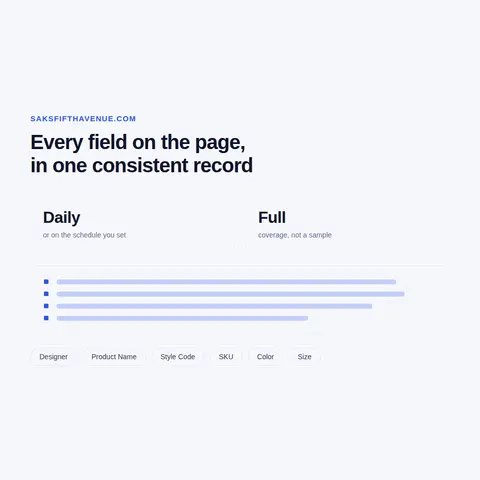
We build the Saks Fifth Avenue scraper, run it on your schedule and hand over the result. Output is CSV, JSON, XLSX or an API endpoint, with the schema agreed before the first run.
Luxury sites are defended, and this one is no exception, so anti-bot handling, proxy rotation and CAPTCHA solving are part of the service rather than something you arrange on the side.
Scope is normally a list of style codes, a set of designer boutiques, or a sweep of department grids. Every record is keyed on the style code, which keeps runs joinable when a slug or a product name is rewritten, and child rows are keyed on the SKU so size-level stock lines up over time. We work only with pages any shopper can open: nothing behind a login, and no customer names or other personal data.
The page separates the house from the item: the headline is the designer and links to that designer's boutique, while the product name sits beneath it as a subtitle. Price is a pair, a current price and a strikethrough price that stays empty at full price. The only schema.org block present is a BreadcrumbList, so price and stock have to be read from the page's own state rather than from product markup.
Ratings exist here as empty fields rather than content: the review module is off on product pages, so a Saks product feed carries no star average and no review text. Sold-out styles swap the buy button for a waitlist and unreleased ones for a pre-order, so both states deserve a column.
The corporate ground shifted twice in two years, and it changes what a crawl can see. Hudson's Bay, the owner of Saks, closed its purchase of Neiman Marcus Group in December 2024 for about $2.7 billion, backed by equity from Amazon, Salesforce, Authentic Brands Group and G-III, and folded the banners into Saks Global. That parent left Chapter 11 and renamed itself Exemplar Luxury Group roughly a year and a half later; saksglobal.com now redirects to exemplarluxurygroup.com, while the shop signs stay Saks Fifth Avenue, Neiman Marcus and Bergdorf Goodman.
The off-price half is gone. SaksOFF5TH.com no longer trades: the address serves a notice that the site is shutting down and sends shoppers to the stores that remain. Anyone who used to line a full-price style up against its outlet twin has no public web source for that comparison any more, and the markdown now happens on saksfifthavenue.com itself, which raises the value of watching this one site closely.
The sibling banners still publish their own catalogues at neimanmarcus.com and bergdorfgoodman.com, so overlap between three houses under one owner is now a question you can answer with numbers instead of guesswork. Saks also keeps a Barneys New York shop inside its own tree at /c/barneys-at-saks, with designer leaves of its own.
One practical point before a run: list and sale prices are wrapped in a currency-swap layer for international sessions, so a job that does not pin the United States view can quietly mix currencies into one column.
Saks Fifth Avenue sells full-price luxury at saksfifthavenue.com, and the older address saks.com now redirects there, so a single host carries the whole catalogue. Two rendering stacks share it: product pages come from a newer application that ships its own state inside the page, while listing pages are still served by the classic Salesforce Commerce Cloud storefront. A scrape of Saks Fifth Avenue therefore needs two parsers, not one.
Every product address takes the shape /product/{designer-slug}-{product-slug}-{style-code}.html. The trailing number is a thirteen-digit style code that currently opens with 0400, with a thin tail of older items carrying a bare eight-digit id instead, and the page prints that same value in its Details block under the label Style Code:. Colour rides in the query string as dwvar_{style-code}_color, so a style with four colourways answers on four addresses.
Designer is the first dimension of this catalogue, not a filter bolted on later. Each label gets its own boutique at /brand/{designer}, about 1,300 of them in mid-2026, with ready-made leaves at /brand/{designer}/sale and colour leaves such as /brand/{designer}/black. The same label reappears inside the department tree, as in /c/men/balenciaga/sale, so a crawl can treat Balenciaga either as a house or as a shelf.
Categories nest up to four segments under /c/, from /c/handbags/handbags/totes to /c/shoes/shoes/boots/booties, and breadcrumbs resolve to numeric category ids through /search?cgid=. Grids page with the start and sz parameters, and every facet value shows its own hit count, so the shape of an assortment can be counted without opening a single item.
Get a Quote
Developers

Customers worldwide

Pages extracted

Hours saved for our clients
€199 / one-time
setup fee - included
€169 / mo
setup fee €499
€229 / mo
setup fee €499
€349 / mo
setup fee €499
€549 / mo
setup fee €799
Delivery: CSV, JSON or XLSX files, our API or a JSON feed. MCP server on request.
Full plan details →Luxury does not discount on a smooth curve. A designer style holds full price for months, then drops in steps, and the useful number is the step rather than the average. Saks Fifth Avenue price data shows this plainly: a dress cut from $345 lands at $129.37, a figure with cents that only appears when a further percentage is laid on top of an already reduced price. Rebuilding that ladder, and dating each rung, is the whole of markdown tracking.
The second question is dispersion. The same house sells through several American retailers at once, and a style still at full price in one window is already cut in another. Because designer and product name are kept as separate fields here, matching a style across sites does not depend on anyone sharing an identifier.
Size availability is the demand signal fashion actually trades on. A style can look healthy while the middle of the size run has gone, and the page says so: each size carries its own buyable flag, and stock sits at SKU level rather than at style level. Watching which sizes empty first, and how quickly, separates a genuine seller from a listing that never moved.
Assortment analytics uses the facets. Each refinement on a designer boutique or a department grid reports its own hit count, so the shape of the buy - how many dresses, which price bands, which sizes - can be read cheaply and often. Brand protection teams run the same crawl to confirm where a label is carried, at what price, and under which promotion.
About 1.9 million auto parts listings from eBay.de with brand, OEM, EAN and fitment, plus titles and specs machine-translated for the client's team.
Learn More
A one-off Takealot product list for an entrepreneur choosing niches: only products rated 4 stars or higher with at least 50 reviews.
Learn More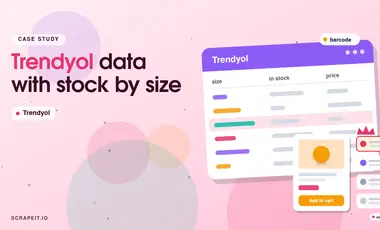
Trendyol product data for an e-commerce startup reselling Turkish fashion: 27 categories in JSON on FTP, with in-stock status for every size.
Learn MoreLearn how to use web scraping to solve data problems for your organization
If you sell online, run a marketplace, or advise e-commerce clients, you already know why eBay matters: it’s one of the few places where big retailers compete side by side with thousands of small merchants and private sellers.

E-commerce teams do not just need “some” competitor data anymore. They need a continuous stream of real prices, discounts, stock levels, reviews, and seller behavior from the platforms that actually shape their markets.
Amazon provides valuable information gathered in one place: products, reviews, ratings, exclusive offers, news, etc. So scraping data from Amazon will help solve the problems of the time-consuming process of extracting data from e-commerce.
ScrapeIt is a managed scraping agency. We write the crawlers, host them, watch them and repair them when a site changes, so what reaches you is data rather than code.
Saks Fifth Avenue moves both its page structure and its promotional calendar through the year, so the maintenance is the service. Tell us which fields you need and how often you need them, and we will confirm what is actually available before any work starts.
Yes. The ScrapeIt Saks Fifth Avenue API returns designer, style code, current and strikethrough price, size-level stock and final sale flags as JSON from an endpoint we host, refreshed on the schedule you set. The same data also comes as CSV or XLSX files or straight into your database.
The style code. It is a thirteen-digit number beginning 0400, it closes the product address, and the page prints it under Style Code in the Details block. The slug in front of it is cosmetic, so a renamed product still resolves. Each buyable size hangs off the style as its own SKU, an eight-digit number, and grid tiles carry a UPC slot as well. Key parent records on the style code and child rows on the SKU, and a Saks scrape stays joinable even after the merchandising team rewrites titles or moves a style between categories.
Price and size availability move fastest, and they move independently of each other. A designer style can hold one price for months and then step down twice inside a fortnight, while sizes empty continuously in between. Markdown activity clusters around the seasonal designer sale events, when the sale price often carries cents because a further percentage has been applied to an already reduced figure. Most clients take price and size availability daily, a designer sweep weekly, and a catalogue-wide pass monthly to catch new style codes and retirements.
CSV, JSON, XLSX, a database drop or an API endpoint, on a schedule you set. Coverage extends to neimanmarcus.com and bergdorfgoodman.com, which are separate sites under the same owner, so one designer can be compared across all three banners in a single table. SaksOFF5TH.com is not an option any more: the outlet site has stopped trading and now serves a shutdown notice, and the stores that remain publish no catalogue of their own.
Yes. We collect only publicly available data - the product, designer and category pages any visitor can open on Saks Fifth Avenue without an account - and we collect it legally. We do not sign in, and we stay out of cart and checkout. Personal data is out of scope by default, and in this case there is little to argue about anyway, because Saks does not publish customer reviews on its product pages.
Step 1 - Make a Request
You share your needs, expectations, and desired timeframe. We’ll suggest the best solution based on your request and budget.
Step 2 - Configuring Custom Web Crawlers
Our specialists configure the crawlers and extract a sample dataset for your review before proceeding with the full-scale extraction.
Step 3 - Collect and Deliver
Once you approve the sample, we launch the project and start full data collection. We gather, filter, and structure the data for easy use, delivering it on time in your preferred format.
Step 4 - Maintain and Support
Our team manages ongoing processes, monitors website changes, and supports all data extraction cycles. We can also help integrate data into your systems or create dashboards to simplify analysis.
Saks Fifth Avenue data from €169/month. Free project assessment, reply within 1 business day.

Scrapeit Sp. z o.o.
10/208 Legionowa str., 15-099, Bialystok, Poland
KRS: 0000996672
NIP: 5423457175
REGON: 523384582