Flight Pricing at Scale: Opodo Scraped with Full Filter Logic
Automated scraping of filtered flight ticket data from Opodo.com, including complex on-page interactions for airline and pricing selection.
Learn More
Expedia sells the booking, so the price on the page is a selling price tied to a date, a currency and a point of sale. We collect it that way and hand you the file.
Plans from €169/month · Free project assessment · Reply within 1 business day
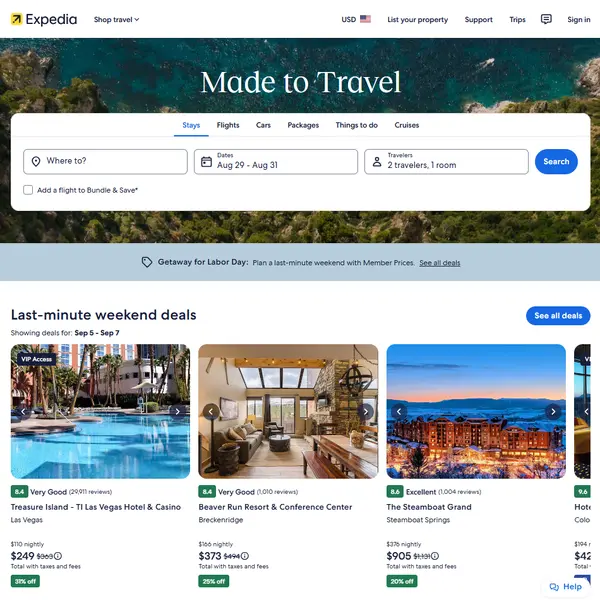
You tell us the destinations, stay windows, points of sale and cadence. We build the crawler, run it and send a sample for review before any full job starts. Once you sign off, it goes on schedule and we maintain it - Expedia changes markup and result layout, and keeping up with that is our work, not yours.
Output is CSV, JSON or XLSX, or an API endpoint your systems call. Delivery goes wherever you want it: email, S3, SFTP or a webhook. Frequency runs from a single pull to several times a day. A paid Expedia data sample costs 9.99 EUR if you want to see the shape of the file first.
Scope is agreed in writing before anything runs. These are the fields an Expedia scraper can reach on public pages, grouped the way the site itself groups them.
That last group is not padding. A rate without its point of sale, its stay dates and its capture time is a number with no meaning, and it is the first thing missing from most datasets we are asked to repair. Collection covers public rate and listing data only, with no traveller or booking data of any kind.
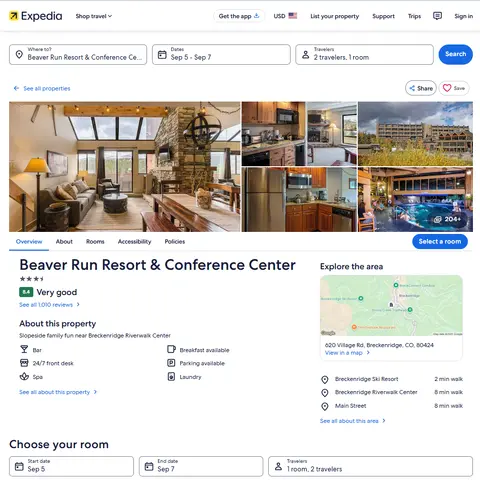
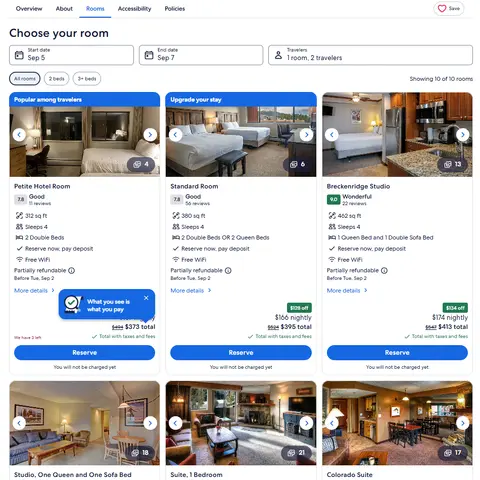
Expedia runs the One Key programme, and part of its rate inventory is member pricing, presented in tiers and shown to signed-in members. A signed-out visitor does not see those rates. We do not log in and we do not collect anything behind an account, so a public crawl records the public price and nothing else. If your comparison depends on the member rate, a public crawl is the wrong instrument and we will tell you that before you buy rather than after.
Dated search is where the public rates live. A hotel rate exists only against a check-in and check-out pair, a fare against a route and a date, a car against a location and rental window. We collect those results for the date grid you set, per storefront: nightly figure and stay total, taxes and fees, room and board terms, refundability, cancellation deadline and sold-out signals.
The defences are live. Expedia turns automated requests away on property pages, hotel search URLs and country home pages alike, so pacing, proxy rotation and CAPTCHA handling come before any parsing, and that handling is our part of the work. We pace collection rather than hammering a booking engine, and we would rather run a narrower job slowly than put load on a live checkout path.
Expedia takes the booking itself. A traveller picks a hotel, a flight, a car or a bundle of them and pays on expedia.com, so the figure on the page is a price Expedia is prepared to sell at on that day, in that currency, to that visitor. The last part of that sentence is where most Expedia scraping projects quietly go wrong.
The site carries several inventory types that behave differently. Hotel results are dated: a rate exists only against a check-in and check-out pair, so a property has no single standing price you can look up. Flight results are itinerary-level, priced per passenger against a route and a date. Cars and activities follow their own supply. Packages combine flight and hotel into one total, and Expedia promotes them heavily.
Expedia Group runs the same machinery under several names. Hotels.com, Vrbo, Orbitz, Travelocity and ebookers run on the same platform machinery and share its URL paths, down to paths for products a brand does not sell - Vrbo carries flight and cruise paths even though it lists whole homes. One platform, several storefronts. A buyer who says Expedia sometimes means the brand and sometimes means the group, and the two scopes produce different datasets.
Point of sale is the other structural fact. Each storefront carries its own pricing, language and currency rules. expedia.de, expedia.fr and expedia.co.uk are separate storefronts, and the same property can be quoted differently across them.
Get a Quote
Developers

Customers worldwide

Pages extracted

Hours saved for our clients
€199 / one-time
setup fee - included
€169 / mo
setup fee €499
€229 / mo
setup fee €499
€349 / mo
setup fee €499
€549 / mo
setup fee €799
The most common defect in an Expedia dataset is a mixed price series. A bundled component price is not the standalone price. When a hotel appears inside a flight-plus-hotel result the traveller sees a bundle total, and the parts are not broken out the way they are on a standalone search. Package inventory is frequently sold on terms that hold only inside the bundle. Write those rows into the same column as standalone nightly rates and the series is corrupted: it shows phantom drops on whichever dates packages happened to be sampled, and a downstream model reads them as real demand. We keep package rows in a separate, tagged stream and never fold them into a standalone rate history.
Past that, the reasons to scrape Expedia data are ordinary and measurable. Hotels and groups check how their own inventory is presented against their competitive set - which rate plan surfaces first, whether the refundable option is visible, where they rank on a dated search. Revenue teams watch how an Expedia price moves as the arrival date approaches, because the same room on the same night is priced differently ninety days out than it is at seven. Analysts track supply and seasonality across a city. Distribution teams verify that the rate loaded into a channel is the rate a traveller actually sees.
None of that works from one snapshot. We repeat the same queries with the same parameters on a fixed cadence and let the series build.
Automated scraping of filtered flight ticket data from Opodo.com, including complex on-page interactions for airline and pricing selection.
Learn More
Daily scraping of Booking.com services - hotels, flights, car rentals, and attractions - with best-price selection across global destinations.
Learn MoreLearn how to use web scraping to solve data problems for your organization

If you work in travel tech, an OTA, a hotel chain, or at an airport, you are in a price-and-availability arms race. Fares change by the hour, room inventory disappears in minutes, and competitors test new bundles and ancillaries constantly.

Leveraging advances in technology, the AI-powered web scraper has skyrocketed in demand and is helping to expand capabilities by automating tedious daily tasks and speeding up data collection from thousands of websites several times over.
Web scraping is a method of obtaining web data by extracting it from pages of web resources with the help of a program, that is, in automatic mode. It is used to syntactically convert web pages into more usable forms.
ScrapeIt is a managed extraction company. You are not buying a library or a proxy pool to operate. We build the crawler, run it, watch it and hand over finished files. Travel is a large part of our work: we already run a daily Booking.com pipeline covering hotels, flights, cars and attractions, and a filtered flight extraction on Opodo with the on-page airline and price selection handled in the crawler.
Tell us which Expedia searches matter and how often. We reply within one business day.
Yes. The ScrapeIt Expedia scraper API returns hotel rates by stay date with taxes and fees, room and rate attributes, flights, cars and package totals, each tagged with its point of sale, as JSON from an endpoint we host, refreshed on the schedule you set. The same data also comes as CSV or XLSX files or straight into your database.
No, and treat any vendor who says yes with suspicion. We run scheduled crawls - hourly, daily or several times a day - and stamp every row with the moment it was captured. That is a time series, not a live feed. Because an Expedia price is dated inventory that moves against the arrival date, a timestamped series is the more useful artefact anyway. An earlier version of this page described real-time capture from a product page; that was overstated, and this page corrects it.
No. One Key member prices are shown to signed-in members, and reaching them would mean operating an account. We do not log in and we do not collect anything behind authentication. What you receive is the public price a signed-out visitor sees, which is the correct basis for public rate benchmarking and the wrong basis for modelling member discounts. Where a member-price label is visible on a public page, we record the label as an attribute without the rate behind it.
Not automatically, and this matters at the scoping stage. Hotels.com, Vrbo, Orbitz and Travelocity are Expedia Group brands running on shared platform machinery. Lodging supply overlaps heavily, but the storefronts price, rank and label independently, and Vrbo's inventory is whole homes rather than hotel rooms. If you need cross-brand comparison we crawl each brand as its own source and key them together on property identity where they overlap. Scoping Expedia as one brand and scoping it as the group are two different jobs with two different price tags.
CSV, JSON, XLSX or an API endpoint, whichever suits your stack. Timing depends on volume and how many points of sale you want covered, but the sequence is fixed: agree scope, receive a sample for approval, then run the full job on your schedule. A paid Expedia data sample is available for 9.99 EUR before you commit to a plan, and we reply to quote requests within one business day.
Step 1 - Make a Request
You share your needs, expectations, and desired timeframe. We’ll suggest the best solution based on your request and budget.
Step 2 - Configuring Custom Web Crawlers
Our specialists configure the crawlers and extract a sample dataset for your review before proceeding with the full-scale extraction.
Step 3 - Collect and Deliver
Once you approve the sample, we launch the project and start full data collection. We gather, filter, and structure the data for easy use, delivering it on time in your preferred format.
Step 4 - Maintain and Support
Our team manages ongoing processes, monitors website changes, and supports all data extraction cycles. We can also help integrate data into your systems or create dashboards to simplify analysis.

Scrapeit Sp. z o.o.
10/208 Legionowa str., 15-099, Bialystok, Poland
NIP: 5423457175
REGON: 523384582