Charter Flight Data from 12 Danish Tour Operators: a Pilot in 2 Weeks
A paid pilot for a regional airport in Scandinavia: direct charter departures from 12 Danish tour operator sites, sampled in two weeks.
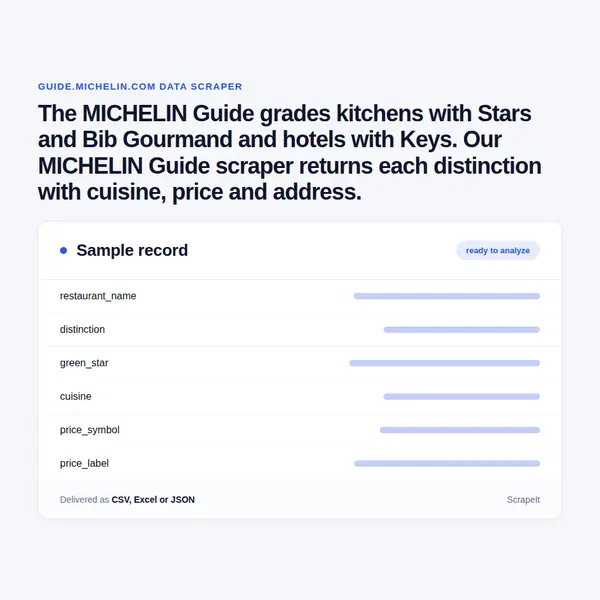
The MICHELIN Guide grades kitchens with Stars and Bib Gourmand and hotels with Keys. Our MICHELIN Guide scraper returns each distinction with cuisine, price and address.
Plans from €169 a month · Free project assessment · Reply within 1 business day
CSV · Excel · JSON · XML · FTP · SFTP · Amazon S3 · Google Cloud
API, JSON feed or CSV, XLSX and JSON files
ScheduleOne-time, monthly, weekly, daily or 3 times a day
MICHELIN Guide pages, filters, fields and a schedule
Built, monitored and repaired by our team
API, JSON feed or CSV, XLSX and JSON files
You choose the territory - one city, one country edition or the whole selection - and the layers you want: restaurants, hotels or both. We build the crawler, run it on the schedule you set and repair it when guide.michelin.com changes its pages; there is nothing to install. The guide builds much of each page with scripts and guards it against automated traffic, so rendering, pacing, proxy rotation and CAPTCHA handling come with the service.
Rows arrive as CSV, Excel, JSON or JSONLines, or in Amazon S3 or Google Cloud Storage, together with a field guide. A free project assessment comes first, then a sample from the city you name.
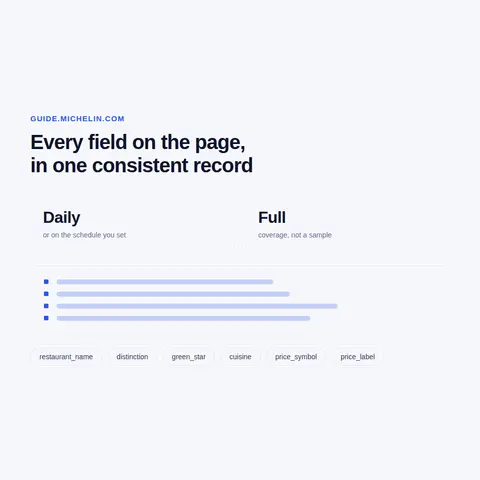
A MICHELIN Guide restaurant address reads like its breadcrumb: territory and language, region, city, then /restaurant/ and a slug, as in /us/en/new-york-state/new-york/restaurant/le-bernardin. We keep that path as the row key and read the page into these groups:
Labels come in the language of the edition you collect, so we store each distinction as a code next to its wording: a French row reading 2 Étoiles and an English row reading 2 Stars join on the same value.
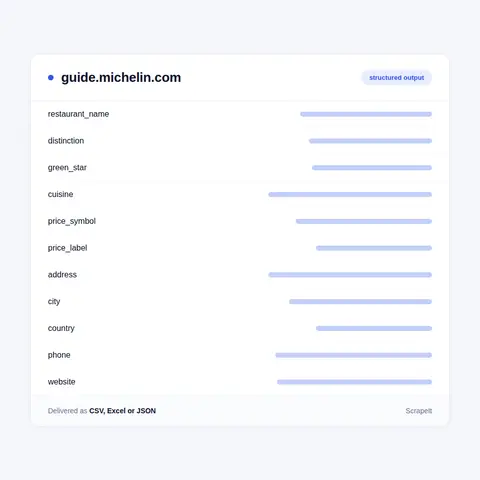
Hotels hold a distinction of their own, the MICHELIN Key, and their pages sit under /hotels-stays/ with a city and a slug ending in a numeric id, also reachable as /h/ plus that id. A hotel row holds the One, Two or Three Keys level with its gloss (Three MICHELIN Keys reads An extraordinary stay), neighborhood, atmosphere, number of rooms, address, check-in and check-out times, the amenities list, the Need to Know notes on children, pets, breakfast and deposits, and the restaurant inside the hotel with its own distinction. A guest score out of 20 is split into Rooms, Services, Cleanliness, Public Spaces and Overall Experience. Room rates depend on dates, so they come from a date search that books nothing.
Above the single page sit the list views, and every facet there is a field: distinction, Good for tags such as Chef's Table, Date night, Eat like a local or Worth Queueing For, cuisine, special diets, price, days open, lunch or dinner, Book Online and facilities. Repeat runs keep the history the guide itself does not show: which addresses appear among the newly added restaurants, and how distinctions move when each edition is announced.
The MICHELIN Guide started as a free handbook meant to get motorists on the road, and in 1926 it began awarding Stars to fine dining, at first a single Star. Today guide.michelin.com is the guide itself: restaurants, hotels, travel guides, best-of guides and a magazine, with table and room booking built in.
The site is organised by territory, language and currency, set in its display settings - Global - English - USD or France - Français - EUR. Country editions have their own paths, such as /us/en/, /fr/fr/ or /pl/en/, and translate the labels, while the selection underneath is shared: the Saint James Paris hotel page is linked under /pl/en/ as well. Price symbols follow the restaurant's country, so Arpège in Paris shows four euro signs and Le Bernardin in New York four dollars.
The restaurant selection has five levels, from Selected Restaurants through Bib Gourmand to one, two and three Stars, and the Green Star runs across them for sustainable practice. For a buyer of the data the useful split is simple: Stars and Bib Gourmand describe the cooking, the price symbols the bill, the facets the occasion, and the Keys the place to sleep nearby.
Delivery: CSV, JSON or XLSX files, our API or a JSON feed. MCP server on request.
Full plan detailsThe guide is a curated selection, not an open directory, and that is its value: every address on it has been chosen by an inspector.
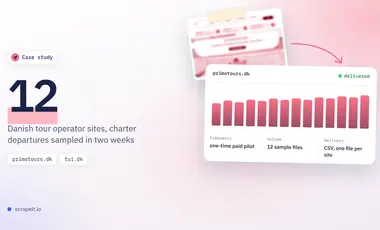
A paid pilot for a regional airport in Scandinavia: direct charter departures from 12 Danish tour operator sites, sampled in two weeks.
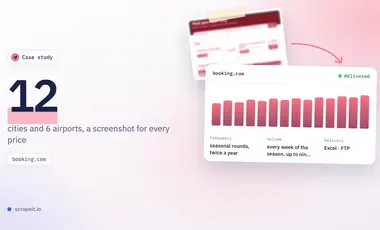
For several years, weekly car rental and, more recently, hotel prices from Booking.com for a tourism organization comparing its destination with rivals.
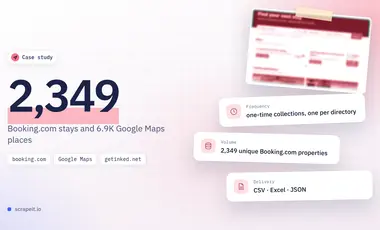
Four datasets for a studio that builds directory websites: Hawaii stays from Booking.com, UK schools and tattoo studios from Google Maps, GetInked profiles.
Learn how to use web scraping to solve data problems for your organization
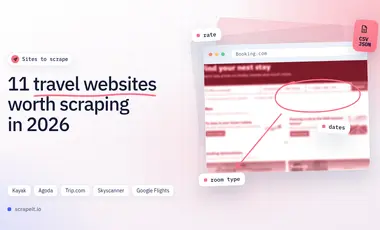
If you work in travel tech, an OTA, a hotel chain, or at an airport, you are in a price-and-availability arms race. Fares change by the hour, room inventory disappears in minutes, and competitors test new bundles and ancillaries constantly.
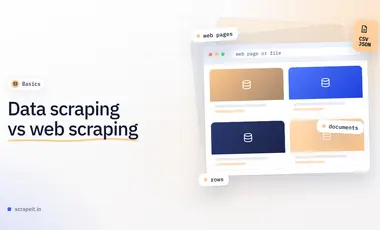
Data scraping is the wide term that includes documents, scans and old screens; web scraping is the part that works on websites. We compare sources, daily work, output and cost drivers, give a briefing checklist and walk through two of our projects.
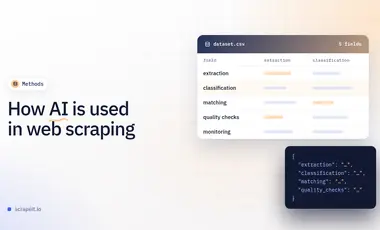
Leveraging advances in technology, the AI-powered web scraper has skyrocketed in demand and is helping to expand capabilities by automating tedious daily tasks and speeding up data collection from thousands of websites several times over.

ScrapeIt runs managed data collection for travel, hospitality and dining sites: we build the crawler, keep it running and deliver the dataset with a description of every field. For a curated guide the work is mostly about editions, distinctions and change over time, and our runs are set up to track exactly that. Ask for a free project assessment and a sample covering the city you care about. Plans start from EUR 169 a month, or EUR 199 for a one-time extract.
Still unsure? Write to info@scrapeit.io
Yes. The ScrapeIt MICHELIN Guide API returns restaurant name, distinction, cuisine, price symbol, address and opening hours as JSON from an endpoint we host, updated on the schedule you choose. The same records can also come as CSV or Excel files, or land in Google Drive, Dropbox or your own database.
Yes. Distinctions, inspector descriptions, addresses, opening hours and hotel details sit on open pages anyone can read. We collect only publicly available data - everything a visitor can see on the MICHELIN Guide - and we collect it legally. Chefs appear only as part of a restaurant record, never as a list of people.
It is the guide's own scale of one to four currency symbols: On a budget, A moderate spend, Special occasion and Spare no expense. The symbol follows the restaurant's country, euros for Arpège and dollars for Le Bernardin, so we deliver the symbol count, its label and the currency as separate columns.
Yes. Hotel pages give the One, Two or Three Keys level, neighborhood, atmosphere, room count, address, check-in and check-out times, amenities, the guest score and the restaurant on site. Rates depend on travel dates, so they come from a date search we run without booking anything.
Distinctions change when each country edition is announced, while newly added restaurants appear between editions in the guide's list of new additions. A monthly run catches the additions, and a run straight after an announcement records the new and lost Stars. Opening hours and facilities shift quietly, so weekly runs suit a sales or CRM feed.
You share your needs, expectations, and desired timeframe. We'll suggest the best solution based on your request and budget.
Our specialists configure the crawlers and extract a sample dataset for your review before proceeding with the full-scale extraction.
Once you approve the sample, we launch the project and start full data collection. We gather, filter, and structure the data for easy use, delivering it on time in your preferred format.
Our team manages ongoing processes, monitors website changes, and supports all data extraction cycles. We can also help integrate data into your systems or create dashboards to simplify analysis.
Tell us which sites, which fields and how often. A couple of lines is enough to start.
MICHELIN Guide data from €169/month. Free project assessment, reply within 1 business day.