Flight Pricing at Scale: Opodo Scraped with Full Filter Logic
Automated scraping of filtered flight ticket data from Opodo.com, including complex on-page interactions for airline and pricing selection.
Learn More
Kayak is metasearch. It holds no inventory and shows quotes supplied by airlines, agencies and hotel providers, so every Kayak price we extract is dated and attributed to its seller.
We build the crawler, run it, watch it, and repair it when Kayak changes. You receive data, not code. Output arrives as CSV, JSON, XLSX or through an API, on the schedule the question needs: hourly for a short pricing window, daily for a fare curve, weekly for a market survey. Every row carries its full query key and its observation timestamp, so successive deliveries stack into a clean series with no reconciliation work at your end. We agree the route list, the date ladder, the cabins, the currencies and the points of sale before collection starts, then hold them fixed so the numbers stay comparable. A paid data sample is available before any larger commitment.
A fare quote means nothing without its full key attached. We store every part of that key, because a stored price missing any part of it cannot be compared with anything - not with last week, not with a competitor, not with the same itinerary on another country site.
Fields a provider does not return are recorded as empty rather than filled in. We do not infer a baggage allowance, a fare brand or an operating carrier that Kayak did not show.
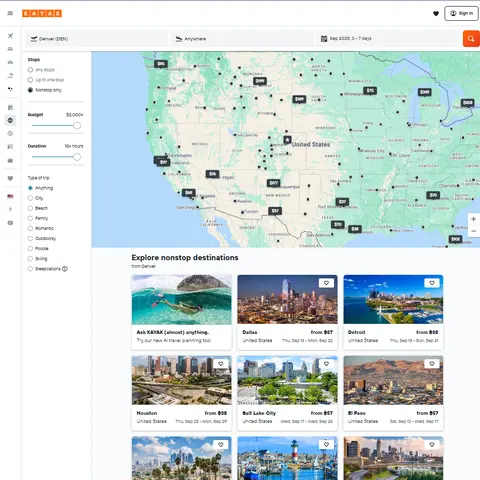
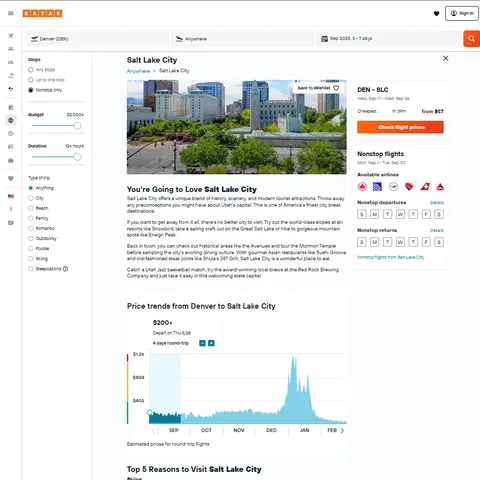
A Kayak search is addressable by URL. A request for /flights/LON-NYC/2026-11-10/2026-11-17/business/2adults returns a results page, so origin, destination, both dates, cabin and passenger count all sit in the path. The response ran to roughly 1.3 MB and contained no fare figures at all. It is a shell.
The prices arrive afterwards. That document named the endpoints the page polls, with separate poll paths for flights, hotels and cars, and a mode string of basicAndPolling. It also carried a metadata block flagged as required for the poll, so the poll is gated on a value handed down by the first response. A collector that only fetches and parses the page gets no prices.
That design is why the same query repeated twenty minutes later can return a different set. Suppliers do not answer identically every time. We treat each pass as a dated observation and never overwrite an earlier one. Reproducibility comes from repeating the query on a fixed schedule, not from expecting a URL to hold still.
Kayak is defensive, reasonably so: every search it serves costs it real supplier calls. Its robots.txt runs to 23 user-agent blocks and, for the default agent, permits the bare /flights/ front door while disallowing the search paths beneath it. We pace collection to a low, steady rate across an agreed grid rather than hammering the search endpoint, and make no attempt to defeat any protection. Collection covers public fare and listing data only, and no traveller or booking data is touched.
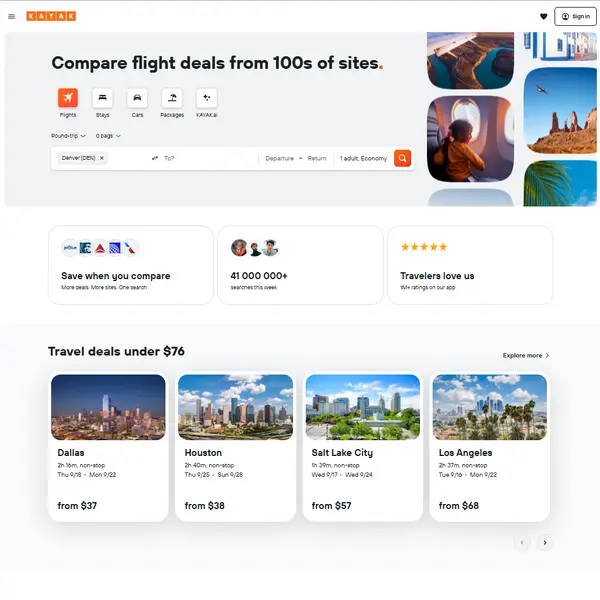
Kayak is a metasearch engine owned by Booking Holdings. It holds no inventory of its own. When a traveller runs a search, Kayak passes that query out to airlines, online agencies and hotel providers, collects what they answer with, and displays the quotes side by side. Its own help pages state plainly that Kayak is not a travel agent, does not sell flight tickets or make reservations, and is not involved in the payment. Selecting a result sends the traveller off the site to the provider that supplied it.
That single structural fact governs everything about Kayak data. A Kayak price is not a price Kayak sets. It is a quote from a named provider, valid at the moment it was returned, for one exact query. Kayak itself warns that a price shown on the site may already be gone by the time the traveller clicks through. Anyone who treats a stored Kayak fare as a fixed catalogue price will draw the wrong conclusion from it.
Kayak also runs many national sites, and point of sale is part of the question rather than a display preference. We requested the same flight path from kayak.com, kayak.co.uk, kayak.de and kayak.fr on 4 September 2026 and all four answered, with the document language changing from en-us to en-gb to de-de. The site selector inside the page we were served listed 59 country codes and 43 currency codes.
Get a Quote
Developers

Customers worldwide

Pages extracted

Hours saved for our clients
€199 / one-time
setup fee - included
€169 / mo
setup fee €499
€229 / mo
setup fee €499
€349 / mo
setup fee €499
€549 / mo
setup fee €799
Kayak is the point where many sellers quote the same itinerary at the same instant. That is the reason to scrape Kayak rather than one airline or one agency. A row from an airline site tells you what that airline charges. A row from Kayak tells you what the market answered, and who answered it.
Revenue teams use that to watch a competitor route against departure date, which is the shape airline pricing actually has: a curve that moves as seats sell and as the departure date closes in. Distribution teams use it to check whether their own inventory appears at all on a given point of sale, at what price, and through which reseller. Analysts use it for route entry and exit, because a carrier appearing on a city pair for the first time shows up in metasearch before it appears in any published commentary. Hotel and car operators run the same method to see how their property or fleet is quoted beside the alternatives a traveller is actually shown.
None of that works from a single snapshot. The value sits in a repeated series with an unchanged query key, so that a change in the number is a change in the market and not a change in the question.

Automated scraping of filtered flight ticket data from Opodo.com, including complex on-page interactions for airline and pricing selection.
Learn More
Daily scraping of Booking.com services - hotels, flights, car rentals, and attractions - with best-price selection across global destinations.
Learn MoreLearn how to use web scraping to solve data problems for your organization

If you work in travel tech, an OTA, a hotel chain, or at an airport, you are in a price-and-availability arms race. Fares change by the hour, room inventory disappears in minutes, and competitors test new bundles and ancillaries constantly.

Leveraging advances in technology, the AI-powered web scraper has skyrocketed in demand and is helping to expand capabilities by automating tedious daily tasks and speeding up data collection from thousands of websites several times over.

Web scraping is a method of obtaining web data by extracting it from pages of web resources with the help of a program, that is, in automatic mode. It is used to syntactically convert web pages into more usable forms.
ScrapeIt is a managed web scraping agency. We write the crawler, run it on your schedule, monitor it, and fix it when the target changes, which on a metasearch platform happens often. You get documented output in the format you asked for and a named contact who knows the project. There is nothing for your team to install and nothing to maintain. Tell us the routes, the dates, the cabins and the points of sale you care about, and we will tell you what is collectable and what is not before you commit.
There is no public, self-serve API. Kayak API access sits inside its affiliate and partner programme: a business applies, states the intended use, and access is granted case by case after review. The distinction matters more than the yes or no. Those terms exist for partners who send Kayak booking traffic, not for a company that wants a fare dataset to analyse. A data buyer will usually not qualify, and where access is granted the permitted use is set by the contract rather than by what the buyer wants to do with the numbers. Scraping public Kayak result pages is the practical route to a fare dataset, and it is the route we take.
Yes, and the shape of the request matters. A Kayak collection is a grid: route list, multiplied by a ladder of departure dates, multiplied by trip length, cabin, passenger count, currency and country site. Twenty routes across a sixty-day booking window on two cabins is already a few thousand searches per pass, and each pass has to be paced. We size that grid with you first, then quote against it. Narrowing the ladder, for example weekly rather than daily departure dates beyond ninety days out, usually costs little in signal and a great deal in load.
Because the results are not a stored page. Kayak polls its suppliers when the search runs, and the set that comes back depends on which suppliers answered, how fast, what they had left, and what their own caches were holding at that second. Seat availability moves. A provider drops out or joins. Kayak states in its own help material that a price shown may no longer be available by the time the traveller clicks through to book. This is why we timestamp every observation and never treat one pass as the true price of a route.
Slower than most buyers first assume. Each search we run makes Kayak call its suppliers, so the load is real rather than a page view. We agree a fixed grid and a fixed cadence, spread requests over the day, and keep the rate low and steady. We do not attempt to defeat protections or work around blocking. In practice that shapes the brief: a tight route list checked several times a day is straightforward, while a broad crawl of every city pair on every date is not something we will take on.
We cannot supply a back history. A fare quote only exists because somebody observed it at a moment in time, and no archive of past Kayak observations exists for us to draw on. The series starts on the day collection starts, which is a good reason to begin before the season you want to analyse rather than after it. Delivery is CSV, JSON, XLSX or an API endpoint, whichever suits your pipeline, with a documented schema and one row per provider quote per observation.
Step 1 - Make a Request
You share your needs, expectations, and desired timeframe. We’ll suggest the best solution based on your request and budget.
Step 2 - Configuring Custom Web Crawlers
Our specialists configure the crawlers and extract a sample dataset for your review before proceeding with the full-scale extraction.
Step 3 - Collect and Deliver
Once you approve the sample, we launch the project and start full data collection. We gather, filter, and structure the data for easy use, delivering it on time in your preferred format.
Step 4 - Maintain and Support
Our team manages ongoing processes, monitors website changes, and supports all data extraction cycles. We can also help integrate data into your systems or create dashboards to simplify analysis.

Scrapeit Sp. z o.o.
10/208 Legionowa str., 15-099, Bialystok, Poland
NIP: 5423457175
REGON: 523384582