Charter Flight Data from 12 Danish Tour Operators: a Pilot in 2 Weeks
A paid pilot for a regional airport in Scandinavia: direct charter departures from 12 Danish tour operator sites, sampled in two weeks.
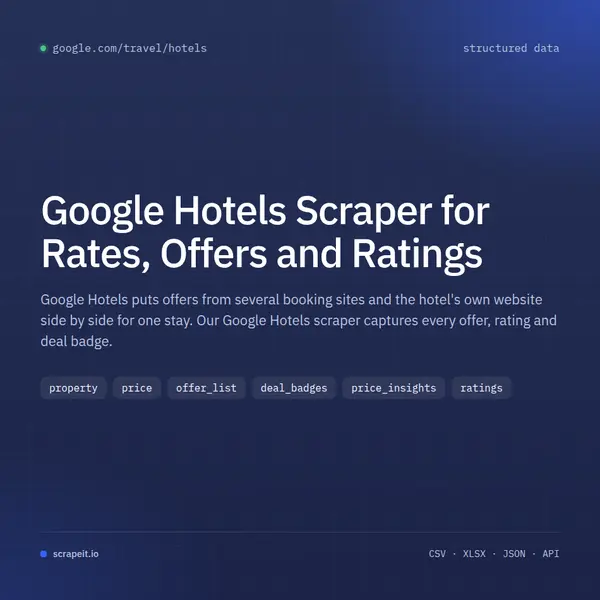
Google Hotels puts offers from several booking sites and the hotel's own website side by side for one stay. Our Google Hotels scraper captures every offer, rating and deal badge.
Plans from €169 a month · Free project assessment · Reply within 1 business day
CSV · Excel · JSON · XML · FTP · SFTP · Amazon S3 · Google Cloud
API, JSON feed or CSV, XLSX and JSON files
ScheduleOne-time, monthly, weekly, daily or 3 times a day
Google Hotels pages, filters, fields and a schedule
Built, monitored and repaired by our team
API, JSON feed or CSV, XLSX and JSON files
You name the destinations - cities, neighborhoods, a map area or a list of properties - together with the stay dates or a rolling window of check-in dates, the number of guests and the market and currency to price in. We write the crawlers, run them once or on your schedule and keep them working whenever Google reshapes the results list or the hotel page. Proxy rotation in the right country, pacing, CAPTCHA handling and browser rendering are included.
A rate is never separated from the dates, guests and currency it was quoted for: each capture records that search. Field documentation travels with the dataset, the assessment of your project is free, and a sample for your own city can be ordered before the first scheduled run.
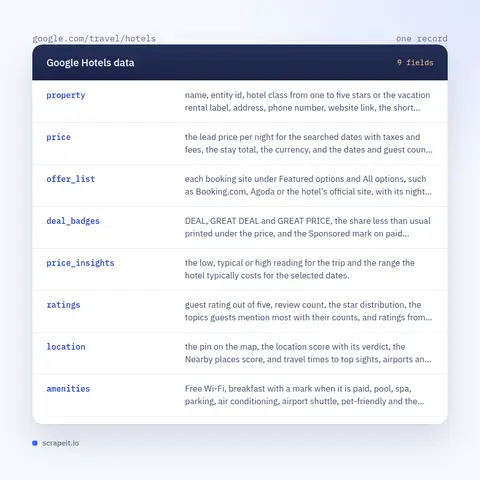
Google Hotels shows each property twice: as a card in the results and as a hotel page with Overview, Prices, Reviews, Location, About and Photos tabs. We read both and join them on the entity id in the hotel page address.
Badges and price readings are kept exactly as captured, so a GREAT DEAL row can later be checked against the offers that earned it.
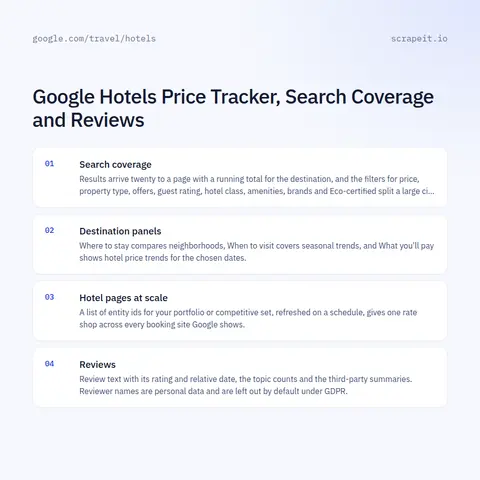
Signed-in visitors can keep a list of Tracked hotel prices; we build the price tracker from repeated runs instead. The same hotels and stay dates are captured daily or weekly and every offer keeps its booking site, so the price history shows not only the lowest rate but which site held it and when the gap between sites opened.
Google Hotels is the accommodation search inside Google's travel pages, next to Flights, Vacation rentals and Explore, and a "hotels in" query on Google can open the same search in a unit with a map. It works as a price comparison layer rather than a booking site: prices come from Google's partners - hotel owners and online travel agencies - and choosing an offer sends the visitor to that partner to book.
Results default to relevance, built from location, price and ratings, and can be re-sorted by lowest price or highest rating. Paid booking links are grouped as Featured options above the rest. Deal and Great Deal labels mark properties priced well below similar hotels nearby, Great Price marks one of the cheapest options in its category, and partners are expected to include taxes and fees in what they show.
Hotel class runs from one to five stars, taken from official ratings where they exist and from other sources Google gathers where they do not. The review summary counts only reviews written on Google, while ratings from third-party travel sites appear beside it, and the Eco-certified badge marks hotels whose sustainability practices meet the standards of accredited organizations. Currency, language and location are set per visitor, and a rate belongs to that setting as much as to its dates.
Delivery: CSV, JSON or XLSX files, our API or a JSON feed. MCP server on request.
Full plan detailsHotel revenue managers scrape Google Hotels because it is where their direct rate and every agency's rate for the same stay appear side by side. One capture of a hotel page answers the parity question - whether Booking.com, Agoda or a smaller site undercuts the official website - and a daily capture shows how long the gap lasts.
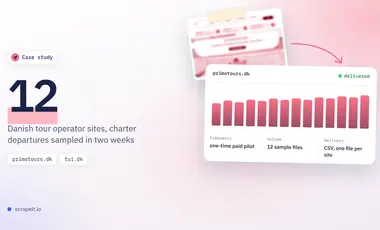
A paid pilot for a regional airport in Scandinavia: direct charter departures from 12 Danish tour operator sites, sampled in two weeks.
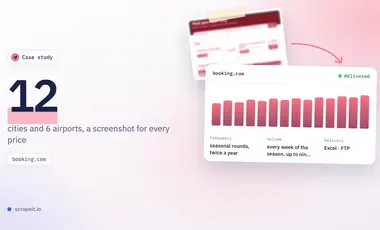
For several years, weekly car rental and, more recently, hotel prices from Booking.com for a tourism organization comparing its destination with rivals.
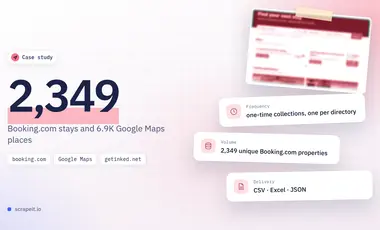
Four datasets for a studio that builds directory websites: Hawaii stays from Booking.com, UK schools and tattoo studios from Google Maps, GetInked profiles.
Learn how to use web scraping to solve data problems for your organization
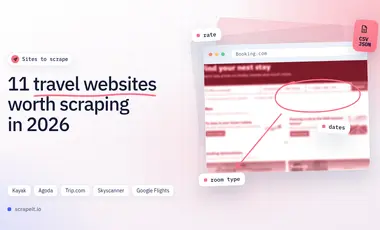
If you work in travel tech, an OTA, a hotel chain, or at an airport, you are in a price-and-availability arms race. Fares change by the hour, room inventory disappears in minutes, and competitors test new bundles and ancillaries constantly.
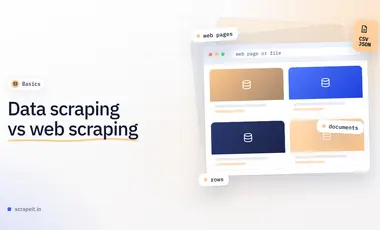
Data scraping is the wide term that includes documents, scans and old screens; web scraping is the part that works on websites. We compare sources, daily work, output and cost drivers, give a briefing checklist and walk through two of our projects.

Leveraging advances in technology, the AI-powered web scraper has skyrocketed in demand and is helping to expand capabilities by automating tedious daily tasks and speeding up data collection from thousands of websites several times over.

ScrapeIt runs web scraping as a managed service for teams that need data rather than tools: we write the crawlers, keep them running and deliver the files. Hotel comparison pages are a regular job - one property, many sellers, and rates that only mean something next to their dates, guests and currency. Plans start from EUR 169 a month, or EUR 199 for a one-time extract. We treat personal data under GDPR and do not build profiles of reviewers or guests.
Still unsure? Write to info@scrapeit.io
Yes. The ScrapeIt Google Hotels API returns hotel name, hotel class, guest rating, nightly price, stay total and the booking site behind each offer as JSON from an endpoint we host, updated on your schedule. The same rows also arrive as CSV or Excel files, through a JSON feed or loaded into your database.
The guest rating and review count, the split by star, the review topics with their mention counts and the review text Google shows, plus ratings and review counts from other travel sites such as Tripadvisor and Trip.com. Reviewer names are left out by default as personal data.
Yes. Hotel cards, offer lists, ratings, amenities and location details are open to anyone who searches a destination. We collect only publicly available data - everything a visitor can see on Google Hotels - and we collect it legally. Account features such as Tracked hotel prices are not part of the dataset.
We repeat the same searches and hotel pages - same property list, check-in dates, guests and currency - daily or weekly and store every offer with its capture time. That gives a history per hotel, per booking site and per stay date, including the days a deal badge appeared or disappeared.
Yes. Vacation rentals appear in the same results under a VACATION RENTAL label with their own fields - property type, how many guests they sleep, bedrooms, bathrooms, beds and amenities such as a kitchen - and Vacation rentals also has its own search beside Hotels. We deliver them in a separate table or flagged in the same one.
You share your needs, expectations, and desired timeframe. We'll suggest the best solution based on your request and budget.
Our specialists configure the crawlers and extract a sample dataset for your review before proceeding with the full-scale extraction.
Once you approve the sample, we launch the project and start full data collection. We gather, filter, and structure the data for easy use, delivering it on time in your preferred format.
Our team manages ongoing processes, monitors website changes, and supports all data extraction cycles. We can also help integrate data into your systems or create dashboards to simplify analysis.
Tell us which sites, which fields and how often. A couple of lines is enough to start.
Google Hotels data from €169/month. Free project assessment, reply within 1 business day.