Flight Pricing at Scale: Opodo Scraped with Full Filter Logic
Automated scraping of filtered flight ticket data from Opodo.com, including complex on-page interactions for airline and pricing selection.
Learn More
trivago compares one hotel across a different set of booking sites on each country site. Our trivago scraper records the lowest price and the site count, market by market.
Plans from €169/month · Free project assessment · Reply within 1 business day
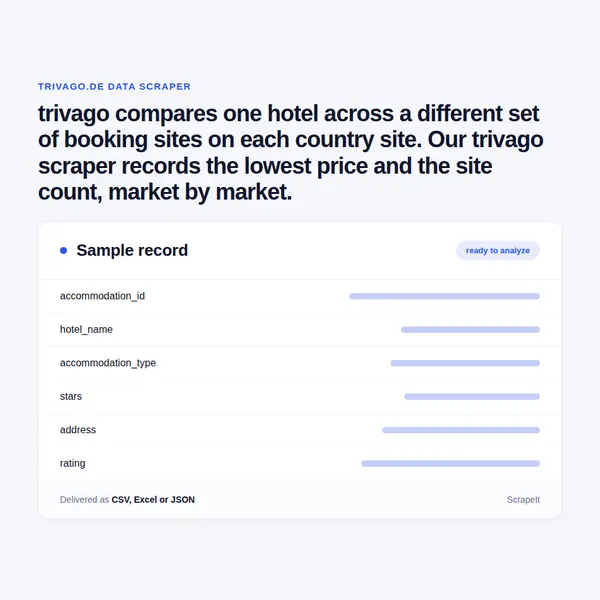
You choose the destinations or the hotels, the country sites, the stay dates and the party size; we return a table of what trivago showed for each combination. Building the crawler, running it and repairing it after a site change is our side of the work.
trivago refuses plain automated requests and assembles its result list in the browser, so anti-bot handling - rendering, pacing, proxy rotation, CAPTCHA handling - is included. A price on a metasearch means little without its context, which is why every row carries the country site, currency, check-in and check-out dates, guests and rooms, and the time it was read. We never sign in, so member-only prices are not in the dataset.
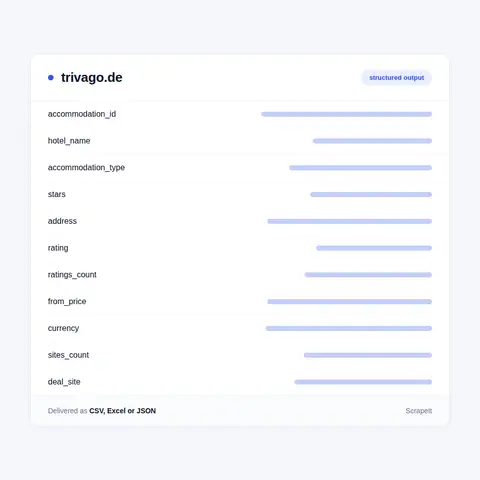
trivago identifies everything by number. A destination and a hotel each have an id in the search parameter of the address, and that id - not the words in front of it - decides what opens. Rows are keyed on it. From hotel listings and hotel pages we return:
A result list carries the same core fields as the hotel page, so a city can be covered from its list first and deepened hotel by hotel where rooms and amenities are needed.
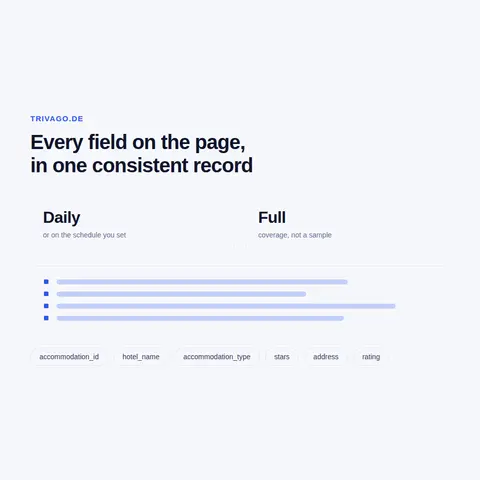
One search is one cell of a much larger grid, and the value is in the grid.
trivago is a hotel metasearch founded in 2005 in Düsseldorf, Germany, where trivago N.V. is still based. It sells no rooms. It compares prices from 100s of booking sites - online travel agencies such as Expedia or Hotels.com, hotel chains and the hotel's own website - and hands the traveller over to the site that holds the deal. Above each result list it links to a note on how payments from those sites affect ranking, so the order of a list is commercial information, not a neutral sort.
The brand runs more than fifty country sites, from trivago.de, trivago.co.uk and trivago.com to Japan, Brazil and an Arab World edition. Language and currency are set separately on each, and the address keeps the locale - /en-GB/ or /de/ - in front of the page type.
Two page types matter. A destination page lists the hotels of a city, region or landmark with filters and a map. A hotel page gathers prices, rooms, ratings, amenities and location for one property. Both are built for a search with dates: without them trivago shows From prices and the prompt Select dates.
Get a Quote
Developers

Customers worldwide

Pages extracted

Hours saved for our clients
€199 / one-time
setup fee - included
€169 / mo
setup fee €499
€229 / mo
setup fee €499
€349 / mo
setup fee €499
€549 / mo
setup fee €799
Delivery: CSV, JSON or XLSX files, our API or a JSON feed. MCP server on request.
Full plan details →A hotel sees its own rates and a booking site sees its own inventory. trivago is where they are laid side by side, and that view is what the data is bought for.
Automated scraping of filtered flight ticket data from Opodo.com, including complex on-page interactions for airline and pricing selection.
Learn More
Daily scraping of Booking.com services - hotels, flights, car rentals, and attractions - with best-price selection across global destinations.
Learn MoreLearn how to use web scraping to solve data problems for your organization

If you work in travel tech, an OTA, a hotel chain, or at an airport, you are in a price-and-availability arms race. Fares change by the hour, room inventory disappears in minutes, and competitors test new bundles and ancillaries constantly.

Leveraging advances in technology, the AI-powered web scraper has skyrocketed in demand and is helping to expand capabilities by automating tedious daily tasks and speeding up data collection from thousands of websites several times over.

Web scraping is a method of obtaining web data by extracting it from pages of web resources with the help of a program, that is, in automatic mode. It is used to syntactically convert web pages into more usable forms.
ScrapeIt collects web data as a managed service, from the first crawler to the delivered file. Travel prices are the least forgiving data we handle: a rate belongs to a date, a market and a moment, and it cannot be fetched again later. Crawlers for a price comparison are therefore planned around a calendar of searches, not a list of pages.
You get a free project assessment, a sample on order and field documentation with the dataset. Delivery is one-off or scheduled, by FTP, Google Drive, e-mail or as a load into your database.
Yes. The ScrapeIt trivago API returns hotel name, accommodation id, From price, currency, number of booking sites, rating and stay dates as JSON from an endpoint we host, refreshed on the schedule you set. The same data also comes as CSV or XLSX files, a JSON feed or straight into your database.
Yes. Result lists, hotel pages and the prices trivago compares are shown to every visitor without an account. We collect only publicly available data - everything a visitor can see on trivago - and we collect it legally. Member-only prices behind sign-in are not collected.
Constantly - trivago says so itself under its result lists, because the rates are supplied by booking sites. One read a day per hotel and arrival date is the usual starting point for rate parity and competitor pricing. In the last days before arrival, or around events, several runs a day catch moves a daily pass misses.
One row per hotel, stay date and country site: name, accommodation id, type, stars, address, distance to the centre, score and number of ratings, From price per night, currency, number of booking sites and badges. Hotel pages add rooms, amenities, category scores and the price trend calendar.
Any of them: trivago.de, trivago.co.uk, trivago.com and the other country sites in the selector. Each is read separately, because the booking sites compared, the currency and the distance units differ by market. Rows join on the accommodation id, which stays the same from one country site to the next.
Step 1 - Make a Request
You share your needs, expectations, and desired timeframe. We’ll suggest the best solution based on your request and budget.
Step 2 - Configuring Custom Web Crawlers
Our specialists configure the crawlers and extract a sample dataset for your review before proceeding with the full-scale extraction.
Step 3 - Collect and Deliver
Once you approve the sample, we launch the project and start full data collection. We gather, filter, and structure the data for easy use, delivering it on time in your preferred format.
Step 4 - Maintain and Support
Our team manages ongoing processes, monitors website changes, and supports all data extraction cycles. We can also help integrate data into your systems or create dashboards to simplify analysis.
trivago data from €169/month. Free project assessment, reply within 1 business day.

Scrapeit Sp. z o.o.
10/208 Legionowa str., 15-099, Bialystok, Poland
NIP: 5423457175
REGON: 523384582