Booking.com Data: 12 Cities, 6 Airports, a Screenshot for Every Price
Since 2022, weekly car rental and, from 2025, hotel prices from Booking.com for a tourism organization comparing its destination with rivals.
Learn More
Agoda opens on a base rate per night with taxes and service fees left out of it. Store that number as the price of the room and the whole series is wrong, so we keep all three price views apart.
Plans from €169/month · Free project assessment · Reply within 1 business day
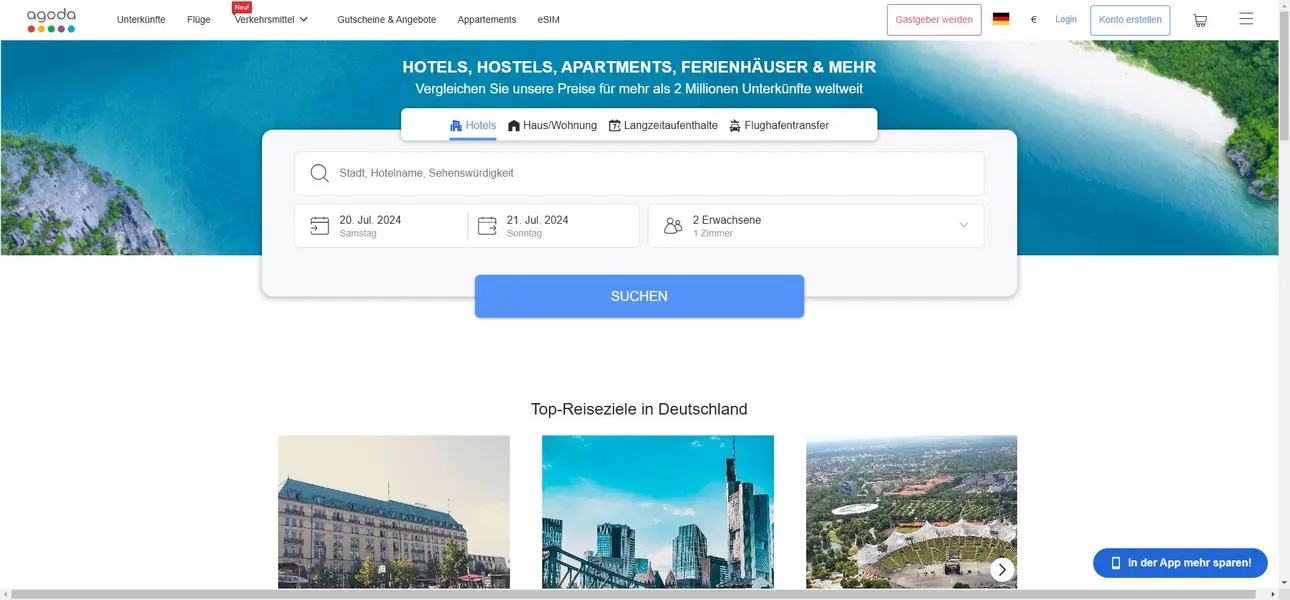
Name the cities or the compset, the arrival dates and lengths of stay, the occupancies, the currencies and the locales. We design the schema, build the crawler, run it, watch it and repair it when Agoda moves its markup, and you receive files rather than code. Output is CSV, JSON or XLSX, or an endpoint your systems call, delivered by email, S3, SFTP or webhook, from a single pull to several runs a day.
Anti-bot handling, proxy rotation and CAPTCHA solving sit on our side of the line, and you never build or maintain that layer. We pace collection instead of hammering a live booking engine, because every dated search costs the operator real work. Every row carries its full query key and its capture time, so deliveries stack into one series with nothing to reconcile at your end. A sample comes to you for approval before the full job starts.
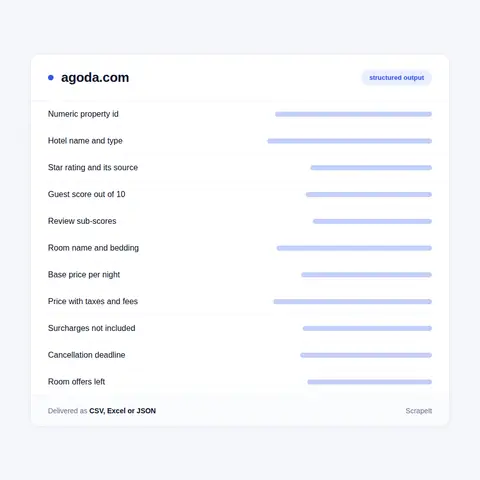
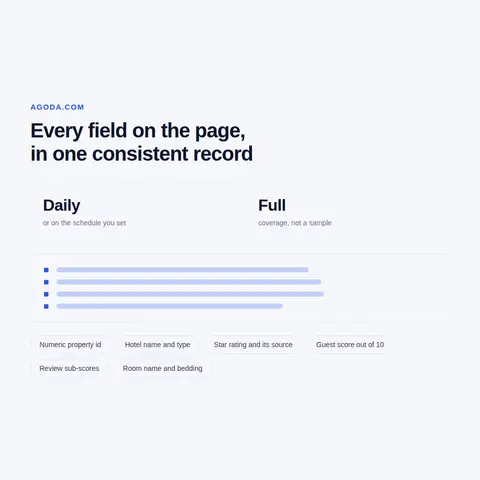
Scope is agreed in writing before anything runs. These are the fields an Agoda scraper can extract from public pages, grouped the way Agoda groups them.
Every public review carries a reviewer name and country. That is personal data and we leave it out by default.
Agoda runs one inventory behind many storefronts. Its sitemap set is a default index plus 48 locale variants, eight of them regional English builds, and the locale indexes are thinner: the default lists 261 files where the Japanese and Thai builds list a little over a hundred. Each file holds about 45,000 URLs and hotel pages fill 142 of them, roughly 6.35M crawlable property pages against the 6.59M the world page counted in September 2026. Currency and guest nationality are separate axes again: the rate shown depends on the guest country, and a rate row without its locale, currency and stated origin compares to nothing. The Asia-Pacific tilt shows in the fields, not just the map - pay-at-hotel is a browsable theme, properties carry UnionPay and Alipay flags, and Japanese stock comes through JTB.
Alternative stays need their own schema. Apartments, villas, hostels, homestays and guest houses sit under Agoda Homes, flagged as an entire home or apartment, sometimes managed by a private host, described by rooms, beds and common space instead of room types, and starred on a scale Agoda derives rather than one a chain declares. Day Use stays are a separate funnel, with check-in and check-out on the same date.
Some things stay out of reach, and we say so up front. Member, VIP and AgodaCash prices sit behind a sign-in; we do not log in and take nothing from behind it. Everything a signed-out visitor sees - room offers, rate lines, taxes, availability, scores and public review text - is in scope.
Agoda is a booking platform run by Agoda Company Pte. Ltd. out of Singapore, and its own about page counts over 6M hotels and holiday properties plus flights and activities, in 39 languages. Agoda belongs to Booking Holdings, and the link is not decorative: the footer carries a brand row naming Booking Holdings Inc., KAYAK, priceline.com and Booking.com, and a property page can show Booking.com verified reviews in their own section and even a Booking.com Genius discount. Supply overlaps heavily, yet the two storefronts rank, label, translate and price it separately, which is why an Agoda scraper and a Booking.com scraper return different rows for the same hotel on the same night.
The catalogue is laid out strictly. Countries sit at /country/, regions at /region/, cities at /city/city-cc.html, and every property gets /slug/hotel/city-cc.html with its reviews split off to /slug/reviews/city-cc.html. Around them run 42 theme paths at /theme/name/city/city-cc.html - apartments, hostels, villas, glamping, agoda-home, pay-at-hotel, free-cancellation, casino - plus neighborhood maps, airport pages, activity pages under /activities/detail/ and routes under /flights/airport/.
Identity is where jobs break. Roughly nine in ten property URLs are a bare name slug; many of the rest add an underscore and a digit, or -h and a numeric id. The durable key is the numeric property id the page carries, so Agoda scraping keyed on the slug drifts the moment a hotel is renamed.
Search never becomes a path. The site assembles a query string in which city is a numeric id, checkIn is a date and los is the number of nights, followed by rooms, adults and children. No check-out date appears in it.
Get a Quote
Developers

Customers worldwide

Pages extracted

Hours saved for our clients
€199 / one-time
setup fee - included
€169 / mo
setup fee €499
€229 / mo
setup fee €499
€349 / mo
setup fee €499
€549 / mo
setup fee €799
Delivery: CSV, JSON or XLSX files, our API or a JSON feed. MCP server on request.
Full plan details →The first thing to settle in any Agoda price data project is which price you are storing. The price display control offers base price per night, total price per night and total price for the full stay, and it opens on the base price, taxes and service fees left out. Compare that against a tax-inclusive rate somewhere else and the gap you report is arithmetic, not competition. We keep the exclusive figure, the inclusive figure and the tax and fee split in their own columns.
Length of stay is a price driver here, not a divisor. Agoda advertises weekly, two-week and monthly discounts of up to 20, 30 and 40 percent, so a nightly rate pulled for one night and a nightly rate pulled for seven are different numbers by design. We hold los fixed across the grid.
Rank deserves the same care. Agoda's disclosure describes its default Our picks order as driven by click-through rate, gross bookings and projected margin, nudged by commission, VIP and growth programmes, and a room row can say outright that Agoda earns increased commission there. We pin locale, currency and sort order, then treat rank as a series.
Past that the work is ordinary. Hotels run rate parity checks on a fixed date grid and compset. Revenue teams read the curve for one arrival date at ninety, thirty and seven days out. Analysts watch occupancy pressure through the room offers left counter and through rate plans quietly withdrawing. No snapshot answers any of it, so we repeat the query on a cadence and the travel data feed is the product.
Since 2022, weekly car rental and, from 2025, hotel prices from Booking.com for a tourism organization comparing its destination with rivals.
Learn More
Four datasets for a studio that builds directory websites: Hawaii stays from Booking.com, UK schools and tattoo studios from Google Maps, GetInked profiles.
Learn More
Daily scraping of Booking.com services - hotels, flights, car rentals, and attractions - with best-price selection across global destinations.
Learn MoreLearn how to use web scraping to solve data problems for your organization

If you work in travel tech, an OTA, a hotel chain, or at an airport, you are in a price-and-availability arms race. Fares change by the hour, room inventory disappears in minutes, and competitors test new bundles and ancillaries constantly.

Leveraging advances in technology, the AI-powered web scraper has skyrocketed in demand and is helping to expand capabilities by automating tedious daily tasks and speeding up data collection from thousands of websites several times over.

Web scraping is a method of obtaining web data by extracting it from pages of web resources with the help of a program, that is, in automatic mode. It is used to syntactically convert web pages into more usable forms.
ScrapeIt is a managed web scraping agency. You are not buying a library, a proxy pool or a tool to babysit: we design the schema, run the crawler on your schedule, monitor it and hand over documented output with a named contact who knows the project. Travel is a large part of the work, including a daily Booking.com pipeline across hotels, flights, cars and attractions, so the distance between two Booking Holdings storefronts is familiar ground. Tell us which Agoda searches matter and how often, and we reply within one business day.
Yes. The ScrapeIt Agoda API returns numeric property ids, room offers, base and tax-inclusive rates, cancellation deadlines, guest scores and availability as JSON from an endpoint we host, refreshed on the schedule you set. The same data also comes as CSV or XLSX files or straight into your database.
Both, in separate columns, plus the split between them. Agoda opens on the base price per night, exclusive of taxes and service fees. The same control also offers total price per night and total price for the full stay. We capture the exclusive amount, the inclusive amount, the tax and fee figures and any surcharge listed as not included, together with currency, locale and the length of stay the quote belongs to. A single price column mixing those views is unusable for parity work.
No. Those rates are shown to signed-in members, and reaching them would mean operating an account. We do not log in and we collect nothing behind authentication, so what you receive is the public price a signed-out visitor sees. That is the right basis for public rate benchmarking and the wrong basis for modelling loyalty discounts. Where a member badge or a promotion label is visible publicly, we record the label as an attribute without the hidden rate behind it.
Yes, but a city is covered by slicing, not by one enormous request. We loop the numeric city id across districts, property types, star bands and price bands, then dedupe on the numeric property id. On dates the site sets the ceiling: check-in runs up to 365 days ahead and a stay up to 90 nights, and one search covers one length of stay, so a ladder of stay lengths is a ladder of runs. Depth and cadence are a cost decision - a compset of forty hotels on a ninety-day ladder is a different job from a whole capital refreshed daily.
CSV, JSON, XLSX or an endpoint you call, sent by email, S3, SFTP or webhook, on a schedule from one-off to several times a day. On the legal side, yes. We collect only publicly available data - everything a visitor can see on Agoda - and we collect it legally. We do not log in, and we do not take personal data such as reviewer names by default.
Step 1 - Make a Request
You share your needs, expectations, and desired timeframe. We’ll suggest the best solution based on your request and budget.
Step 2 - Configuring Custom Web Crawlers
Our specialists configure the crawlers and extract a sample dataset for your review before proceeding with the full-scale extraction.
Step 3 - Collect and Deliver
Once you approve the sample, we launch the project and start full data collection. We gather, filter, and structure the data for easy use, delivering it on time in your preferred format.
Step 4 - Maintain and Support
Our team manages ongoing processes, monitors website changes, and supports all data extraction cycles. We can also help integrate data into your systems or create dashboards to simplify analysis.
Agoda data from €169/month. Free project assessment, reply within 1 business day.

Scrapeit Sp. z o.o.
10/208 Legionowa str., 15-099, Bialystok, Poland
KRS: 0000996672
NIP: 5423457175
REGON: 523384582