Flight Pricing at Scale: Opodo Scraped with Full Filter Logic
Automated scraping of filtered flight ticket data from Opodo.com, including complex on-page interactions for airline and pricing selection.
Learn More
Opodo is the flight-led travel agency of eDreams ODIGEO, selling through country storefronts that each quote in their own currency and show a public Prime price beside the standard one.
Plans from €169/month · Free project assessment · Reply within 1 business day
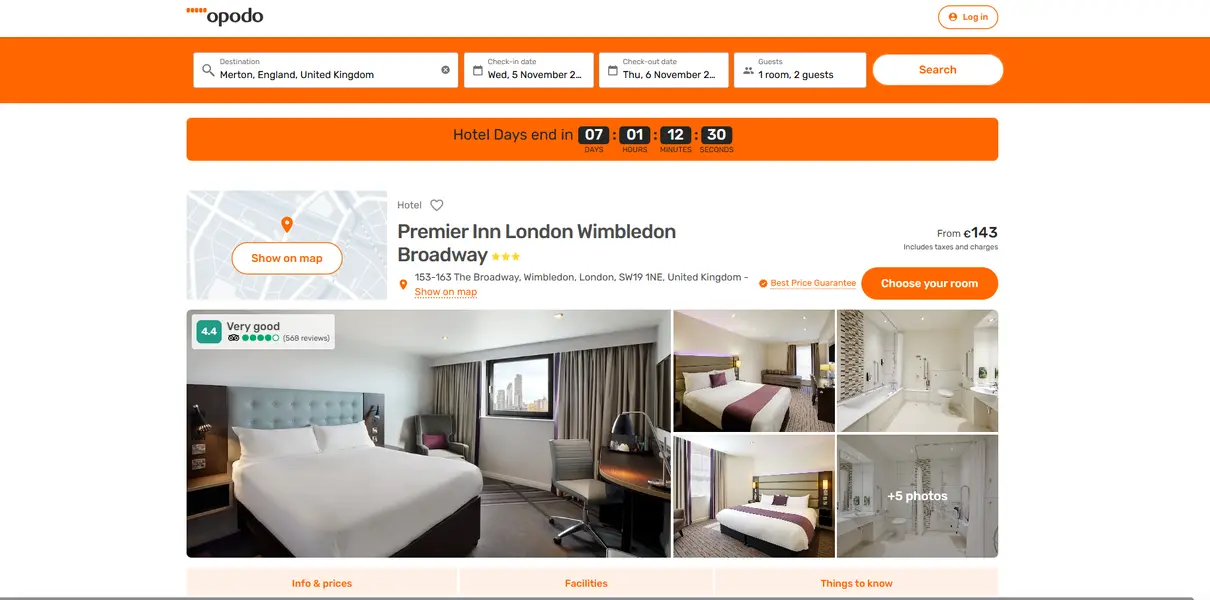
Opodo does not serve automated clients. Even the homepage comes back as a short Cloudflare block response rather than the page itself. Everything is refused the same way.
Handling that is our side of the job, not yours. We run real browser sessions, rotate proxies by point of sale, solve challenges when they appear, and adapt when the funnel shifts.
We pace collection on purpose. Every flight search costs Opodo real supplier calls, so we work to an agreed route list and cadence instead of hammering a live booking engine. We do not log in and do not reach member-only prices.
Each row is one itinerary as the results page presented it, tied to the storefront, locale and currency that produced it. A fare without that context is not comparable to anything.
Fields that Opodo does not publish on the page do not appear in the file. If a fare brand carries no baggage indication at result level, the cell is empty rather than guessed, and we say so in the schema we hand over before the first full run.
Collection covers public fare and listing data only. No traveller records, no booking records, no account content.
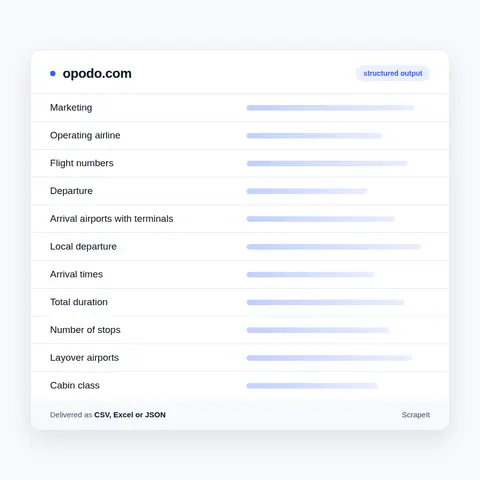
The same itinerary is not one price. It is a price per storefront, per currency and per membership state, and Opodo encodes much of that in the URL itself.
Archived captures of opodo.com show search state carried as matrix parameters inside the path rather than a query string: a results URL built from check-in and check-out dates, a geoId, occupancy counts and a server-side searchId, captured in September 2025. Flight entry points appear as a deeplink parameter holding type, from and to in the same semicolon style, seen on archived landing URLs. Those captures also carry buyPath, recording the route the visitor took into the funnel, and a feeSelected flag that appears as both 0 and 1 on otherwise identical searches.
The practical consequence is that a search binds to a server-side session, not to a clean permalink you can replay next week. We reproduce the search rather than store a link to it, and every row records the parameters used.
Fare composition matters as much. A headline result price is the fare for the brand shown. Hold baggage, seat selection and the agency's own service and payment charges land in later steps, and an add-on bought through the agency need not match what the airline charges for the same thing. We record the headline price and the inclusions as displayed, and label which is which, because a stored total with no inclusions attached will not compare against a rival's total.
Opodo is an online travel agency owned by eDreams ODIGEO, the group behind eDreams, GO Voyages, Travellink and the Liligo search engine. Flights lead the catalogue, with rail, hotels, car hire and dynamic flight-plus-hotel packages sold beside them.
The brand sells through country storefronts rather than a single site. Probing them directly, opodo.co.uk, opodo.fr, opodo.de, opodo.it, opodo.es, opodo.pt, opodo.nl, opodo.pl, opodo.at, opodo.ch, opodo.se, opodo.dk, opodo.fi and opodo.no all resolved and answered from the same edge, alongside opodo.com and an Australian storefront. Three domains we tried, opodo.ie, opodo.gr and opodo.ca, did not resolve at all.
Those storefronts share one platform: the same application answers under localised booking paths, German routes next to English ones.
Opodo also sells Prime, a paid membership carrying a member fare. eDreams and GO Voyages run the same mechanic under their own names, so a buyer who says Opodo may be scoping one brand or the whole group. Worth settling before anyone writes a spec, because the route list and the row count change completely.
Get a Quote
Developers

Customers worldwide

Pages extracted

Hours saved for our clients
€199 / one-time
setup fee - included
€169 / mo
setup fee €499
€229 / mo
setup fee €499
€349 / mo
setup fee €499
€549 / mo
setup fee €799
Delivery: CSV, JSON or XLSX files, our API or a JSON feed. MCP server on request.
Full plan details →Opodo assembles its result list in the browser. Filters, sliders and sort order all change what the server returns, so there is no static document to fetch and parse. A scraper that drives those controls can ask a narrow question and let the site answer it, instead of pulling everything and discarding most of it.
That is how we built it for a client feeding an analytics pipeline. The brief was a recurring dataset of flight ticket prices from opodo.com, covering tickets between named departure and arrival airports for each of the next N days, rebuilt daily. The client asked for the filtering to happen on the page rather than in our code, so the site's own server did the selection.
Three conditions decided which row survived: the full forward window rather than a spot check, a return leg operated by the same airline as the outbound leg, and one row per carrier per departure date at the best available price. Every condition applied on the site is a batch of results we never request at all.
Automating it meant driving a range slider to a target value and having the page register it, which is rare in production automation and had to hold for a whole run rather than once. Setup and launch took four working days. The job has produced roughly 13,000 rows a day since.

Automated scraping of filtered flight ticket data from Opodo.com, including complex on-page interactions for airline and pricing selection.
Learn More
Daily scraping of Booking.com services - hotels, flights, car rentals, and attractions - with best-price selection across global destinations.
Learn MoreLearn how to use web scraping to solve data problems for your organization

If you work in travel tech, an OTA, a hotel chain, or at an airport, you are in a price-and-availability arms race. Fares change by the hour, room inventory disappears in minutes, and competitors test new bundles and ancillaries constantly.

Leveraging advances in technology, the AI-powered web scraper has skyrocketed in demand and is helping to expand capabilities by automating tedious daily tasks and speeding up data collection from thousands of websites several times over.

Web scraping is a method of obtaining web data by extracting it from pages of web resources with the help of a program, that is, in automatic mode. It is used to syntactically convert web pages into more usable forms.
ScrapeIt is a managed data extraction company. We build the crawlers, run them on a schedule, watch the target site for layout changes, and repair breaks before they reach your dataset.
Opodo data arrives as CSV, JSON, XLSX or an API endpoint, on the cadence you set, delivered to your storage or straight into a database. You review a sample before the full run starts. Scoping, maintenance and support are part of the engagement rather than extras.
Yes. The ScrapeIt Opodo API returns carriers and flight numbers, routing, departure and arrival times, the fare with cabin class and currency, and the Prime member price beside the standard one, as JSON from an endpoint we host, refreshed on the schedule you set. The same data also comes as CSV or XLSX files or straight into your database.
Yes. Each country domain is treated as its own point of sale with its own currency, locale and result set, and they arrive in one dataset with the storefront stamped on every row. Probing them directly, opodo.co.uk, opodo.fr, opodo.de, opodo.it, opodo.es, opodo.pt, opodo.nl, opodo.pl, opodo.at, opodo.ch, opodo.se, opodo.dk, opodo.fi and opodo.no all answered, alongside opodo.com. Tell us which markets matter and we scope to those rather than all of them.
We capture both where the public results page displays both, on the same row, so the advertised member discount stays measurable per route and per carrier. To be exact about the limit: we do not log in, we hold no membership, and we cannot confirm what a signed-in member sees at checkout. What lands in your file is the public quote as an anonymous visitor saw it, with the capture timestamp attached to it.
Yes, and on one live project that was the entire point. Our automation drives the on-page controls, including range sliders, so the server returns only itineraries matching your rules - for example both legs operated by the same airline, and only the best-priced option per carrier per departure date. Filtering on the site rather than in post-processing keeps request volume down and means nothing downstream has to clean up after it.
Daily is the usual cadence for fare monitoring, and tighter intervals are workable on a narrower route list. We pace runs against a booking engine rather than pushing them, so cadence and route count get traded against each other during scoping. On the live flight-pricing project, setup and launch took four working days and the daily dataset runs to roughly 13,000 rows. Simpler route lists go faster.
Step 1 - Make a Request
You share your needs, expectations, and desired timeframe. We’ll suggest the best solution based on your request and budget.
Step 2 - Configuring Custom Web Crawlers
Our specialists configure the crawlers and extract a sample dataset for your review before proceeding with the full-scale extraction.
Step 3 - Collect and Deliver
Once you approve the sample, we launch the project and start full data collection. We gather, filter, and structure the data for easy use, delivering it on time in your preferred format.
Step 4 - Maintain and Support
Our team manages ongoing processes, monitors website changes, and supports all data extraction cycles. We can also help integrate data into your systems or create dashboards to simplify analysis.
Opodo data from €169/month. Free project assessment, reply within 1 business day.

Scrapeit Sp. z o.o.
10/208 Legionowa str., 15-099, Bialystok, Poland
NIP: 5423457175
REGON: 523384582