Flight Pricing at Scale: Opodo Scraped with Full Filter Logic
Automated scraping of filtered flight ticket data from Opodo.com, including complex on-page interactions for airline and pricing selection.
Learn More
Plans from €169/month · Free project assessment · Reply within 1 business day
We build the crawler, run it on your schedule and hand over the output. Files arrive as CSV, JSON or XLSX, pushed to S3, Google Cloud Storage, an SFTP drop or a link your own job pulls from. If your team would rather query than parse, the same dataset is exposed as a REST API keyed by origin, destination and date.
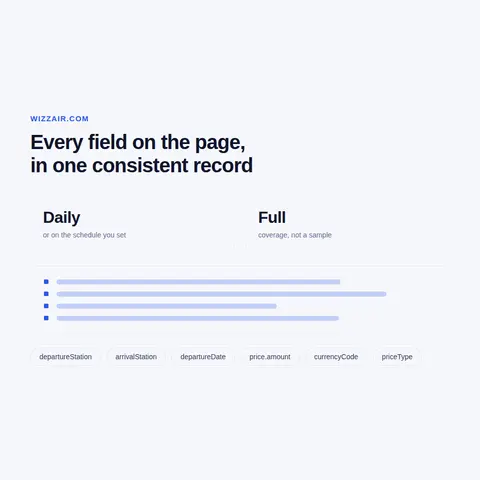
Cadence follows how quickly the numbers matter: daily for most fare tracking, tighter for a shortlist of routes inside a booking window, weekly for the station list and route map. The schema is agreed before the first run, and Ryanair, easyJet or any other carrier can be normalised into the same columns so rows compare directly rather than by hand.
The commercial data falls into three sets, plus the availability markers and fare extras that sit on top of them.
A single pull of Wizz Air fares is one moment in a pricing system that moves daily. The value is in the series, and two structural caps decide how that series gets built.
Timetable fares come in date windows of limited width, so a full year of one route needs roughly nine chained windows, stitched back together on our side. Fare chart rows come as a short band of dates around the anchor date. Both limits are fixed, so the crawl plan is designed around them rather than fought.
Repetition also catches what one crawl cannot. Rows arrive with an amount of 0.0 and a priceType of noData or checkPrice when a date is not flown, is sold out or needs a live quote; stored without the priceType, that silently becomes a free seat in your dataset. A pair Wizz Air does not sell is rejected as a market not served, so the route list has to be refreshed from the route map before each cycle - the cheapest way to watch routes appear and disappear. And the booking engine changes with each release, which is the part that quietly breaks in-house scripts.
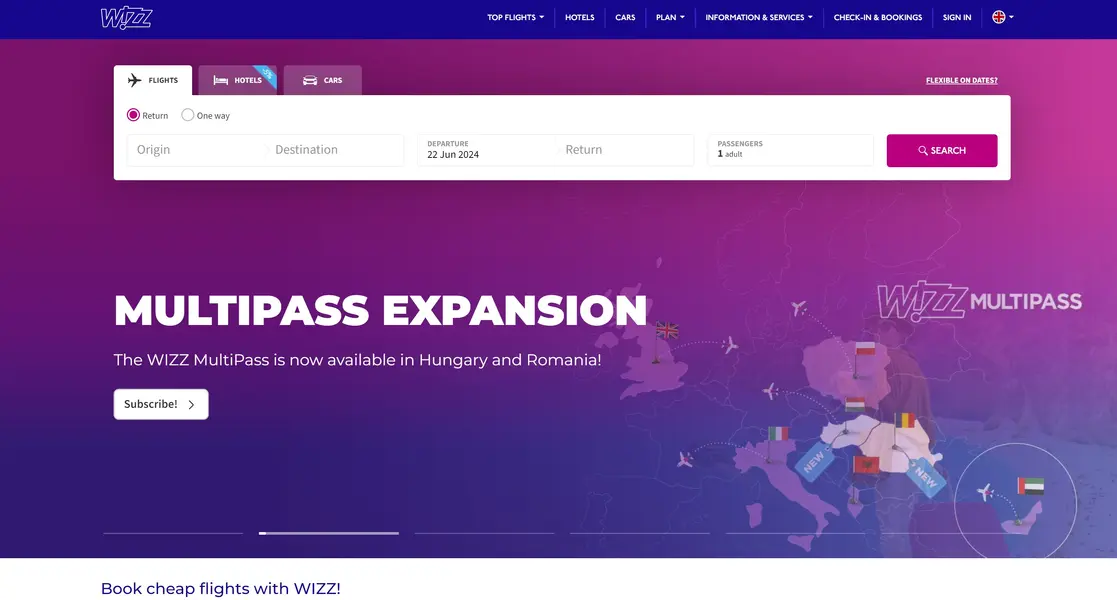
Wizz Air is a European low-cost carrier flying under four operating certificates - Wizz Air Hungary (W6 / WZZ), Wizz Air Malta (W4), Wizz Air UK (W9) and Wizz Air Abu Dhabi (5W). The public site is wizzair.com, with locale paths shaped as /{lang}-{country}. On a recent crawl the page carried 29 hreflang alternates: en-gb acts as the x-default, alongside hu-hu, pl-pl, ro-ro, cs-cz, bg-bg, sq-al, mk-mk, ka-ge, uk-ua and script-qualified variants such as sr-cyrl-rs and bs-latn-ba. The bare domain 301-redirects to the www host.
Very little of that surface holds fares. The front end is a Nuxt server-rendered application; fares come from a separate booking engine that changes with each release. Any crawler hardcoded to one release has a short shelf life.
The indexable side is thin by comparison. On a recent crawl the English sitemap held a few hundred URLs and no per-route pages at all: roughly two hundred /en-gb/cheap-flights-to-{city} destination pages, /en-gb/flights/{country} pages, the Fare Finder, WIZZ Route Map and Timetable tools, and help-centre articles. Legacy /en-gb/flights/{city} URLs redirect to the cheap-flights-to form. Those pages carry a schema.org BreadcrumbList and an AggregateOffer block with lowPrice in EUR - a teaser figure for an entire city, not a bookable fare for a date, and it does not agree with what the booking engine quotes.
Get a Quote
Developers

Customers worldwide

Pages extracted

Hours saved for our clients
€199 / one-time
setup fee - included
€169 / mo
setup fee €499
€229 / mo
setup fee €499
€349 / mo
setup fee €499
€549 / mo
setup fee €799
Delivery: CSV, JSON or XLSX files, our API or a JSON feed. MCP server on request.
Full plan details →Fare monitoring across the European low-cost market is the usual brief. Wizz Air, Ryanair and easyJet overlap on hundreds of city pairs, and competitor fare tracking only works when the same route, on the same departure date, is sampled on the same day for every carrier in the comparison. A single pull answers nothing. A daily series shows who moved first and by how much.
Airports and regional tourism bodies read the route map instead. The operationStartDate and isNew flags on each connection make route launches visible as data, and a connection that vanishes from the route map between two crawls is a route being dropped. Route development teams watch both directions.
Corporate travel desks and consolidators want the curve rather than a single number: which dates inside a booking window sit under a policy cap, and how Basic, WIZZ Go and WIZZ Plus change the total once a cabin bag or a seat is added. Metasearch and affiliate sites go one step further and rebuild the booking deep link, which is positional rather than query-string based: /{locale}/booking/select-flight/{origin}/{destination}/{outbound date}/{return date or null}/{adults}/{children}/{infants}/{promo or null}.

Automated scraping of filtered flight ticket data from Opodo.com, including complex on-page interactions for airline and pricing selection.
Learn More
Daily scraping of Booking.com services - hotels, flights, car rentals, and attractions - with best-price selection across global destinations.
Learn MoreLearn how to use web scraping to solve data problems for your organization

If you work in travel tech, an OTA, a hotel chain, or at an airport, you are in a price-and-availability arms race. Fares change by the hour, room inventory disappears in minutes, and competitors test new bundles and ancillaries constantly.

Leveraging advances in technology, the AI-powered web scraper has skyrocketed in demand and is helping to expand capabilities by automating tedious daily tasks and speeding up data collection from thousands of websites several times over.

Web scraping is a method of obtaining web data by extracting it from pages of web resources with the help of a program, that is, in automatic mode. It is used to syntactically convert web pages into more usable forms.
ScrapeIt is a managed scraping agency, not a tool you install. We write the crawlers, run them on our own infrastructure, watch them when a target shifts, and deliver data your analysts can open. With airline fares that maintenance is most of the work: booking engine releases land, validation rules tighten, station lists change. You receive the dataset and an agreed schema. The breakage stays with us.
Routes and dates are the core of the job. You give us the origin-destination pairs as IATA station codes and the booking window; we collect the lowest fare per calendar date from the timetable, and the fare curve and fare class around chosen dates from the fare chart. Flight-level detail - departure times, flight numbers, per-passenger pricing and bundle availability - comes from the flight search itself, which sits behind a Kasada bot-management challenge (KPSDK). Handling that challenge is part of the service, and we scope flight-level collection separately. Collection runs as far ahead as Wizz Air has loaded the schedule for sale; past that horizon the calendar simply returns no data.
Daily suits most fare tracking and is the usual setting. Tighter refresh is workable on a defined shortlist of routes and dates rather than the whole network, because the timetable comes in date windows of limited width and a single route-year costs roughly nine chained requests - refresh rate and route coverage trade against each other. We size the schedule with you against that arithmetic and run at a request rate that keeps load on the origin low. The route map and station list change slowly and are normally refreshed weekly.
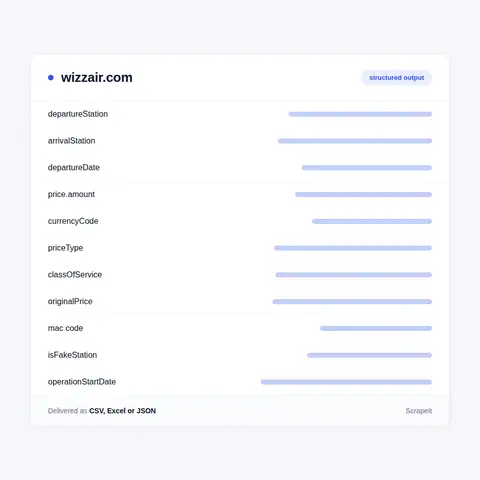
The booking engine picks currency from the departure station's country, not from the locale in the URL. Budapest to London Luton quotes HUF, Luton to Budapest quotes GBP, Warsaw to Rome Ciampino quotes PLN. The route map lists eighteen currencies across the network: EUR, HUF, PLN, RON, GBP, CHF, CZK, DKK, NOK, SEK, RSD, MKD, BAM, ALL, GEL, MDL, AED and USD. Each price object also has exchangedAmount and exchangedCurrencyCode, which stay null unless a conversion is requested. We keep the native price.amount and price.currencyCode untouched and add a converted column at a stated reference rate and date, so a route quoted in HUF and one quoted in GBP sit in the same comparable table.
Yes. The ScrapeIt Wizz Air API returns IATA station codes, departureDate, price.amount with price.currencyCode, classOfService and priceType as JSON from an endpoint we host, keyed by origin, destination and date, and refreshed on the schedule you set. The same data also comes as CSV or XLSX files or straight into your database. On every run we watch for changes in the booking engine: a renamed field, a tightened validation rule, a station that disappears from the map. When something moves, the repair is ours and the feed keeps arriving. Maintenance is part of the service, not a new project.
No. We do not authenticate. WIZZ Discount Club (WDC) and WIZZ MultiPass prices are shown only to signed-in members, so they are out of scope and what you receive is the public fare. Booking retrieval is out too: Find Booking needs the six-character alphanumeric confirmation code, the PNR, plus the lead passenger surname, or a My WIZZ Account sign-in. We collect only publicly available data - everything a visitor can see on Wizz Air - and we collect it legally.
Step 1 - Make a Request
You share your needs, expectations, and desired timeframe. We’ll suggest the best solution based on your request and budget.
Step 2 - Configuring Custom Web Crawlers
Our specialists configure the crawlers and extract a sample dataset for your review before proceeding with the full-scale extraction.
Step 3 - Collect and Deliver
Once you approve the sample, we launch the project and start full data collection. We gather, filter, and structure the data for easy use, delivering it on time in your preferred format.
Step 4 - Maintain and Support
Our team manages ongoing processes, monitors website changes, and supports all data extraction cycles. We can also help integrate data into your systems or create dashboards to simplify analysis.
Wizz Air data from €169/month. Free project assessment, reply within 1 business day.

Scrapeit Sp. z o.o.
10/208 Legionowa str., 15-099, Bialystok, Poland
NIP: 5423457175
REGON: 523384582