Flight Pricing at Scale: Opodo Scraped with Full Filter Logic
Automated scraping of filtered flight ticket data from Opodo.com, including complex on-page interactions for airline and pricing selection.
Learn More
The search is closed and the catalogue is open. For a tour operator the catalogue is the product anyway - which resorts, which hotels, which seasons.
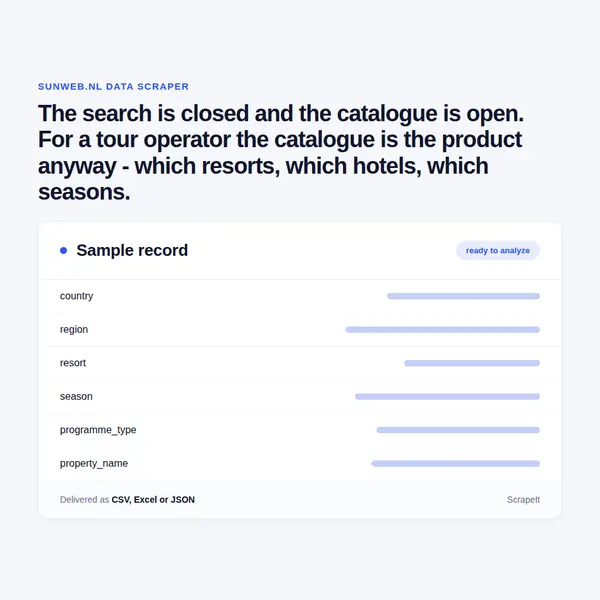
ScrapeIt runs the collection as a managed service. You name the seasons, programmes or destinations; we build the pipeline with season as a field, accommodation linked to resort and destination, and indicative prices labelled as such, and hand back CSV, JSON, Excel or a push into your warehouse.
Programmes change between seasons, so periodic collection with change records fits better than a daily crawl and is what we quote.
We collect published catalogue content only, honour the crawl rules that close search and booking, and pace requests. Where a brief needs live package pricing, that is a commercial arrangement with the operator, not a crawler. Content is copyrighted, so the dataset is for analysis rather than republication.
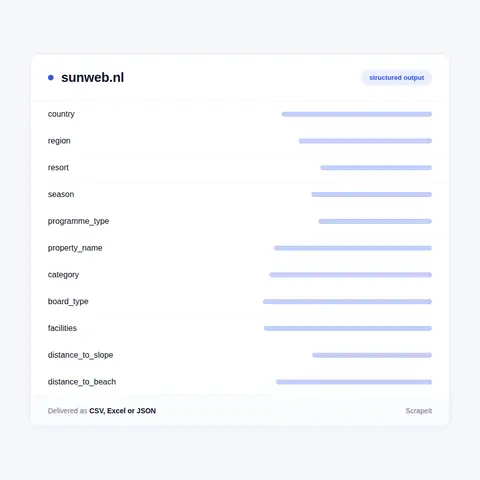
Destination records carry the country, region, resort, season and the programme type - sun or winter sports - along with the descriptive content published for each.
Accommodation records carry the property name, resort, category or star rating as published, board types offered, facilities and the distance information the operator gives, such as distance to the slopes or the beach.
Season is a first class field, because a tour operator's programme is built season by season and the same resort appears in different programmes with different accommodation for winter and summer.
Where a catalogue page shows an indicative from-price, it is collected with that label and never presented as a live search price. The distinction matters: an indicative price on a catalogue page is content; a priced search result is what the rules close.
Every row carries the collection timestamp and the date the item first appeared in the programme.
Programme change tracking is the strongest output: destinations, resorts and properties added or dropped between seasons, which is a direct read on an operator's strategy.
Resort coverage mapping answers which resorts a large operator sells and how deeply, measured by the number of properties it offers there - useful to destinations and to competing operators alike.
Accommodation profiling across the programme - categories, board types, facilities - describes the positioning of the product and how it varies between the sun and ski sides of the business.
The limits are clear. Search results and booking pages are closed in the crawl rules and we do not collect them. Indicative prices on catalogue pages are labelled as indicative. No customer data, no account access, no booking flows.
Sunweb is a Dutch tour operator selling package holidays and winter sports trips across several European markets, with a catalogue of destinations, resorts and accommodation built around sun and ski seasons.
Its crawl rules draw a clear line, and it is the same line we found across the travel sector. The search - queries by date, duration, number of travellers and transport type - is disallowed, as are the booking pages. The destination, resort and accommodation pages that make up the catalogue are not.
For a tour operator that line leaves most of the useful data on the open side. What a tour operator sells is a curated programme: which destinations, which resorts inside them, which hotels, for which seasons. That programme is published as catalogue content, and it is where the operator's commercial decisions are visible.
Category and destination pages respond directly with a great deal of content. The winter sports section alone is substantial.
Get a Quote
Developers

Customers worldwide

Pages extracted

Hours saved for our clients
€199 / one-time
setup fee - included
€169 / mo
setup fee €499
€229 / mo
setup fee €499
€349 / mo
setup fee €499
€549 / mo
setup fee €799
The instinct on a travel site is to go after prices. On this source, and on most of the sector, the priced search is closed - and for a tour operator, it is not where the most useful information is anyway.
A tour operator's programme is a record of decisions. Which destinations it sells, which resorts within them, which properties it contracts, and how that changes season to season is competitive intelligence for other operators, for hotels deciding who to work with, and for destinations tracking how they are being sold.
Those decisions are published as catalogue content, openly. Collected over time they show a programme growing into one region and shrinking out of another, a property dropped, a new resort added - movements that happen well before they show up in any booking data.
The second reason is the winter sports market specifically. Ski holidays are a distinct, seasonal and fairly concentrated market, and a large operator's catalogue of resorts and accommodation is one of the clearer structured views of it.
The third is honesty about scope. We do not collect the closed search, and a brief that needs live package pricing by date needs a commercial data arrangement with the operator rather than a crawler. We say so at the start.

Automated scraping of filtered flight ticket data from Opodo.com, including complex on-page interactions for airline and pricing selection.
Learn More
Daily scraping of Booking.com services - hotels, flights, car rentals, and attractions - with best-price selection across global destinations.
Learn MoreLearn how to use web scraping to solve data problems for your organization

If you work in travel tech, an OTA, a hotel chain, or at an airport, you are in a price-and-availability arms race. Fares change by the hour, room inventory disappears in minutes, and competitors test new bundles and ancillaries constantly.

Leveraging advances in technology, the AI-powered web scraper has skyrocketed in demand and is helping to expand capabilities by automating tedious daily tasks and speeding up data collection from thousands of websites several times over.

Web scraping is a method of obtaining web data by extracting it from pages of web resources with the help of a program, that is, in automatic mode. It is used to syntactically convert web pages into more usable forms.
ScrapeIt is a managed extraction company, not a tool you have to learn. Our team builds the pipeline, follows the programme as it is rebuilt for each season, and repairs the collector before a season change goes unrecorded.
You see a sample first, in your format, over the destinations you actually cover, with accommodation linked to resorts so you can judge the structure on a real programme.
No. The search - by date, duration, travellers and transport - is disallowed in the crawl rules, as are the booking pages. We do not collect them. Live package pricing needs a commercial arrangement with the operator rather than a crawler.
The programme: which destinations, resorts and properties the operator sells, for which seasons. That is a record of commercial decisions, published openly, and tracked over time it shows strategy moving before it shows in any booking data.
Where a page shows an indicative from-price, we collect it with that label. It is catalogue content, and it is never presented as a live search price - the difference is exactly the line the crawl rules draw.
Because the programme is built season by season. The same resort appears in winter and summer programmes with different accommodation, and merging them hides the seasonal shape that is the whole point.
The operator runs editions for several European markets, and programmes differ between them. We collect editions as separate markets so a comparison between them is deliberate rather than accidental.
Step 1 - Make a Request
You share your needs, expectations, and desired timeframe. We’ll suggest the best solution based on your request and budget.
Step 2 - Configuring Custom Web Crawlers
Our specialists configure the crawlers and extract a sample dataset for your review before proceeding with the full-scale extraction.
Step 3 - Collect and Deliver
Once you approve the sample, we launch the project and start full data collection. We gather, filter, and structure the data for easy use, delivering it on time in your preferred format.
Step 4 - Maintain and Support
Our team manages ongoing processes, monitors website changes, and supports all data extraction cycles. We can also help integrate data into your systems or create dashboards to simplify analysis.

Scrapeit Sp. z o.o.
10/208 Legionowa str., 15-099, Bialystok, Poland
NIP: 5423457175
REGON: 523384582