RVUSA Data for 2 Model Years Plus RV Model Tags Rebuilt from Filters
RVUSA catalogs by model year and a full feature-tag list per RV model on RVing Planet, rebuilt from its filters, for a returning client.
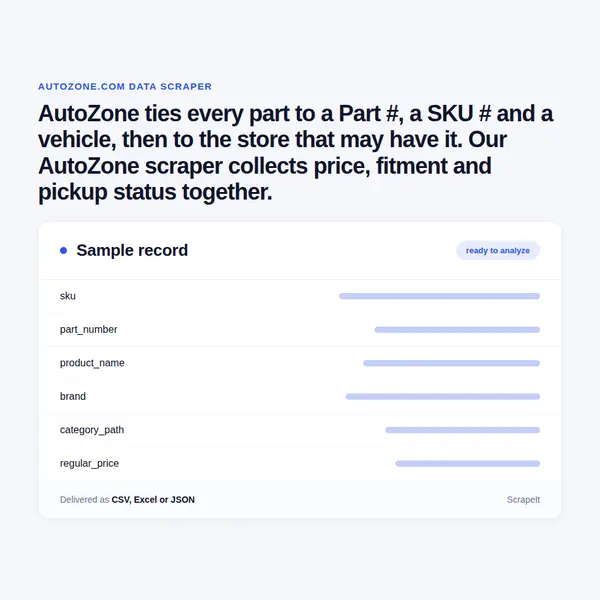
AutoZone ties every part to a Part #, a SKU # and a vehicle, then to the store that may have it. Our AutoZone scraper collects price, fitment and pickup status together.
Plans from €169 a month · Free project assessment · Reply within 1 business day
CSV · Excel · JSON · XML · FTP · SFTP · Amazon S3 · Google Cloud
API, JSON feed or CSV, XLSX and JSON files
ScheduleOne-time, monthly, weekly, daily or 3 times a day
AutoZone pages, filters, fields and a schedule
Built, monitored and repaired by our team
API, JSON feed or CSV, XLSX and JSON files
You send the scope: categories such as batteries or brake pads, a list of SKUs or Part numbers, the vehicles you care about, the stores whose shelves matter, and how often. We build the crawler around AutoZone's catalogue, run it, and repair it whenever the site changes its pages. autozone.com answers unfamiliar traffic with a challenge page, so rendering, pacing, proxy rotation and CAPTCHA handling are included in the service.
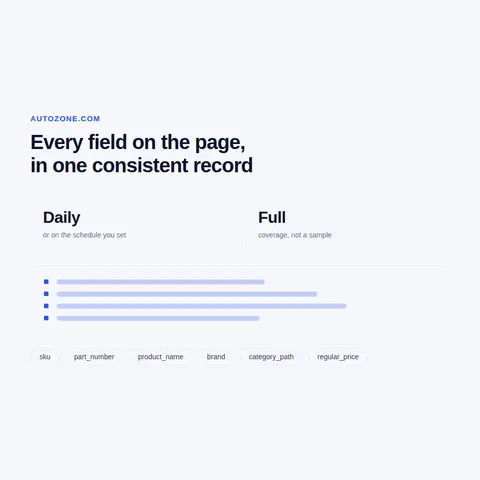
Runs are one-off or scheduled - daily, weekly or on demand - and every file keeps the same columns from run to run. The project starts with a free assessment, and you can order a sample category before committing to a schedule.
An AutoZone scraper gets two identifiers on every product: the brand's Part # - MKD1363 on a set of Duralast Ceramic Brake Pads, 96R-DLG on a Duralast Gold battery - and AutoZone's own SKU #, which also appears at the end of the product address. Rows are keyed on the SKU and carry the part number beside it, so the same item can be matched to other catalogues.
Specifications land in separate columns per category rather than one text field, so a battery file and a brake file each read as a proper table.
Category pages are where coverage is planned. Each shows a result count, sorts by Featured or by price, marks its best sellers with a Best Seller badge, and filters by brand, price band, rating, pickup in store and the attributes of that category - front or rear position for brake pads, for example. We slice large categories by those facets, collect the full set and then open each product page for specifications and fitment.
Fitment is the dimension that multiplies rows. A category returns a different set once a vehicle is added, so for a parts list we run the Year / Make / Model / Engine combinations you name and record which SKUs fit each one. To check AutoZone prices for parts by vehicle, that table is the answer: one row per vehicle and part.
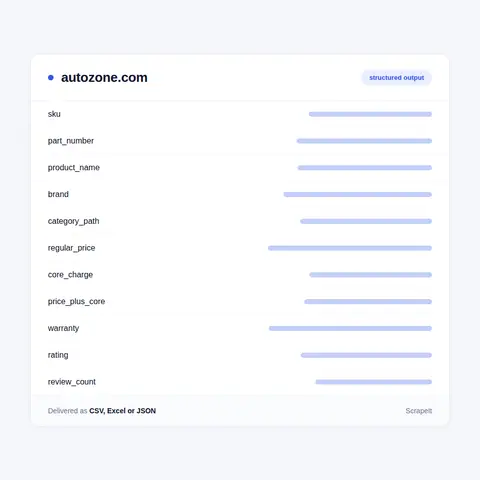
Availability depends on the store. Pickup status follows the store selected, and the store pages under /locations give each store's address, hours and services such as free battery testing and the Loan-A-Tool program. We collect availability for the stores you list, and the store directory itself if you need it. Repeated runs add time: each regular price and core charge is stamped per run, which turns the files into a price history per SKU.
AutoZone is a US auto parts retailer whose website works like its store counter: you name the vehicle, then you see the parts. The breadcrumb runs from a department such as Brakes or Batteries & Chargers down to the part type, and product pages open with First, Add Your Vehicle. Without a vehicle the site still shows prices and a Check if this fits your vehicle prompt; with one, it narrows the list to parts that fit.
The catalogue mixes national brands such as Brembo with Duralast in several tiers - Gold, Elite and Severe Duty for brakes, Gold and Platinum among the batteries - and an economy line, Valucraft. How the customer gets a part depends on the store: In-Store Pickup for a selected store, Home Delivery, or Same Day Delivery where it is offered. Batteries and other parts with a core carry a refundable core charge on top of the price, shown as its own line with a Regular Price Plus Core total. Store pages add the location layer the catalogue lacks: hours, address and the services each store offers.
Delivery: CSV, JSON or XLSX files, our API or a JSON feed. MCP server on request.
Full plan detailsThe catalogue doubles as a price list and a fitment map, and both are useful outside AutoZone:
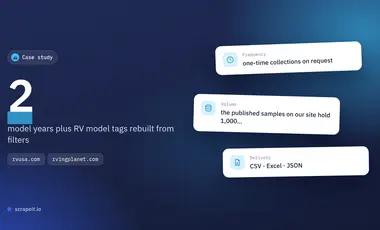
RVUSA catalogs by model year and a full feature-tag list per RV model on RVing Planet, rebuilt from its filters, for a returning client.
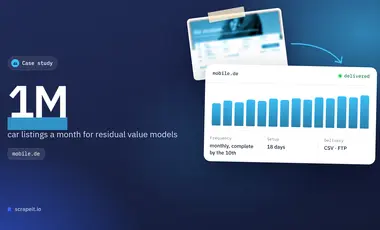
A monthly snapshot of mobile.de for an automotive data company: cars and vans up to 12 years old, delivered in the client's own CSV template.
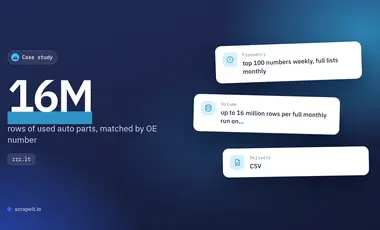
Weekly and monthly prices of used parts by OE number from rrr.lt and a Scandinavian marketplace, for a car dismantling business.
Learn how to use web scraping to solve data problems for your organization
Twelve US car websites compared as data sources, from Autotrader and CarGurus to Copart, IAA and the RV sites: what each shows, which fields need care - VIN, trim, deal labels, damage codes - and how to merge them into one dataset.
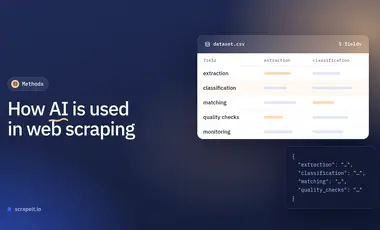
Leveraging advances in technology, the AI-powered web scraper has skyrocketed in demand and is helping to expand capabilities by automating tedious daily tasks and speeding up data collection from thousands of websites several times over.
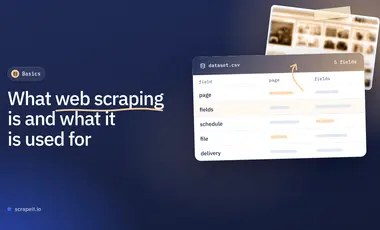
Web scraping is a method of obtaining web data by extracting it from pages of web resources with the help of a program, that is, in automatic mode. It is used to syntactically convert web pages into more usable forms.

ScrapeIt is a managed scraping service for retail and catalogue data. Parts retailers suit the way we work: each product has firm identifiers, fitment multiplies the rows, and prices and availability shift between runs. We build the AutoZone crawler, keep it working through site changes and deliver SKU-keyed files - CSV, Excel, JSON or JSONLines - by e-mail, SFTP or Google Cloud Storage, once or on a schedule. Plans start from EUR 169 a month, or EUR 199 for a one-time extract.
Still unsure? Write to info@scrapeit.io
Yes. The ScrapeIt AutoZone API returns SKU #, Part #, brand, regular price, core charge and pickup availability as JSON from an endpoint we host, on the refresh schedule you choose. The same rows can arrive as CSV or XLSX files, a JSON feed or a direct load into your database.
Yes. Product names, prices, Part # and SKU #, specifications, fitment and store pages are open to every visitor of autozone.com. We collect only publicly available data - everything a visitor can see on AutoZone - and we collect it legally.
Yes. Give us SKUs, part numbers or whole categories and a schedule, and each run stores the regular price, the core charge and availability with its date. After a few runs the file shows every price move per SKU, and items new to a category appear as new rows.
Yes, for the stores you name. In-Store Pickup status depends on the selected store, so we check the products you track against each store and record pickup, Home Delivery and Same Day Delivery separately. The store directory under /locations adds each store's address and hours.
It covers the vehicles you give us. AutoZone checks fit against a Year / Make / Model / Engine selection, and each product page lists the vehicles the part fits; we collect that list per SKU and, where needed, run category searches per vehicle so you get a part-to-vehicle table.
You share your needs, expectations, and desired timeframe. We'll suggest the best solution based on your request and budget.
Our specialists configure the crawlers and extract a sample dataset for your review before proceeding with the full-scale extraction.
Once you approve the sample, we launch the project and start full data collection. We gather, filter, and structure the data for easy use, delivering it on time in your preferred format.
Our team manages ongoing processes, monitors website changes, and supports all data extraction cycles. We can also help integrate data into your systems or create dashboards to simplify analysis.
Tell us which sites, which fields and how often. A couple of lines is enough to start.
AutoZone data from €169/month. Free project assessment, reply within 1 business day.