RVUSA Data for 2 Model Years Plus RV Model Tags Rebuilt from Filters
RVUSA catalogs by model year and a full feature-tag list per RV model on RVing Planet, rebuilt from its filters, for a returning client.
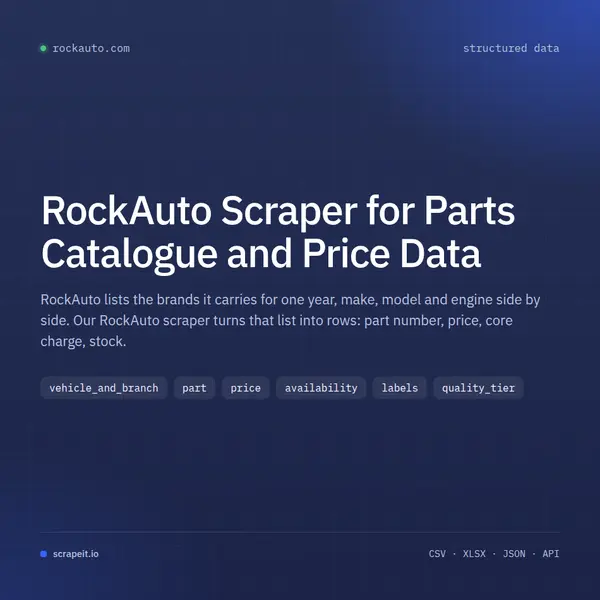
RockAuto lists the brands it carries for one year, make, model and engine side by side. Our RockAuto scraper turns that list into rows: part number, price, core charge, stock.
Plans from €169 a month · Free project assessment · Reply within 1 business day
CSV · Excel · JSON · XML · FTP · SFTP · Amazon S3 · Google Cloud
API, JSON feed or CSV, XLSX and JSON files
ScheduleOne-time, monthly, weekly, daily or 3 times a day
RockAuto pages, filters, fields and a schedule
Built, monitored and repaired by our team
API, JSON feed or CSV, XLSX and JSON files
You tell us what to cover - a list of vehicles, a set of part types such as Brake Pad or Wheel Bearing & Hub, one brand, or a file of part numbers - and we build the crawl around it: RockAuto's own tree of make, year, model, engine, category and part type, or Part Number Search for a list. One part number often belongs to several manufacturers, so a list works best with the brand next to each number; every row keeps the number you asked for, which keeps exact matches and cross-references apart. We run it, check the output against the catalogue and repair the crawler when the pages change. The catalogue answers fast automated browsing with a security-code check, so pacing, proxy rotation, CAPTCHA handling and browser rendering are part of the service rather than your problem.
Each delivery comes with field documentation and arrives as CSV, XLSX or JSON files, through our API or straight into your database - as a one-off extract, or daily, weekly or on demand.
A RockAuto listing is one line inside a vehicle and part-type branch, and much of its meaning sits in small labels around the price. Our RockAuto scraper keeps the branch on every row, so one part number can be read against each vehicle it fits.
Rows taken from Part Number Search add a cross-reference layer: exact matches first, then the items a manufacturer reports as equivalent or closely related, each with its own brand and price.
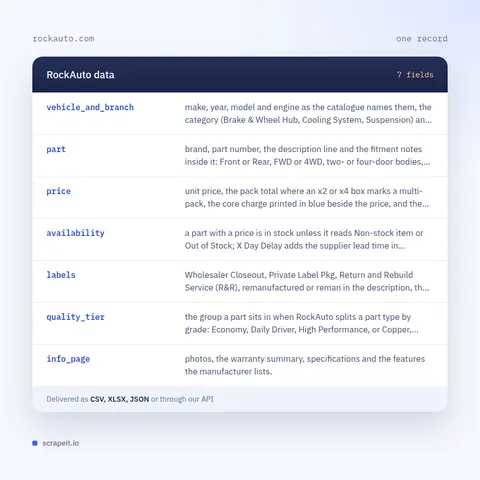
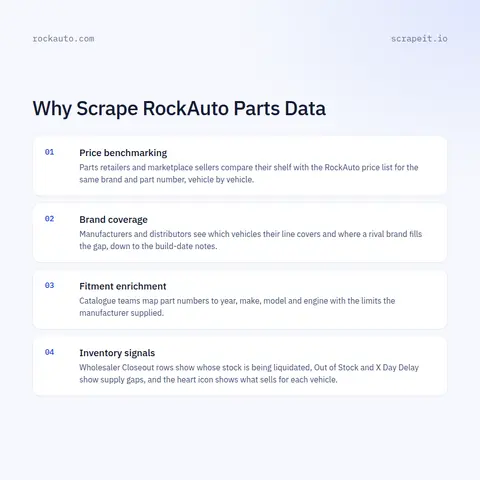
A listing page answers one question for one vehicle. Most buyers need the catalogue sideways: one part type across every vehicle, or one brand across every part type. Because RockAuto files a part under each application it fits, the same part number turns up under many vehicles - we deliver it once in a parts table and again in a fitment table that links it to every make, model, engine and build-date limit.
Outside the vehicle tree, the Tools & Universal Parts tab lists lights, belts, hoses and other parts by size, and the Promotions & Rebates page points to the Show Closeouts Only switch that lists a vehicle's Wholesaler Closeout parts. Vehicles can be filtered by the market they were first sold in, which matters when you price for the US, Canada or Mexico.
The listing price is not what a buyer pays. RockAuto works out delivery in the cart, for a ZIP code, with a choice of carriers and delivery dates, and adds sales tax once a full ship-to address is entered. For a US ZIP code we can add that quote to each in-stock part: the cheapest delivery option with its carrier, service and delivery-by date, how many options were offered, the sales tax and the order total. A quote takes several requests per part instead of one, so it usually runs for a chosen list of parts rather than the whole catalogue.
RockAuto updates its catalogue daily with new parts, pictures and details. Repeat the crawl on a schedule, keyed on brand and part number, and the price column becomes a history: when a price increase landed, when a closeout appeared and sold out, when a core charge moved. That is the dependable way to track RockAuto price increases - every change carries the date of the run that saw it. Prices are billed in US or Canadian dollars, and the other currencies in the selector are estimates converted at interbank rates each morning, so we record the billing currency and leave conversion to you; otherwise exchange-rate moves would show up as price changes.
RockAuto is an online auto parts retailer, a family business founded in 1999 by automotive engineers and based in Madison, Wisconsin. It has no stores and no parts counter: orders are placed only on the website and ship from warehouses, sometimes straight from the manufacturer. The catalogue was built to list every available item with its specifications instead of what one store stocks, so a single part type can show several brands at very different prices for the same vehicle.
That catalogue is a tree. Makes run alphabetically, from current brands to long-gone names such as Duesenberg, Packard and Hupmobile; under each sit years, models and engines, then categories and part types, with frequently bought part types printed in bold. The interface comes in English, Spanish, German and French, and the currency selector runs from US and Canadian dollars to euros, pounds, yen and pesos. Account is marked Optional, and prices, stock labels and fitment notes are visible without signing in.
A box on the home page sets one part's RockAuto price against the regular price of the same brand at national store chains, dated with the day the comparison was taken - RockAuto's own case for being the cheaper option.
Delivery: CSV, JSON or XLSX files, our API or a JSON feed. MCP server on request.
Full plan detailsRockAuto shows the brands it carries for one application on one screen, which makes it a ready benchmark: one vehicle, one part type, one price per brand.
RVUSA catalogs by model year and a full feature-tag list per RV model on RVing Planet, rebuilt from its filters, for a returning client.
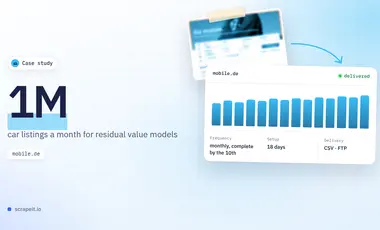
A monthly snapshot of mobile.de for an automotive data company: cars and vans up to 12 years old, delivered in the client's own CSV template.
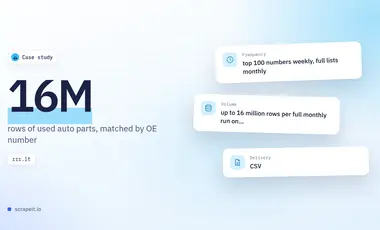
Weekly and monthly prices of used parts by OE number from rrr.lt and a Scandinavian marketplace, for a car dismantling business.
Learn how to use web scraping to solve data problems for your organization
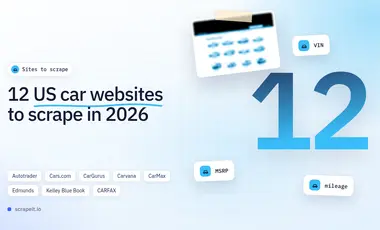
Twelve US car websites compared as data sources, from Autotrader and CarGurus to Copart, IAA and the RV sites: what each shows, which fields need care - VIN, trim, deal labels, damage codes - and how to merge them into one dataset.
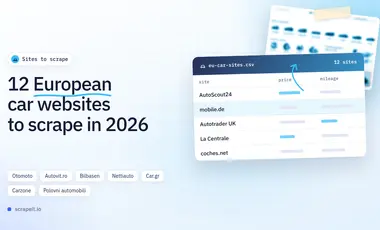
Twelve car marketplaces across Europe compared as data sources, from AutoScout24 and mobile.de to Otomoto, Bilbasen and Car.gr: what each shows, how VAT, mileage, inspection and seller fields differ by market, and how to merge them into one schema.
Data scraping is the wide term that includes documents, scans and old screens; web scraping is the part that works on websites. We compare sources, daily work, output and cost drivers, give a briefing checklist and walk through two of our projects.

ScrapeIt is a managed web scraping service. We build, run and repair the crawlers and hand over the dataset with field documentation, as a one-off extract or on the schedule you set. Catalogues like RockAuto's, where one part fits many vehicles and the useful facts hide in labels and icons, need a crawl that walks the vehicle tree and keeps every label as a column of its own. A free project assessment comes first. Plans start from EUR 169 a month, or EUR 199 for a one-time extract.
Still unsure? Write to info@scrapeit.io
Yes. The ScrapeIt RockAuto API returns brand, part number, unit price, core charge, stock label and the vehicle branch of each row as JSON from an endpoint we host, refreshed on your schedule. If files suit you better, the same rows come as CSV or XLSX, a JSON feed or a load into your database.
Yes. Prices, part numbers, fitment notes and stock labels appear for anyone who picks a vehicle, and the account is optional. We collect only publicly available data - everything a visitor can see on RockAuto - and we collect it legally. We never log in, and steps that need a cart or a postal code stay out of scope.
Yes. We walk every year, model and engine of the make and every category beneath it, then deliver a parts table keyed on brand and part number and a fitment table linking each part to its vehicles. The free assessment sizes the job, and it can be limited to model years or categories.
RockAuto bills in US or Canadian dollars; the euro, pound and other options in its currency selector are estimates converted at interbank rates updated each morning. We collect USD by default, or CAD on request, and stamp every row with its currency code.
For price monitoring, daily: the catalogue is updated daily, closeout stock is limited to the quantity on hand, and stock labels move. For assortment or fitment work, weekly or monthly is enough. Each run is dated, so every change in the history shows when it happened.
You share your needs, expectations, and desired timeframe. We'll suggest the best solution based on your request and budget.
Our specialists configure the crawlers and extract a sample dataset for your review before proceeding with the full-scale extraction.
Once you approve the sample, we launch the project and start full data collection. We gather, filter, and structure the data for easy use, delivering it on time in your preferred format.
Our team manages ongoing processes, monitors website changes, and supports all data extraction cycles. We can also help integrate data into your systems or create dashboards to simplify analysis.
Tell us which sites, which fields and how often. A couple of lines is enough to start.
RockAuto data from €169/month. Free project assessment, reply within 1 business day.