Dealer-Ready Datasets with Every Parameter That Matters
Daily monitoring of car listings on car.gr and autoscout24.com, collecting full technical specifications to support a European auto dealer.
Learn More
A Copart lot stays public only until its sale: it gets a yard, a lane and a sale date, and then it is gone. Our Copart scraper records every lot while it can still be seen.
Plans from €169/month · Free project assessment · Reply within 1 business day
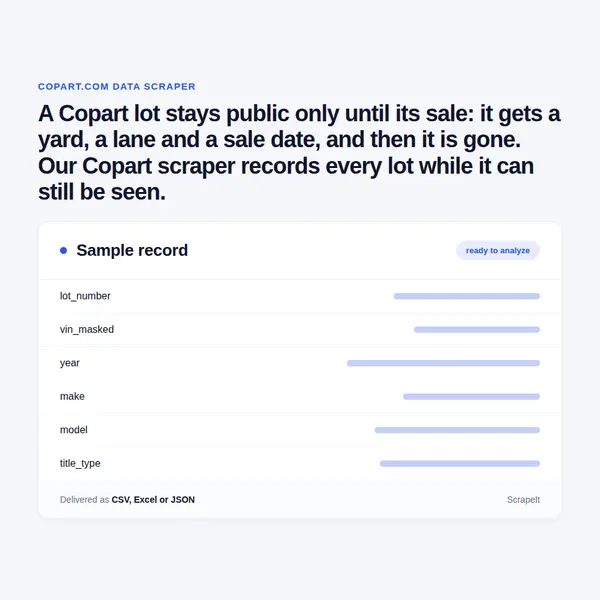
You do not run anything. You tell us which part of Copart you need - a country site, a set of yards, vehicle types, makes, damage types, title types or a list of lot numbers - and how often. We build the crawlers, run them and repair them when the Vehicle Finder or the lot page changes.
Copart draws its lot pages in the browser and meets unfamiliar traffic with a challenge screen, so rendering, pacing, proxy rotation and CAPTCHA handling are part of the service. We work as a guest and never log in: the dataset holds what the public lot page shows and nothing from the member dashboard. A free project assessment comes first, a sample can be ordered, and field documentation ships with every delivery - CSV, Excel, JSON, a JSON feed, our API or a load into your database.
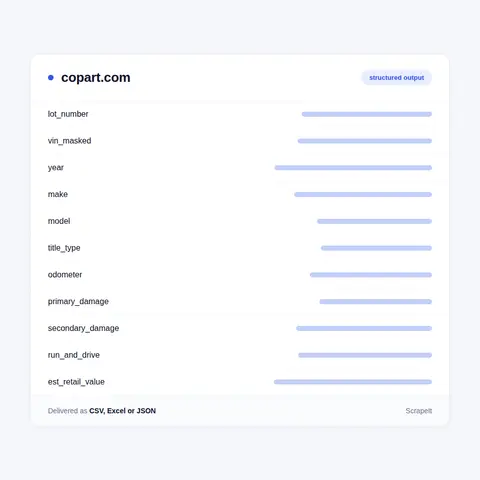
Everything on Copart hangs on the lot number. It sits in the address of the lot page, followed by a slug that already says a good deal about the vehicle: salvage or clean title, year, make, model, trim and yard, with the state added on the American site. A Copart web scraper keys every row on that number. From the public lot page we collect:
A field the lot does not carry - a secondary damage, a Buy It Now price - stays empty instead of being filled with a guess, and every row is stamped with the country site and the time it was read.
A lot page answers one question. The rest of the public site answers the others, and we collect it in the same run.
History comes from repetition. A lot leaves the site after its sale, so to view old Copart listings later they have to be captured while they are live. Repeated runs keyed on the lot number record every change of current bid, sale status and sale date, and that sequence is the price history of the lot up to the auction. The final sale result is not shown on the public page and is not in the dataset.
Copart, headquartered in Dallas, Texas, sells vehicles on behalf of insurance companies, banks and finance companies, fleet owners, dealers and charities. Much of the stock is total-loss cars written off after a claim, which is why the site reads less like a classifieds board and more like a claims file: damage codes, title documents, a run-and-drive check made when the vehicle arrived at the yard, and a retail estimate from the seller.
The stock is physical. Every lot sits in a named yard, is assigned to that yard's sale day and is sold in an online auction; bidding is for members, viewing is for anyone. The sale status printed on a lot decides what a winning bid means: Pure Sale has no reserve, On Minimum Bid has one, On Approval leaves the decision to the seller.
Copart runs separate country sites. Its region selector lists the USA, the UK, Canada, Germany, Spain, Ireland, Brazil, and the UAE, Bahrain and Oman, on domains such as copart.com, copart.co.uk, copart.ca, copart.de, copart.es, copart.ie and copart.com.br. Vocabulary shifts with the market: the British site sorts insurance write-offs into Category S, Category N and their neighbours where the American site speaks of salvage and clean title, and the British lot page adds whether the V5 registration document is available and whether VAT is added to the final price. Each country is a crawl of its own, in its own currency.
Get a Quote
Developers

Customers worldwide

Pages extracted

Hours saved for our clients
€199 / one-time
setup fee - included
€169 / mo
setup fee €499
€229 / mo
setup fee €499
€349 / mo
setup fee €499
€549 / mo
setup fee €799
Delivery: CSV, JSON or XLSX files, our API or a JSON feed. MCP server on request.
Full plan details →Copart reads like an open ledger of damaged vehicles, and each use below leans on a particular field.

Daily monitoring of car listings on car.gr and autoscout24.com, collecting full technical specifications to support a European auto dealer.
Learn MoreLearn how to use web scraping to solve data problems for your organization

Leveraging advances in technology, the AI-powered web scraper has skyrocketed in demand and is helping to expand capabilities by automating tedious daily tasks and speeding up data collection from thousands of websites several times over.

Web scraping is a method of obtaining web data by extracting it from pages of web resources with the help of a program, that is, in automatic mode. It is used to syntactically convert web pages into more usable forms.

If you specialize in machine learning, you need to feed large amounts of data to the algorithms. Web scraping is the easiest and the most efficient method of collecting the data from all over the Internet.
ScrapeIt is a managed web scraping agency: clients describe the data they need, we build and run the crawlers and deliver the dataset. Auction sites are a distinct kind of job - the stock is short-lived, the page is assembled in the browser and the useful signal is the change between two readings - and we plan Copart projects around that.
Yards are businesses and are collected as the site shows them. Where a yard page names its general manager, that name is personal data: under GDPR it is left out by default, and we do not sell dossiers on people or personal contact lists.
Yes. The ScrapeIt Copart API returns lot number, title type, primary and secondary damage, odometer, current bid, sale status and sale date as JSON from an endpoint we host, refreshed on the schedule you set. The same rows also arrive as CSV or XLSX files, as a JSON feed or as a load into your database.
Yes. Lot pages, search results, sales lists and the auction calendar are open to any visitor without an account. We collect only publicly available data - everything a visitor can see on Copart - and we collect it legally. We never log in, so nothing from the member area is in the dataset.
Yes, by reading the same lots repeatedly before the sale. Each run stores the current bid, the Buy It Now price where one exists, the estimated retail value and the sale status against the lot number, which gives the bid curve of one lot and, across lots, the price level of a model by damage code and yard. The final sale result is not shown on the public page, so it is not part of the data.
Every site in the region selector: the USA, the UK, Canada, Germany, Spain, Ireland, Brazil, and the Middle East site for the UAE, Bahrain and Oman. Each one is crawled separately and keeps its own vocabulary and currency, so rows carry a country column and, for the UK, the write-off category in place of the American title type.
Daily at least, because a lot exists on the site only until its sale. New lots appear every day, sale dates are assigned and moved, and the current bid changes during preliminary bidding, so a weekly run loses the bids and date changes in between. For bid tracking on a shortlist, the same lots can be read several times a day in the run-up to the auction.
Step 1 - Make a Request
You share your needs, expectations, and desired timeframe. We’ll suggest the best solution based on your request and budget.
Step 2 - Configuring Custom Web Crawlers
Our specialists configure the crawlers and extract a sample dataset for your review before proceeding with the full-scale extraction.
Step 3 - Collect and Deliver
Once you approve the sample, we launch the project and start full data collection. We gather, filter, and structure the data for easy use, delivering it on time in your preferred format.
Step 4 - Maintain and Support
Our team manages ongoing processes, monitors website changes, and supports all data extraction cycles. We can also help integrate data into your systems or create dashboards to simplify analysis.
Copart data from €169/month. Free project assessment, reply within 1 business day.

Scrapeit Sp. z o.o.
10/208 Legionowa str., 15-099, Bialystok, Poland
NIP: 5423457175
REGON: 523384582