UK Parliament Scraper for Bills, Debates, Votes and Questions

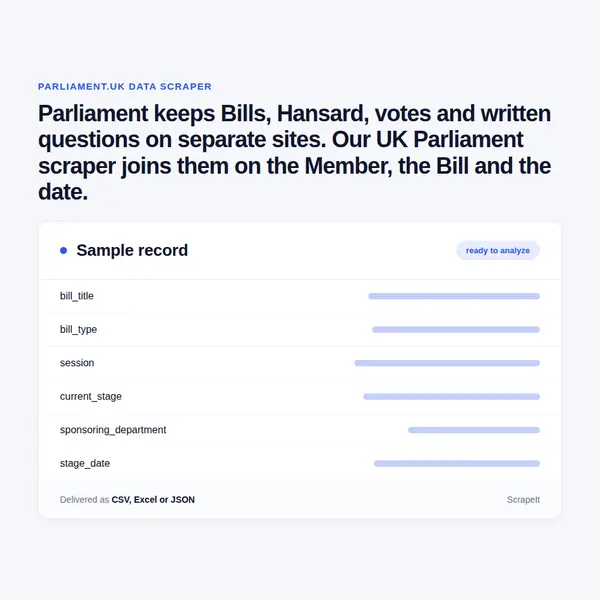
Parliament keeps Bills, Hansard, votes and written questions on separate sites. Our UK Parliament scraper joins them on the Member, the Bill and the date.

Plans from €169 a month · Free project assessment · Reply within 1 business day

CSV · Excel · JSON · XML · FTP · SFTP · Amazon S3 · Google Cloud

parliament.uk
UK Parliament Scraper for Bills, Debates, Votes and Questions
parliament.ukwhat you get
Typical fields for public registers
record_identity_namestatusregistered_ataddressdocument_url
Delivery

API, JSON feed or CSV, XLSX and JSON files

Schedule

One-time, monthly, weekly, daily or 3 times a day

How our UK Parliament data scraper works

  1. You send

    UK Parliament pages, filters, fields and a schedule

  2. We run the scrapers

    Built, monitored and repaired by our team

  3. You receive the data

    API, JSON feed or CSV, XLSX and JSON files

You tell us which parts of the record you follow - Bills in a policy area, every division of the House of Commons, written questions to one department, Hansard mentions of your sector - and how often. We build the crawlers for each Parliament site, run them and repair them when a page layout changes. Anti-bot handling, pacing and proxy rotation are part of the service.

The value is in the joins. A question, a vote and a speech by the same MP arrive with one Member key, and a Bill's stages, publications and divisions sit under one Bill key. Runs are one-off for a research archive or daily while the House sits. Data comes as CSV or Excel files, JSON, a load into your database or our API, with field documentation and a free project assessment first.

UK Parliament data: fields we extract

Each Parliament site has its own record type, so the dataset is a set of linked tables rather than one sheet. These are the fields a visitor sees on the public pages, grouped the way we deliver them:

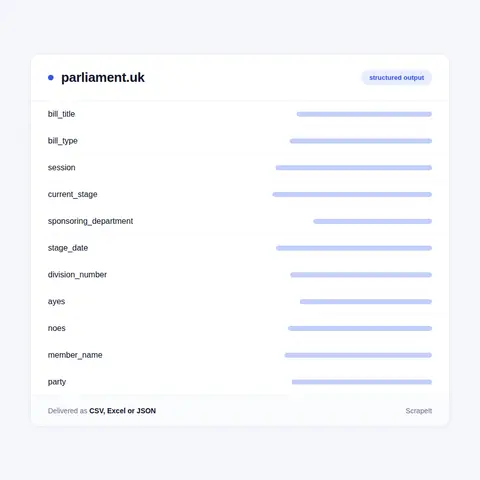
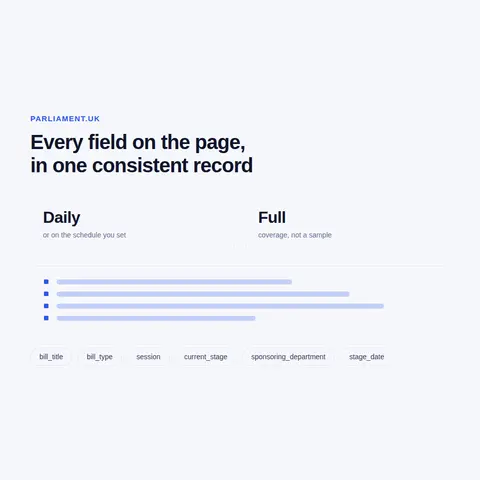
  • BillsBill title and Bill id from the address, Bill type (Government Bill, Private Members' Bill by ballot, presentation or the Ten Minute Rule, Consolidation Bill and others), the session or sessions it spans, originating House, long title, sponsoring department and the sponsoring ministers with party and seat, and the Last updated time.
  • Bill stagesevery stage with its date and House: 1st and 2nd reading, Committee stage, Report stage, 3rd reading, consideration of amendments and Royal Assent, plus programme, money and carry-over motions, and the Next Stage label on the list page.
  • PublicationsBill versions with their print numbers (as introduced, as amended in Committee, Lords Amendments), explanatory notes, amendment papers, briefing papers and committee reports, each with date and House.
  • Hansarddebate title, House and section (Commons Chamber, Westminster Hall, Written Statements, General Committees, Public Bill Committees), volume, column, time stamp, and each contribution with the speaker's name, constituency, party and text.
  • Divisionsdivision number, title, date and time, the result line, Ayes and Noes in the Commons or Contents and Not Contents in the Lords, tellers, and the vote of every Member listed by party, including proxy votes.
  • Written questionsUIN, heading, the department the question is for, the asking Member, question text, tabled and answered dates, the answering Member and answering body, the answer text, and the Named day and Answered flags.
  • Early Day MotionsEDM number, title, tabling Member, date tabled and the count of signatures.
  • Membersname, party, constituency or peerage, current status, posts held, committee memberships and dates of each representation.

Every row keeps the address it came from, so any figure can be traced back to the page that shows it.

UK Parliament data: fields we extract
Scrape UK Parliament across sessions and committees

Scrape UK Parliament across sessions and committees

Most questions about Parliament are questions about change, and change only shows up across repeated runs. A Bill's Next Stage moves on, a written question picks up its answer, an Early Day Motion gains signatures week by week. Keyed on the Bill id, UIN and EDM number, our runs record when each of those moved, which the pages themselves only show as the latest state.

Member pages add a second axis. Each MP or Lord has tabs for parliamentary career, voting record, Early Day Motions, spoken contributions and written questions, so a profile becomes a timeline of party affiliations, seats, front-bench posts and committee memberships with start and end dates. Lords Members carry their type of peerage, such as Life peer.

The committees site lists current inquiries, oral evidence sessions by committee and inquiry, and committee publications by session. Members of Parliament act in public and stay in the data; private people who give evidence or appear in answers are left out by default, under GDPR. For archive work, the Bills pages keep past sessions searchable next to the current one.

How the UK Parliament database is organised

Source
parliament.uk
Category
public registers
Delivery
API, JSON feed, CSV, XLSX
Plans
From €169 a month
Get a quote

There is no single UK Parliament database to search. parliament.uk is a family of subdomains, each with its own record type and search form: bills.parliament.uk for legislation, hansard.parliament.uk for the official report of debates, votes.parliament.uk for divisions, questions-statements.parliament.uk for written questions and statements, members.parliament.uk for MPs and Lords, edm.parliament.uk for Early Day Motions and committees.parliament.uk for select committees and their inquiries.

Two Houses, the House of Commons and the House of Lords, run through all of them, and their vocabulary differs. A Commons division counts Ayes and Noes; a Lords division counts Contents and Not Contents. Written questions carry a Commons or Lords tag, and only Commons MPs can table a named day question. Business is grouped by parliamentary session, and a Bill carried over from one session to the next lists both.

The filters follow the same logic: Bills by session, Bill type, stage, current House, sponsoring Member and department; Members by party, gender and whether they sit now or sat in an earlier Parliament; votes and questions by date ranges. Hansard can be browsed sitting by sitting, and daily debates appear on the site the next working day.

25Developers
500+Customers
1.5BPages extracted
15,000+Hours saved for our clients

UK Parliament scraping plans and pricing

Airplane

€199one-time

Setup fee included

100,000
One-time
Up to 5 days
7 days

Helicopter

€169/ mo

Setup fee €499

250,000
Monthly
Up to 5 days
14 days

Glasses

€229/ mo

Setup fee €499

1,000,000
Weekly
Up to 5 days
30 days

Microscope popular

€349/ mo

Setup fee €499

2,000,000
Daily
Same day
60 days

DNA

€549/ mo

Setup fee €799

3,000,000
3 times daily
Same day
90 days

Delivery: CSV, JSON or XLSX files, our API or a JSON feed. MCP server on request.

Full plan details

Why collect UK Parliament Hansard data and votes

Public affairs teams use the Bill tables as a legislative tracker: every Bill touching their sector, its sponsoring department, its current stage and the dates of the next one, with a flag when an amendment paper or a new print of the Bill appears.

Hansard text answers the question of who said what. Searching contributions for a company, a product or a policy term, then grouping by party, House and constituency, shows which Members raise an issue and how often. Written questions do the same for scrutiny of a department: which answering body gets asked about a topic, by whom, and how long answers take between tabled and answered dates.

Division data supports voting analysis - party cohesion, rebellions on a clause, proxy voting, and how a Member's voting record lines up with their speeches. Early Day Motion signatures give an early read on cross-party support before a topic reaches a vote. Researchers, journalists and consultancies combine all of it into one timeline per Member or per Bill.

About ScrapeIt

ScrapeIt is a managed web scraping service: we build, run and maintain the crawlers and hand over finished datasets. Government sources are a steady part of the work - registers, gazettes and parliamentary records whose value lies in following each record as it changes. For Parliament that means one schema across Bills, Hansard, votes and questions, delivered on the schedule you set. Plans start from EUR 169 a month, or EUR 199 for a one-time extract.

FAQ

Still unsure? Write to info@scrapeit.io

Do you offer a UK Parliament API for Bills, votes and questions?

Yes. The ScrapeIt UK Parliament API returns Bill stages, division results with each Member's vote, written questions with their answers and Hansard contributions as JSON from an endpoint we host, refreshed on the schedule you set. The same data also comes as CSV or XLSX files, a JSON feed or straight into your database.

Is it legal to scrape UK Parliament?

Yes. Bills, Hansard, division lists, written questions and Member pages are published for anyone to read without an account. We collect only publicly available data - everything a visitor can see on the UK Parliament sites - and we collect it legally.

Can you scrape Hansard debates by speaker?

Yes. Every Hansard contribution carries the speaker's name, constituency and party, plus the volume, column and time stamp of the sitting. We split a debate into one row per contribution, so you can filter speeches by Member, party, House or debate section such as Westminster Hall.

How often are UK Parliament votes updated, and how often do you collect them?

Divisions are listed on the votes pages with their number, date and time, and Hansard debates are published the next working day. We can run daily on sitting days, so new divisions, answered questions and moved Bill stages reach you with the next run.

Can you link a Member's votes, questions and speeches?

Yes. Member pages carry a stable Member id, and the same id ties the voting record, written questions, Early Day Motions and spoken contributions together. We deliver a Members table with party, constituency and posts, and every other table refers to it.

How it works

  1. 1

    Make a request

    You share your needs, expectations, and desired timeframe. We'll suggest the best solution based on your request and budget.

  2. 2

    We configure the crawlers

    Our specialists configure the crawlers and extract a sample dataset for your review before proceeding with the full-scale extraction.

  3. 3

    Collect and deliver

    Once you approve the sample, we launch the project and start full data collection. We gather, filter, and structure the data for easy use, delivering it on time in your preferred format.

  4. 4

    Maintain and support

    Our team manages ongoing processes, monitors website changes, and supports all data extraction cycles. We can also help integrate data into your systems or create dashboards to simplify analysis.

Request a quote

Tell us which sites, which fields and how often. A couple of lines is enough to start.

  • We reply within 1 business day
  • A sample dataset before the full run
  • We sign an NDA on request
  • Delivery by API, JSON feed or files
Which sites, which fields, how often. A couple of lines is enough.

This form is protected by Google reCAPTCHA, which loads when you start filling it in; the Google Privacy Policy and Terms of Service apply. If you prefer not to use it, email us at info@scrapeit.io. Privacy & Cookie Policy

We reply within 1 business day. No obligation.

UK Parliament data from €169/month. Free project assessment, reply within 1 business day.