Find a Tender Scraper for UK Procurement Notices and Contract Awards

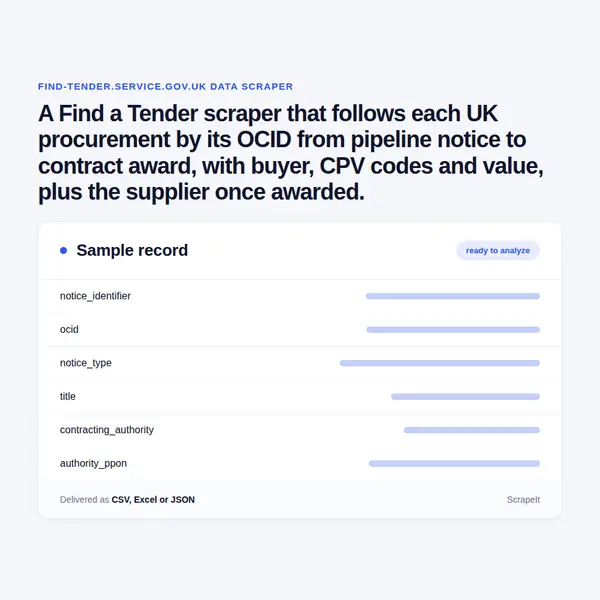
A Find a Tender scraper that follows each UK procurement by its OCID from pipeline notice to contract award, with buyer, CPV codes and value, plus the supplier once awarded.

Plans from €169 a month · Free project assessment · Reply within 1 business day

CSV · Excel · JSON · XML · FTP · SFTP · Amazon S3 · Google Cloud

find-tender.service.gov.uk
Find a Tender Scraper for UK Procurement Notices and Contract Awards
find-tender.service.gov.ukwhat you get
Typical fields for public registers
record_identity_namestatusregistered_ataddressdocument_url
Delivery

API, JSON feed or CSV, XLSX and JSON files

Schedule

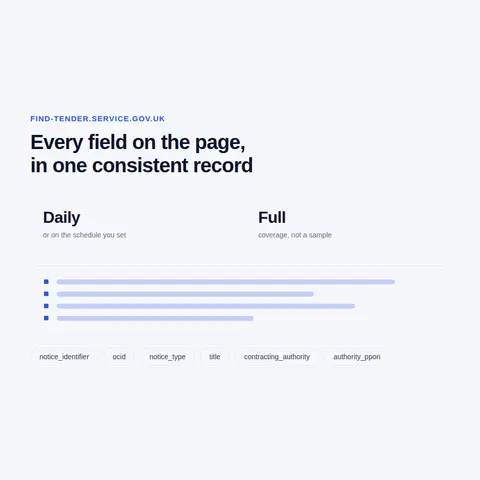
One-time, monthly, weekly, daily or 3 times a day

Find a Tender data, collected as a managed service

  1. You send

    Find a Tender pages, filters, fields and a schedule

  2. We run the scrapers

    Built, monitored and repaired by our team

  3. You receive the data

    API, JSON feed or CSV, XLSX and JSON files

You tell us which notices matter - by notice type, CPV code, contract location, contracting authority, value band or keyword - and we build the crawler, run it and repair it when the service changes its pages. New notices appear on Find a Tender throughout the working day, so a daily run is the usual choice for bid monitoring; a one-off extract of a past period works too. Pacing, proxy rotation and rendering are part of the service, not something you manage.

Each run is matched against the previous one on the notice identifier and the procurement identifier, so a fresh UK4 tender notice, a moved deadline or a UK6 award reaches you as a change to a procurement you already hold rather than as a stray record. A free project assessment comes first, and field documentation comes with the dataset.

Find a Tender notice fields we extract

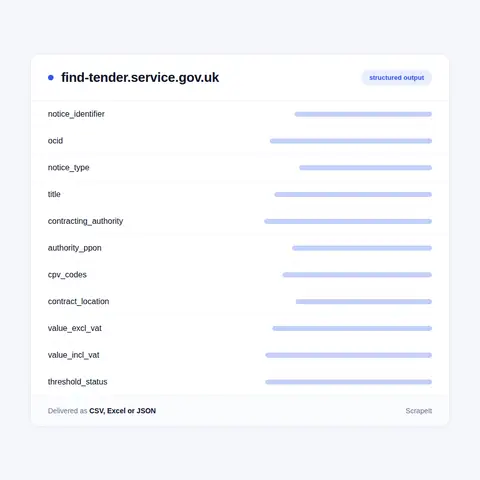
A Find a Tender notice is a long structured page split into sections such as Scope, Participation, Submission, Award criteria, Procedure, Documents, Supplier and Contracting authority. We keep that structure and give every value its own column:

  • Identitythe notice identifier in the 2026/S 000-109211 form, the procurement identifier (OCID) that ties all notices of one procurement together, the notice type code and name, the legal regime, publication date and time, and the notice URL.
  • Scopetitle, description, the buyer's own reference, main procurement category such as Works or Services, CPV codes with their names, and contract locations with their region codes, for example UKD - North West (England).
  • Value and datestotal value estimated excluding and including VAT, the above threshold or below threshold marker, contract dates and duration, possible extension and options.
  • Participation and submissionwhat the procurement is reserved for, particular suitability for SME and VCSE suppliers, enquiry deadline, submission deadline and whether tenders may be submitted electronically.
  • Award criteriaeach criterion from the notice's table with its name, description, type and weighting, so price and quality criteria sit in separate columns.
  • Procedureprocedure type, such as Below threshold - open competition or limited competition.
  • Contracting authorityname, Public Procurement Organisation Number, address, region, organisation type and website.
  • Award and contractsupplier name and its own Public Procurement Organisation Number, contract value, date signed, contract dates, and the SME and VCSE answers recorded for the supplier.
  • Documentsthe names of the associated tender documents attached to the notice.

Notices often name a contact person with a direct phone number. That is personal data, so it is left out by default; the authority's address, website and general mailbox stay in the row.

Find a Tender notice fields we extract
Find a Tender dataset: procurements, commercial tools and payments

Find a Tender dataset: procurements, commercial tools and payments

Single notices are only half of the picture. Find a Tender also runs a summarised search that gathers every notice of a procurement in one place, in three views: Opportunities with the statuses Pipeline, Preliminary Market Engagement, Planned procurement and Active tender; Contracts, active and closed, with the supplier type; and Commercial tools - frameworks, dynamic markets and dynamic purchasing systems. We collect these views next to the notices, so one row per OCID tells you where a procurement stands today.

The Payments transparency register sits under the same service. Each entry names the contracting authority, the contract, the supplier, the payment value excluding VAT, the date the payment was made, the date it was published and the OCID, which lets us join actual payments to the contract they were made against.

History comes from repeated runs. A UK10 contract change notice, a UK11 termination or a corrected deadline is stored as a new version of the same procurement, so you can read the whole life of a contract from pipeline notice to termination.

About Find a Tender and the UK notice regime

Source
find-tender.service.gov.uk
Category
public registers
Delivery
API, JSON feed, CSV, XLSX
Plans
From €169 a month
Get a quote

Find a Tender is the GOV.UK service where public sector buyers publish notices about procurement opportunities and contracts. It replaced Tenders Electronic Daily (TED) in the UK on 31 December 2020. Since 24 February 2025 it carries both above and below threshold notices for new UK procurements, except below threshold procurements in Scotland, and above threshold notices outside Scotland now follow a contract through its full life cycle.

Two families of notice live side by side. Procurements under the Procurement Act 2023 use the UK1 to UK17 notice types - pipeline notice, preliminary market engagement, tender notice, transparency notice, contract award notice, contract details notice, contract change, termination, dynamic market notices and the payments compliance notice. Procurements that started earlier keep the older F01 to F25 forms of the Public Contracts Regulations 2015 and related regulations, plus the T01 and T02 notices for public service contracts.

Search groups notices into the stages Pipeline, Planning, Tender, Award, Contract, Termination and Payments compliance, and buyers are typed as central government, regional and local public authority, public undertaking, private utility or other. The interface runs in English and Cymraeg, and some Welsh buyers appear under bilingual names such as Llywodraeth Cymru / Welsh Government.

25Developers
500+Customers
1.5BPages extracted
15,000+Hours saved for our clients

Find a Tender scraping plans and pricing

Airplane

€199one-time

Setup fee included

100,000
One-time
Up to 5 days
7 days

Helicopter

€169/ mo

Setup fee €499

250,000
Monthly
Up to 5 days
14 days

Glasses

€229/ mo

Setup fee €499

1,000,000
Weekly
Up to 5 days
30 days

Microscope popular

€349/ mo

Setup fee €499

2,000,000
Daily
Same day
60 days

DNA

€549/ mo

Setup fee €799

3,000,000
3 times daily
Same day
90 days

Delivery: CSV, JSON or XLSX files, our API or a JSON feed. MCP server on request.

Full plan details

Why collect Find a Tender notices

Bid pipelines. Suppliers watch UK4 tender notices by CPV code, region and value, sorted by submission deadline, and pick up pipeline and preliminary market engagement notices months before a tender opens. A daily feed into a CRM replaces manual searching.

Competitor and market intelligence. Contract award and contract details notices name the winning supplier, the value and the dates. Over time that shows which companies win which kind of work from which authorities, what share goes to SME and VCSE suppliers, and how award criteria weight price against quality.

Re-procurement forecasting. Contract end dates and extension options point to the next round of a contract long before the new tender is published. The commercial tools view lists the frameworks and dynamic markets a buyer can call off from, and dynamic market establishment notices name the suppliers admitted to them.

Spend analysis. Joining payments from the transparency register to contracts by OCID compares money actually paid with the value a notice announced, buyer by buyer.

About ScrapeIt

ScrapeIt is a managed web scraping service: we build, run and maintain the crawlers, and you receive the dataset. Public procurement sources are a good fit for this way of working, because their value lies in identifiers and changes over time rather than in a single snapshot. For Find a Tender we deliver notices keyed on notice identifier and OCID, as CSV, Excel, JSON or JSONLines files, through our API or into your database.

FAQ

Still unsure? Write to info@scrapeit.io

Do you offer a Find a Tender API for notices and awards?

Yes. The ScrapeIt Find a Tender API returns notice type, OCID, CPV codes, contract value, submission deadline and awarded supplier as JSON from an endpoint we host, refreshed on the schedule you set. The same records also come as CSV or XLSX files, a JSON feed or a load straight into your database.

Is it legal to scrape Find a Tender?

Yes. Find a Tender notices are open to anyone without signing in - buyers, values, CPV codes, deadlines and awarded suppliers. We collect only publicly available data - everything a visitor can see on Find a Tender - and we collect it legally. Named contact persons are left out by default, and personal data is handled under GDPR.

Can you scrape Find a Tender contract awards with supplier details?

Yes. UK6 contract award notices and the older F03 award notices name the supplier and the contract value; UK7 contract details notices, published once the contract is signed, add the date signed and the contract dates. Under the Procurement Act 2023 the supplier also carries a Public Procurement Organisation Number and SME and VCSE answers, which we keep as separate columns.

Do you cover notices published under the older regulations?

Yes. Procurements started before 24 February 2025 still publish F-form notices such as F02 contract notices, F03 award notices and F20 modification notices. We map both families to one schema, keeping the original notice type, so a dataset can span the change of regime without two separate files.

How often are Find a Tender notices published, and how often should we refresh?

Buyers publish new notices throughout the working day, and deadlines or values can change through later notices on the same OCID. Daily runs suit most bid teams; a weekly run is enough for market analysis, and an on-demand extract covers a one-off study of a past period.

How it works

  1. 1

    Make a request

    You share your needs, expectations, and desired timeframe. We'll suggest the best solution based on your request and budget.

  2. 2

    We configure the crawlers

    Our specialists configure the crawlers and extract a sample dataset for your review before proceeding with the full-scale extraction.

  3. 3

    Collect and deliver

    Once you approve the sample, we launch the project and start full data collection. We gather, filter, and structure the data for easy use, delivering it on time in your preferred format.

  4. 4

    Maintain and support

    Our team manages ongoing processes, monitors website changes, and supports all data extraction cycles. We can also help integrate data into your systems or create dashboards to simplify analysis.

Request a quote

Tell us which sites, which fields and how often. A couple of lines is enough to start.

  • We reply within 1 business day
  • A sample dataset before the full run
  • We sign an NDA on request
  • Delivery by API, JSON feed or files
Which sites, which fields, how often. A couple of lines is enough.

This form is protected by Google reCAPTCHA, which loads when you start filling it in; the Google Privacy Policy and Terms of Service apply. If you prefer not to use it, email us at info@scrapeit.io. Privacy & Cookie Policy

We reply within 1 business day. No obligation.

Find a Tender data from €169/month. Free project assessment, reply within 1 business day.