230,000 Daily Rows Standardized Across 5 EU Property Sites
Monitoring of real estate listings on funda.nl, pararius.com, rentberry.com, rentola.com, and zimmo.be to support the growth of a European property portal.
Learn More
We build and run the crawler, resolve every Immowelt geo id and expose UUID, and hand back Immowelt data on your schedule as CSV, JSON, XLSX or an API.
Plans from €169/month · Free project assessment · Reply within 1 business day
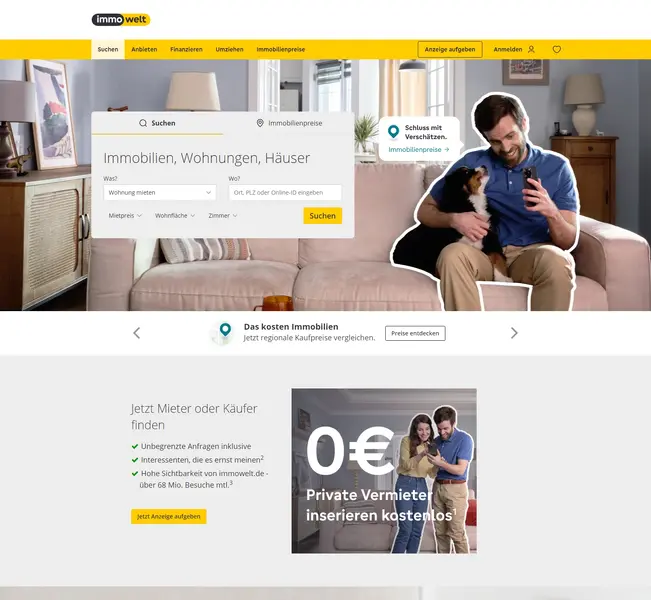
You describe the target - regions, segments, fields, frequency. We build the crawler, run it, and keep it working when Immowelt changes its markup. Output arrives as CSV, JSON, XLSX or an API endpoint, on the schedule you set: once, nightly, or several times a day for fast-moving city rentals.
The schema is fitted to your side, not ours. Column names, units, currency handling, one row per expose or one row per expose per run for change tracking, and the UUID kept intact so the data joins to what you already hold. When a page does not serve on a given run, the record is marked as not collected rather than filled with a guess.
An Immowelt expose prints the seller's declared numbers and the portal's own computed ones in one layout. A usable extract keeps them apart.
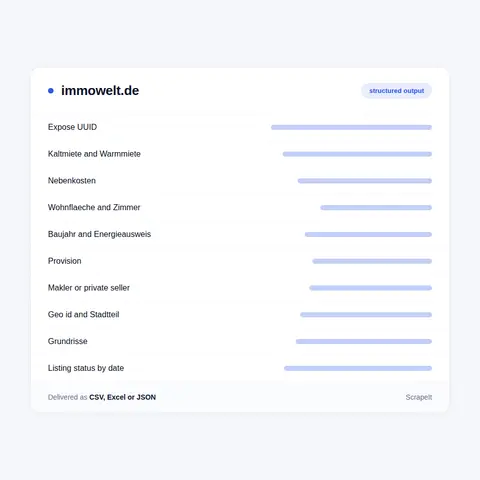
Immowelt identifies a listing with a UUID. An expose URL reads /expose/0af2db2b-9b04-43e5-b8dc-6f63c12f7120. Older project listings still use a short code instead, as in /projekte/expose/k2dc732. The UUID is the join key we carry into every delivery.
Geography sits in a token at the end of the search path, and the prefix marks the level. ad04de is a Bundesland (bayern/ad04de9), ad06de a Kreis (harburg-03353/ad06de37), ad08de a city or municipality (munchen-80331/ad08de6345), and ad09de or nbh2de a Stadtteil (stuttgart-70173/botnang-70195/ad09de353). The number inside the slug is not decoration: at Kreis level it is the five-digit official Kreisschlüssel, as in recklinghausen-05562, while city and Stadtteil slugs carry a Postleitzahl.
The same token drives the search URLs. Munich is ad08de6345 in the readable path and AD08DE6345 as the locations value in a parameterised search URL. Filters ride in the path as stacked segments - privat, ohne-provision, wbs-ja, wohnen-auf-zeit, wohngemeinschaft, zimmer-3, guenstig. We build the crawl frontier from these, so a brief such as two-room rentals from private sellers in three Stadtteile of Leipzig becomes a concrete list of URLs rather than a search box someone has to drive by hand.
Immowelt runs immowelt.de, a German property portal operated by AVIV Germany, part of the Aviv Group. The corporate structure matters when you plan a crawl. In 2015 the Bundeskartellamt cleared a joint venture that placed immowelt.de and immonet.de under the same roof, and the two catalogues have been converging ever since.
That convergence is now visible on the wire. Every immonet.de path now redirects to www.immowelt.de, so immonet is no longer a separate source and collection targets immowelt directly. The path is discarded and only the query string survives, so a request for /immobiliensuche/sel.do?suchart=2&city=87991 lands on the Immowelt home page rather than on an equivalent Immowelt search. Anyone still treating immonet.de as a second German source is collecting a redirect. One Immowelt scraper now covers what used to be two targets.
The portal splits its inventory three ways at the top of the URL: mieten for rentals, kaufen for sales and zwangsversteigerung for forced auctions. Beneath those sit the residential types and a full commercial set - office, retail, warehousing, hospitality, agriculture and parking. The sitemap index at /sitemaps/sitemap_index.xml listed 204 sitemap files, and each file is one facet of that catalogue.
Get a Quote
Developers

Customers worldwide

Pages extracted

Hours saved for our clients
€199 / one-time
setup fee - included
€169 / mo
setup fee €499
€229 / mo
setup fee €499
€349 / mo
setup fee €499
€549 / mo
setup fee €799
Delivery: CSV, JSON or XLSX files, our API or a JSON feed. MCP server on request.
Full plan details →A single snapshot answers what is on the market today. Repeat collection answers what the market is doing. Because each expose keeps a stable UUID, the same listing can be matched across runs, and the differences become the dataset: a Kaltmiete cut, a Provision that changed, a listing that vanished, a listing that came back.
Analysts use Immowelt price series to calibrate valuation models against asking levels at Gemeinde and Stadtteil resolution. Developers size local demand before committing to a site. Agencies watch competitor inventory - which Makler (estate agents) are adding stock, which are letting listings age, which are cutting asking rents. Proptech teams use the feed to seed their own search products.
The private-seller split is the part that usually goes unused. Immowelt exposes a privat facet in the URL, so private listings can be counted as a real share of a local market instead of estimated. The ohne-provision facet does the same for commission-free stock, which is a direct read on how much of a market moves without an agent. Both survive into the delivered rows as flags, so the split can be cut by region and by month.

Monitoring of real estate listings on funda.nl, pararius.com, rentberry.com, rentola.com, and zimmo.be to support the growth of a European property portal.
Learn More
Daily detection of new private property listings in Switzerland on Homegate.ch and ImmoScout24.ch, giving the agency first access to high-value leads.
Learn More
Scraping residential listings from Immobilienscout24.de in Germany and Mallorca, including complete data and resized images.
Learn MoreLearn how to use web scraping to solve data problems for your organization
Real estate teams work in a fragmented data landscape. The sites that drive demand in Boston look nothing like the ones that matter in Berlin, São Paulo, Dubai, or Mumbai.

Real estate teams are operating in a data environment that is bigger, faster, and more fragmented than ever. Listings go live and disappear in hours, price cuts happen quietly, and the portals that matter most in each country are rarely the same global “top 5.”

Six jobs that scraped property data does, each backed by a ScrapeIt project: seller leads, listing monitoring, image datasets, weekly market supply, sold records and unit-level rentals. For every use case - the fields it needs and how often to refresh them.
ScrapeIt is a managed web scraping agency. We are not selling a library, a proxy pool or a dashboard you have to learn. We agree the fields with you, build the crawler, run it on your schedule and repair it when the source changes. You receive data, not maintenance work. Most Immowelt projects start with one region and one segment, then widen once the schema has been checked against real rows.
Yes. The ScrapeIt Immowelt API returns Kaltmiete, Nebenkosten and Warmmiete, Kaufpreis and Provision, Wohnflaeche, Zimmer, the Energieausweis class and the expose UUID as JSON from an endpoint we host, refreshed on the schedule you set. The same data also comes as CSV or XLSX files or straight into your database.
Yes. We collect only publicly available data - the rent and sale blocks, Wohnflaeche, Zimmer, the Energieausweis class, feature chips and the provider a visitor can see on Immowelt - and we collect it legally, without log-ins. Search paths serve simple requests, while expose detail pages sit behind bot protection, so detail collection runs through a real browser engine at a measured rate, and a page that will not serve is marked rather than invented.
Only if you ask for it. Immowelt listings can carry a named private seller or a named contact at a Maklerbüro, so the provider block is the one place where output can touch personal data. Our default is listing and commercial data - price, size, rooms, location, features, dates, listing id and the provider's company name. Personal contact details can be excluded on request, and the provider block can be suppressed entirely. Under the GDPR you are the controller for whatever you choose to store, so the scope is worth deciding before the first run rather than after. We build the extract to the boundary you set.
Immowelt takes an expose down once the property is let or sold, and the UUID is what lets you notice. Each run records which ids were still present in the result pages, so a listing that stops appearing is dated rather than quietly dropped. From that you get time on market and a price change history per listing. We also flag likely relistings by matching municipality, Wohnflaeche, Zimmer and provider across runs, which catches a property that returns under a different id. Historical rows are kept rather than overwritten, so the series stays auditable.
Coverage is defined by the URL set, not by a quota. Immowelt prints its own result count in the page title, which gives you a check against our row counts: the Berlin rental search read 6.808 Angebote, Munich 2.656 and Hamburg 3.058. Those figures move daily, so treat them as measurements with a date attached, not as constants. Depth is the part that needs care. On the readable /suche/ path a page parameter did not change what the server returned in our test, so we get depth by splitting geography instead - ad06de Kreis, then ad08de Gemeinde, then ad09de or nbh2de Stadtteil - until each slice is small enough to walk to the end.
Step 1 - Make a Request
You share your needs, expectations, and desired timeframe. We’ll suggest the best solution based on your request and budget.
Step 2 - Configuring Custom Web Crawlers
Our specialists configure the crawlers and extract a sample dataset for your review before proceeding with the full-scale extraction.
Step 3 - Collect and Deliver
Once you approve the sample, we launch the project and start full data collection. We gather, filter, and structure the data for easy use, delivering it on time in your preferred format.
Step 4 - Maintain and Support
Our team manages ongoing processes, monitors website changes, and supports all data extraction cycles. We can also help integrate data into your systems or create dashboards to simplify analysis.
Immowelt data from €169/month. Free project assessment, reply within 1 business day.

Scrapeit Sp. z o.o.
10/208 Legionowa str., 15-099, Bialystok, Poland
NIP: 5423457175
REGON: 523384582