Homegate Data: A Daily Snapshot of Two Cantons with 46K Photos
Every day, a full snapshot of all active Homegate listings in one Swiss region, with photos and PDFs, for a company's own listing-history database.
Learn More
Kijiji.ca is Canada’s largest classifieds platform, with thousands of new listings added every day - from real estate and vehicles to services and consumer goods. Our Kijiji scraper gives you fast, structured access to all this information. In a market that changes by the minute, having up‑to‑date data is your key advantage - and we deliver it without complex tools or restrictions.
Plans from €169/month · Free project assessment · Reply within 1 business day
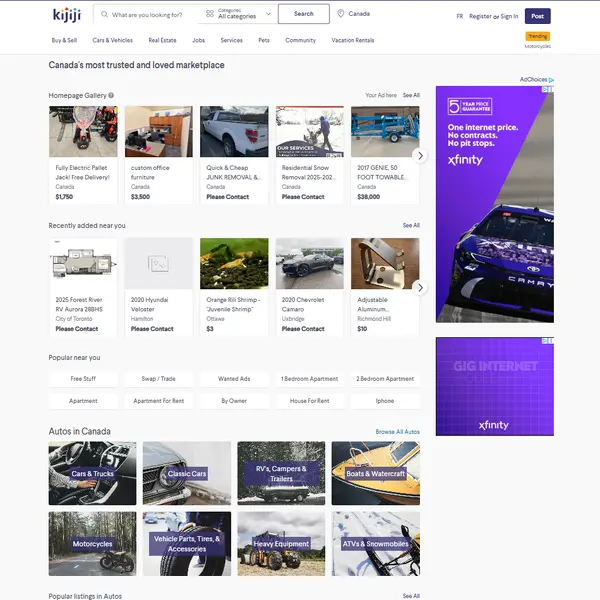
Every project runs the same way. We agree the scope first: which categories, which provinces or cities, which fields, how often. We build the crawler, run a sample and let you check the columns before anything is scheduled. Then it runs on your cadence - hourly for a narrow watch list, daily for dealer inventory, weekly for a broad category sweep.
Output is CSV, JSON, XLSX, a direct database load, or an API endpoint you call. We deduplicate on ad id, carry first-seen and last-seen dates on every ad, and flag rows where the price changed since the previous run. If a field stops appearing because the site changed, we repair the crawler. That maintenance is part of the service, not a change request.
Kijiji ad pages are rendered server side, and the record behind the page is consistent enough to map field by field. A standard extract covers:
Attribute blocks differ by vertical. A Cars and Trucks ad carries make, model, trim, kilometres, body type, transmission, drivetrain, colour, doors and an equipment list. A Long Term Rentals ad carries unit type, bedrooms, bathrooms, furnished, utilities, parking, pet rules, agreement type, move-in date and square footage. We flatten the block you need into named columns and keep the raw attribute list beside it.
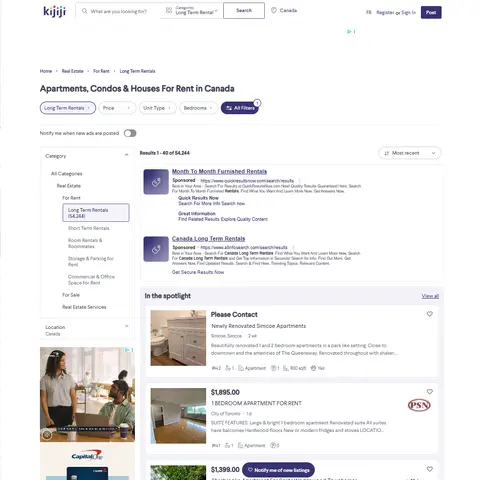
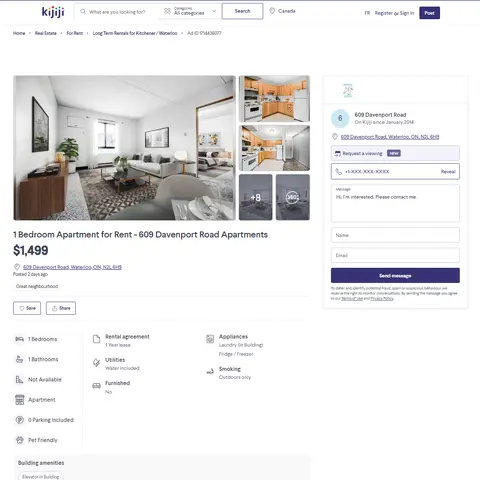
Kijiji moves constantly. In August 2026, the Cars and Trucks browse page for Canada reported 138,302 active ads at the start of a short run and 138,306 a few minutes later, and the all-Canada total across the eight top-level sections read 3,365,927. Those are point-in-time readings, not stable facts, which is why every row we deliver carries the snapshot date it was captured on.
Two site behaviours shape the crawl plan. A result page returns forty organic rows plus six paid Top Ads in the same block, so promoted ads have to be separated or they inflate counts and skew a price median. The offer type filter defaults to Offering, which quietly drops Wanted ads unless the crawl asks for them. Pagination is an offset over a fixed page size of forty; on that same run the offset walked to 135,960 of a reported 138,306 and still returned a full page.
Kijiji screens automated clients, and an ad id that no longer resolves is redirected to a not-found page rather than failing outright, so a removal has to be read from where the request lands. Anti-bot handling, proxy rotation and CAPTCHA handling are part of the service, and every run goes at a measured rate. We collect only publicly available data - everything a visitor can see on Kijiji - and we collect it legally.
Kijiji launched in Canada in 2005 as an eBay subsidiary and now runs general classifieds across the country. Ownership moved to Adevinta when the eBay Classifieds Group deal closed on 25 June 2021, putting Kijiji in the same group as Marktplaats and Gumtree. Adevinta was itself taken private by Permira and Blackstone and delisted from the Oslo Stock Exchange in June 2024. Those brands share a corporate parent, not a schema. A crawler written for Gumtree will not read kijiji.ca.
The site is addressed on two numeric axes. A browse page is /b-category-slug/location-slug/c[categoryId]l[locationId], so Cars and Trucks for the whole country is /b-cars-trucks/canada/c174l0, where 174 is the category and 0 is Canada. Category 174 sits under 27, Cars and Vehicles. Long Term Rentals is 37, under For Rent 30349001, under Real Estate 34. The ids are not sequential and do not encode depth, so the tree has to be read from the site rather than guessed.
Locations nest the same way: Canada is 0, Ontario is 9004, Toronto GTA is 1700272 and City of Toronto is 1700273. A keyword search inserts a k0 segment, as in /b-jobs/canada/jobs/k0c45l0. An individual ad lives at /v-category-slug/city-slug/title-slug/[adId], and the ten-digit ad id is the only part that carries meaning. Request that id under the wrong category or city slug and the correct ad still comes back, which makes the id the safe primary key. Jobs, real estate and general goods all share this grammar; Kijiji Autos runs on its own domain with its own rules.
Get a Quote
Developers

Customers worldwide

Pages extracted

Hours saved for our clients
€199 / one-time
setup fee - included
€169 / mo
setup fee €499
€229 / mo
setup fee €499
€349 / mo
setup fee €499
€549 / mo
setup fee €799
Delivery: CSV, JSON or XLSX files, our API or a JSON feed. MCP server on request.
Full plan details →Buyers scrape Kijiji for questions a retail catalogue cannot answer. Supply is split between private sellers clearing a garage and dealers rotating stock, and the two behave differently. Dealer inventory turns on a business cycle, reprices in steps and reappears under the same store. Private supply is lumpy, seasonal and priced by hope. Because Kijiji labels which is which, the two can be held apart and measured separately instead of averaged into noise.
Three analytical shapes come up again and again. Price movement on a single ad: the same ad id observed across days exposes every reduction, and the earlier asking price is carried on the ad itself. Time to sale: an ad has an activation date and a scheduled end date, so a listing that vanishes well before its end date is a strong sold-through signal, while one that runs to term and returns under a new id is not. Regional inventory: every ad carries a numeric location id inside a province tree, so stock can be counted per city and compared week on week.
On top of those, Kijiji price data supports dealer competitor sets, asking-rent series by city and neighbourhood, resale checks on specific models, and supply counts that tell a merchandiser what is already saturated in a given province.

Every day, a full snapshot of all active Homegate listings in one Swiss region, with photos and PDFs, for a company's own listing-history database.
Learn More
A real-estate analytics company got two portals archived listing by listing: the saved page, a JSON file and every photo, 420K+ listings in all.
Learn More
US real-estate investors get agent lists for their markets from MLS portals under their own 2FA logins, plus realtor.com and Zillow directories.
Learn MoreLearn how to use web scraping to solve data problems for your organization

Real estate teams work in a fragmented data landscape. The sites that drive demand in Boston look nothing like the ones that matter in Berlin, São Paulo, Dubai, or Mumbai.

Real estate teams are operating in a data environment that is bigger, faster, and more fragmented than ever. Listings go live and disappear in hours, price cuts happen quietly, and the portals that matter most in each country are rarely the same global “top 5.”

Six jobs that scraped property data does, each backed by a ScrapeIt project: seller leads, listing monitoring, image datasets, weekly market supply, sold records and unit-level rentals. For every use case - the fields it needs and how often to refresh them.
ScrapeIt is a managed web scraping agency. We build, run and maintain the crawlers and hand over the data, so you do not run infrastructure or debug a parser at midnight. Work is scoped in writing, delivered on a schedule and monitored between runs, and we say plainly when a source will not support what is being asked. Send the categories and cities that matter to you and we will come back with a field list, a sample file and a cadence.
Yes. The ScrapeIt Kijiji Canada API returns ad id, title, price, seller type, category path and location as JSON from an endpoint we host, refreshed on the schedule you set. The same data also comes as CSV or XLSX files or straight into your database. We monitor the pages we crawl and keep your output schema stable even when the source moves underneath it.
Yes, and it is read off the ad rather than guessed. The catch is that the flag is not one field. Goods and vehicles carry an attribute named forsaleby with the values ownr and delr. Long term rentals use forrentbyhousing, with ownr and reprofessional. Jobs use jobofferedby. Ad pages also expose a seller type on the poster record and dealer markers among the ad flags. We normalise all of that into one seller type column and keep the raw value beside it. As an illustration of the split, on 26 August 2026 the Cars and Trucks section for Canada reported 110,269 dealer ads against 27,973 owner ads.
Classified ads are posted by private individuals, so names, phone numbers and sometimes street detail turn up in free text. Our default output is limited to listing and commercial data: title, price, dates, category, location, attributes, images and seller type. Seller identifiers can be pseudonymised behind a stable hash or excluded entirely on request, and free-text fields can be redacted before delivery. Kijiji already masks part of the seller phone number in the page payload on the ads we inspected. Personal information handled in the course of commercial activity in Canada falls under PIPEDA, the Personal Information Protection and Electronic Documents Act. We scope the extract to what you actually need.
Most Kijiji ads run for 60 days, with shorter terms in some categories such as vacation rentals and certain professional accounts, and each ad carries its own activation date and end date. Reposting starts a fresh term, and a paid Bump Up resets the date the listing sorts by, which is why the sorting date and the activation date are stored as separate columns rather than merged. For price we key on ad id and compare run to run: the current amount, the earlier amount where Kijiji carries one, and the price drop flag on the ad. Every row gets a first-seen date, a last-seen date and a change marker, so a genuine disappearance can be told apart from a repost under a new id.
All eight top-level sections are addressable - Buy and Sell, Cars and Vehicles, Real Estate, Jobs, Services, Pets, Community and Vacation Rentals - down to any leaf category beneath them. Geography can be the whole country, a single province such as Ontario or Alberta, a metro region such as Toronto GTA, or one city, because each level carries its own numeric id. French and English listings are both captured as posted. Kijiji Autos runs on a separate domain and is scoped as its own project. Delivery is CSV, JSON, XLSX, a database load or an API, on whatever schedule you set.
Step 1 - Make a Request
You share your needs, expectations, and desired timeframe. We’ll suggest the best solution based on your request and budget.
Step 2 - Configuring Custom Web Crawlers
Our specialists configure the crawlers and extract a sample dataset for your review before proceeding with the full-scale extraction.
Step 3 - Collect and Deliver
Once you approve the sample, we launch the project and start full data collection. We gather, filter, and structure the data for easy use, delivering it on time in your preferred format.
Step 4 - Maintain and Support
Our team manages ongoing processes, monitors website changes, and supports all data extraction cycles. We can also help integrate data into your systems or create dashboards to simplify analysis.
Kijiji Canada data from €169/month. Free project assessment, reply within 1 business day.

Scrapeit Sp. z o.o.
10/208 Legionowa str., 15-099, Bialystok, Poland
NIP: 5423457175
REGON: 523384582