Homegate Data: A Daily Snapshot of Two Cantons with 46K Photos
Every day, a full snapshot of all active Homegate listings in one Swiss region, with photos and PDFs, for a company's own listing-history database.
Learn More
Trade Me Property runs on New Zealand terms - deadline sale, price by negotiation, rateable value, rent per week. We collect it as it is written.
Plans from €169/month · Free project assessment · Reply within 1 business day
We run the crawler and you receive files. Trade Me data arrives as CSV, JSON or XLSX, or through a REST endpoint your systems call. Delivery goes to S3, Google Cloud Storage, SFTP, a database you nominate, or email for small sets.
Schedules match the pace the data moves. Rentals and open homes reward a daily pass. A regional for-sale snapshot is usually weekly. A single extract for a one-off market study is fine too.
Every run is checked before it ships: row counts against the previous run, null rates per column, and an alert when a field stops populating because a template changed. When the site changes, we fix the crawler. That is the part you are actually buying.
Scope is agreed per project. A property build usually starts from the listing page and the search result rows behind it, and lands as one row per listing per collection date.
Motors, jobs and marketplace rows carry their own columns: make, model, year, odometer and body type for vehicles; job title, employer, location and any listed pay for jobs; category, auction closing time and Buy Now price for general goods. We keep the source column names and the cleaned ones side by side so a disputed value can be traced back to the page it came from.
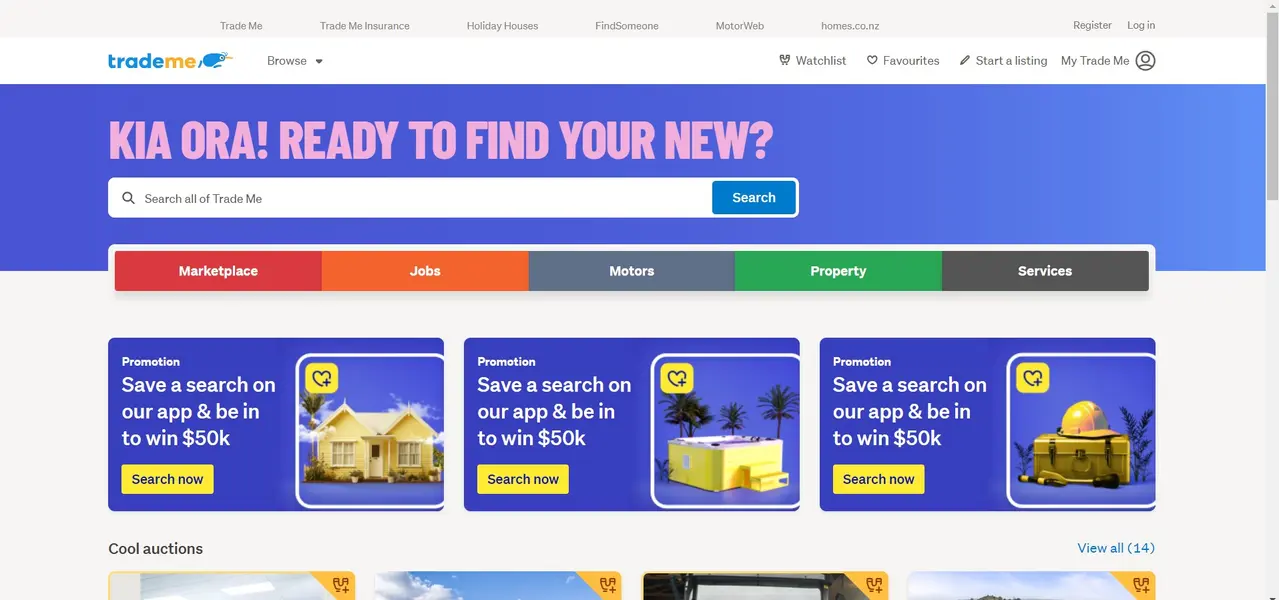
Trade Me does not serve its pages to naive clients. A property search path such as /a/property/residential/sale/wellington/wellington is refused outright rather than served. That is a refusal, not a page of listings, and it is the first thing that breaks a script written against the site over a weekend.
Handling that is our side of the job: pacing, proxy rotation and page rendering are part of the service, and we watch the templates, because search pages change. Collection is planned around the site's own structure - property by region, district and suburb, jobs by region, category and employment type - so coverage is known before the first run.
Addresses are predictable, which helps. A residential sale listing sits at /a/property/residential/sale/listing/ followed by a numeric listing id. That id is what makes a longitudinal dataset possible: it lets you match the same property across a price revision or a relisting instead of counting it twice.
Trade Me is the dominant online marketplace in New Zealand. It started as a general auction site and grew large vertical sections around that core: Trade Me Property, Trade Me Motors, Trade Me Jobs, Trade Me Services, and the general marketplace where goods still sell by auction with a closing time or by Buy Now.
Property leads this page. It splits into residential for sale, residential to rent, lifestyle, rural, commercial for sale and for lease, retirement villages and new homes. Listings come from licensed agencies and from private sellers - Trade Me publishes its own guide for owners listing without an agent - so agency attribution is not a safe assumption on every record.
The vocabulary is local, and it decides how the numbers should be read. A listing carries a sale method rather than always a figure: asking price, enquiries over, auction, tender, price by negotiation (no price shown, offers invited), or deadline sale (offers close at a stated date and time). Sellers give floor and land area in square metres, and either capital value or rateable value, the council valuation a property is rated on rather than a market appraisal. Rent is quoted per week. The geography runs region, then district, then suburb, from Tāmaki Makaurau Auckland or Whangārei down to a single suburb such as Karori or Fendalton.
Get a Quote
Developers

Customers worldwide

Pages extracted

Hours saved for our clients
€199 / one-time
setup fee - included
€169 / mo
setup fee €499
€229 / mo
setup fee €499
€349 / mo
setup fee €499
€549 / mo
setup fee €799
Delivery: CSV, JSON or XLSX files, our API or a JSON feed. MCP server on request.
Full plan details →Trade Me is the dominant marketplace in New Zealand, and its listing pages hold what a market study needs: the price string and sale method, rateable value, chattels, open homes and agency attribution, down to suburb level. Motors and jobs add their own columns on the same schedule.
We read pages served to any visitor, on a schedule, and we keep the history. Price history is what a single visit cannot give you. What a listing asked last month, a switch from deadline sale to asking price, the week it vanished and the week it returned under a new id - those exist only if somebody was recording them all along.
Every day, a full snapshot of all active Homegate listings in one Swiss region, with photos and PDFs, for a company's own listing-history database.
Learn More
A real-estate analytics company got two portals archived listing by listing: the saved page, a JSON file and every photo, 420K+ listings in all.
Learn More
US real-estate investors get agent lists for their markets from MLS portals under their own 2FA logins, plus realtor.com and Zillow directories.
Learn MoreLearn how to use web scraping to solve data problems for your organization

Real estate teams work in a fragmented data landscape. The sites that drive demand in Boston look nothing like the ones that matter in Berlin, São Paulo, Dubai, or Mumbai.

Real estate teams are operating in a data environment that is bigger, faster, and more fragmented than ever. Listings go live and disappear in hours, price cuts happen quietly, and the portals that matter most in each country are rarely the same global “top 5.”

Six jobs that scraped property data does, each backed by a ScrapeIt project: seller leads, listing monitoring, image datasets, weekly market supply, sold records and unit-level rentals. For every use case - the fields it needs and how often to refresh them.
ScrapeIt is a managed web scraping service. We build the crawler, run the Trade Me scraper on your schedule, watch it, and repair it when the site changes. You do not maintain code and you do not run proxies.
Start by telling us the regions, the property types and the fields you need. We come back with a sample extract from a small slice, so you can check the columns against a real listing before any schedule is agreed.
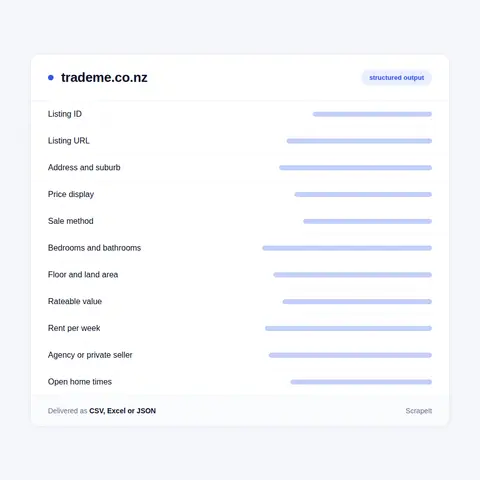
Yes. The ScrapeIt Trade Me API returns listing id, the price string and sale method, suburb, district and region, bedrooms, rateable value and open home times as JSON from an endpoint we host, refreshed on the schedule you set. Motors, jobs and marketplace rows come through the same endpoint with their own columns. The same data also comes as CSV or XLSX files or straight into your database.
Yes, and the per week part matters. New Zealand quotes residential rent weekly, not monthly. Trade Me's own rental search takes a minimum and maximum price in NZD per week and returns a rent per week value. A team that assumes a monthly figure and multiplies by twelve will be wrong on every row, because a year holds 52 weeks rather than 48. We deliver the number as published and label the column per week. If your model needs a monthly figure we add a derived column, rent times 52 divided by 12, and keep the original beside it. We do not convert silently.
A listing page shows the structured basics: listing id, title, address, suburb and district, price display, bedrooms, bathrooms, floor area, land area, property type, agency details, photos and open homes. Two things buyers ask for regularly take more work. Rateable value or capital value is entered by the seller when the listing is created, and chattels - the fixtures, fittings and appliances included in the sale - are normally written into the description rather than shown as their own field, so they need parsing out of free text. The third is history. What a listing asked last month is not on the page. Price reductions, a change of sale method, and withdrawal followed by a relist exist only in a record taken repeatedly.
Treat them as temporary. Listings run to a closing date and leave the active search once they expire, sell or are withdrawn. That is the strongest argument for continuous collection over a single large pull: whatever you did not record before a listing left is gone from your side of the fence. We put a first seen date, a last seen date and a collection timestamp on every row, so a disappearance becomes a data point rather than a gap. When a listing id reappears at a different price, you can read it as a relist instead of counting a new property. Auction outcomes and the spread between an initial asking figure and a final result are built the same way, from the sequence of observations rather than from one snapshot.
By default we deliver listing and commercial data: the property, the price, the sale method, the location, the agency. Agency name and branch are business attribution and we keep them. Individual agent names, direct phone numbers and email addresses can be excluded from your delivery on request, and we will exclude them by default if you say so at scoping. Private sellers do appear in property and in the general marketplace, so this is not a theoretical point. New Zealand's Privacy Act 2020 governs the collection and use of personal information about identifiable individuals. We collect only publicly available data - everything a visitor can see on Trade Me - and we collect it legally, with nothing behind a login.
Step 1 - Make a Request
You share your needs, expectations, and desired timeframe. We’ll suggest the best solution based on your request and budget.
Step 2 - Configuring Custom Web Crawlers
Our specialists configure the crawlers and extract a sample dataset for your review before proceeding with the full-scale extraction.
Step 3 - Collect and Deliver
Once you approve the sample, we launch the project and start full data collection. We gather, filter, and structure the data for easy use, delivering it on time in your preferred format.
Step 4 - Maintain and Support
Our team manages ongoing processes, monitors website changes, and supports all data extraction cycles. We can also help integrate data into your systems or create dashboards to simplify analysis.
Trade Me data from €169/month. Free project assessment, reply within 1 business day.

Scrapeit Sp. z o.o.
10/208 Legionowa str., 15-099, Bialystok, Poland
NIP: 5423457175
REGON: 523384582