The Entire Iherb Supplements Catalog, Captured End-to-End in 3 Days
Scraping supplement products from iHerb.com with full details, including descriptions and packaging variations.
Learn More
castorama.pl is the Polish Castorama storefront, part of the Kingfisher group. We build and run the crawlers and hand over its catalogue, prices and per-store stock on your schedule.
Plans from €169/month · Free project assessment · Reply within 1 business day
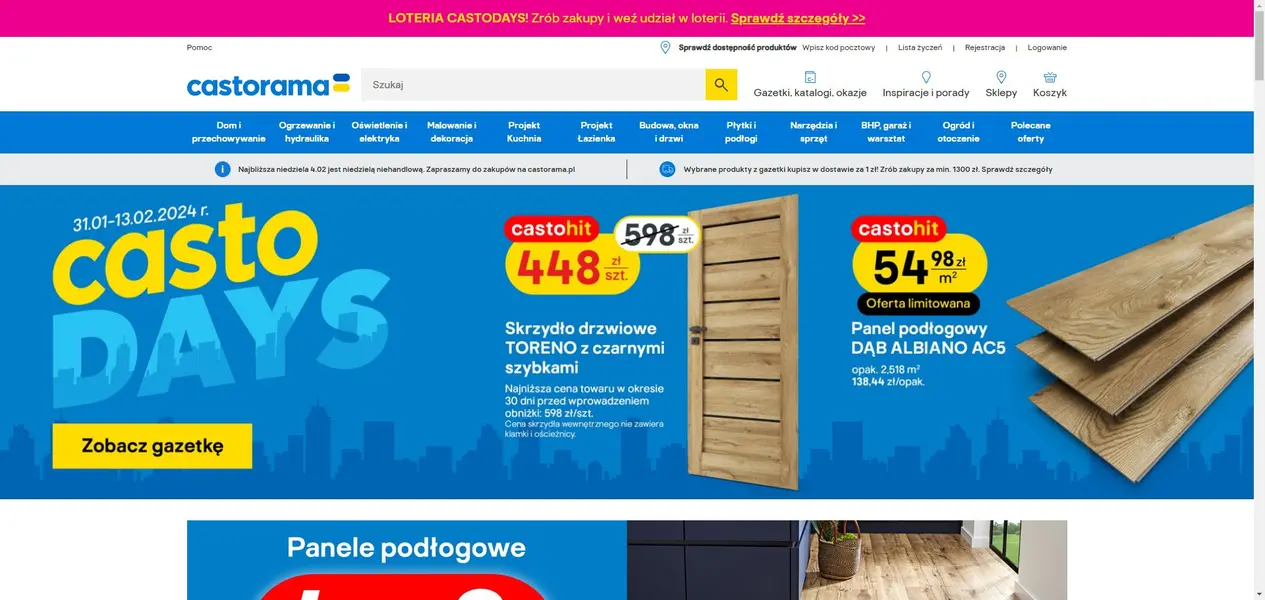
Common briefs: daily price and promotion tracking against other Polish DIY chains on matched EANs; assortment and rotation reporting for suppliers who need to see when a line lands or leaves; own brand against national brand share by category; unit price benchmarking across tiles, panels, paint and insulation; availability reporting by shop for field teams; and catalogue enrichment where an EAN list needs Polish names, parametry techniczne and images attached to it.
Because the EAN sits in the address itself, a supplier list of article numbers can be checked against the site directly, with no fuzzy name matching in between. That is the brief we are asked for most often and usually the first one delivered.
A product address on castorama.pl ends with a 13 digit number and the suffix _CAPL.prd, for example /farba-akrylowa-do-wnetrz-dekoral-sciany-i-sufity-snieznobiala-mat-10-l/5904000804987_CAPL.prd. That number is the EAN. The identifier you would normally have to reconstruct is already in the address, which removes an entire matching step before any data reaches you. The banner suffix is part of the grammar: castorama.fr uses the same shape ending _CAFR.prd. Categories are their own path type and end in.cat, nested as deep as the tree goes, for example /plytki-i-podlogi/plytki-podlogowe/plytki-ceramiczne/gres.cat.
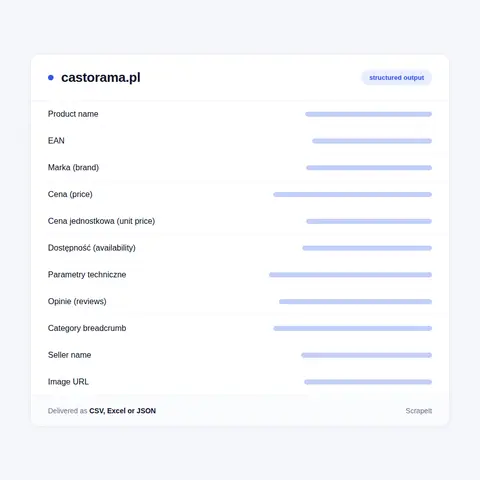
Fields we extract for each item:
Listing pages help too. Each one carries a paging block with the total result count, the first and last record shown, the page size and the next page number, so a category sweep knows its own size before it starts rather than discovering it by walking.
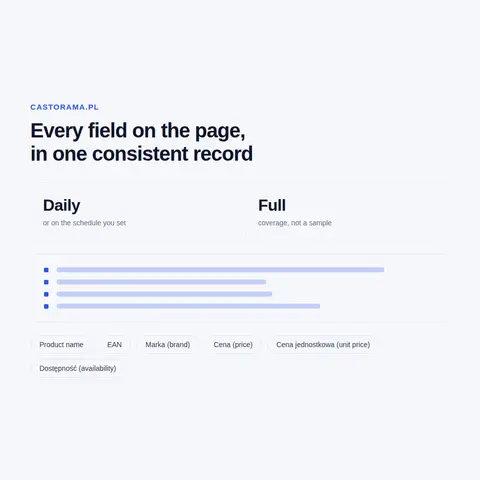
Availability on castorama.pl is not one national flag. The site's own FAQ states that once a shop has been selected, each product shows its availability in that shop. Fulfilment comes through as structured values rather than prose: home delivery with its lead time message, same day and next day Zamów i Odbierz (order and collect), and a distribution centre to shop route for goods that do not sit on the floor. Bulky lines - baths, doors, boards, bagged aggregates - behave differently from small tools here, and the fulfilment block is where that difference shows up.
Promotional structure deserves its own columns. The Polish storefront runs the Omnibus reference price presentation, so a discounted line is shown against a prior price rather than on its own. Listing pages also carry sponsored placements, which we flag or exclude so paid positions do not pollute a ranking series. Gazetka leaflet campaigns and the seasonal garden ranges rotate through the year, and rotation is usually the thing a single snapshot misses: a line that vanishes in October has not changed price, it has left the assortment.
Pages also hold a coverage calculator input, GPSR safety text, energy label data where the category requires it, spare parts availability and legal notices. Collection covers public product and pricing data only; no customer data is touched.
Castorama is a DIY, home improvement and garden chain in Poland, run by Castorama Polska as part of the Kingfisher group. This page covers the Polish storefront at castorama.pl and nothing else. Kingfisher also operates Castorama France at castorama.fr. The two are sibling banners under one owner, not one shop in two languages: they carry different assortments, price in different currencies and make their own range decisions. We collect the French storefront the same way when a project calls for it, and we keep it as a separate source rather than folding it into the Polish rows.
The shared ownership does surface in the Polish catalogue. Kingfisher own exclusive brands such as GoodHome, Colours and Magnusson sit in the assortment, and many of their articles carry EANs in the group GS1 blocks that begin 5059340 or 3663602 - the same blocks the French site uses. The Polish storefront even loads GoodHome as its own web typeface. Where a Polish supplier packs a group brand for this market, the article arrives on a Polish 590 prefix instead, so the brand label alone will not tell you which sourcing route a product took. The EAN will.
In January 2025 Kingfisher announced a Mirakl based marketplace for Castorama Poland, putting third-party merchant offers next to the assortment Castorama Polska sells itself. Kingfisher put the addition at over 500,000 third-party products alongside about 50,000 already sold directly. Product records carry a seller name, so first-party and merchant listings stay separable in the output instead of collapsing into one undifferentiated price list.
Get a Quote
Developers

Customers worldwide

Pages extracted

Hours saved for our clients
€199 / one-time
setup fee - included
€169 / mo
setup fee €499
€229 / mo
setup fee €499
€349 / mo
setup fee €499
€549 / mo
setup fee €799
Delivery: CSV, JSON or XLSX files, our API or a JSON feed. MCP server on request.
Full plan details →Most retail comparisons work on the shelf price. DIY does not. A box of gres (porcelain stoneware tile) is priced per box and covers a stated area. Panels sell per pack, trim and cable by the running metre, aggregates by the bag, paint by the litre with a coverage figure attached. Two products can look far apart on the ticket and sit within a few groszy of each other per square metre.
castorama.pl carries both numbers as separate fields, and that is what makes it workable as a source. On an archived capture of a Dune gres tile page from 5 October 2023 the box price was 129.57 PLN for 1.44 m2 and the unit price was 89.98 PLN per m2. On an archived Dekoral emulsion page from 25 March 2025 the tin was 82.98 PLN for 10 l, the unit price 8.30 PLN per litre and the stated Pokrycie (coverage) 120 m2. Both figures sit in the same payload, so a comparison can be built on whichever one the category actually trades on.
Unit codes need normalising before they compare. The storefront maps codes such as M2, M3, L, KG and TON onto display forms, and pack sizes vary by supplier, so we return the raw unit code next to the amount and let your side choose the target unit. Buyers scrape Castorama for exactly this reason: the per-unit figure is the only one that survives a repack.

Scraping supplement products from iHerb.com with full details, including descriptions and packaging variations.
Learn More
Daily scraping of lowest prices for 150K products on Allegro.pl to support marketplace pricing and margin optimization.
Learn More
Regular monitoring of Ralph Lauren clothing, footwear, and accessories sold across Amazon subdomains: AE, DE, ES, FR, IT, NL, PL, UK.
Learn MoreLearn how to use web scraping to solve data problems for your organization

If you sell online, run a marketplace, or advise e-commerce clients, you already know why eBay matters: it’s one of the few places where big retailers compete side by side with thousands of small merchants and private sellers.

E-commerce teams do not just need “some” competitor data anymore. They need a continuous stream of real prices, discounts, stock levels, reviews, and seller behavior from the platforms that actually shape their markets.
Amazon provides valuable information gathered in one place: products, reviews, ratings, exclusive offers, news, etc. So scraping data from Amazon will help solve the problems of the time-consuming process of extracting data from e-commerce.
ScrapeIt is a managed web scraping agency. We build the crawler, run it on your schedule, watch it when the site changes and hand over clean files - CSV, JSON, XLSX or an API endpoint your systems can call. Nothing to maintain on your side. We collect only publicly available data - everything a visitor can see on Castorama - and we collect it legally. Request rates are set conservatively, and when a field stops being published we say so rather than filling the gap with a guess.
Yes. The ScrapeIt Castorama API returns EAN, product name, brand, gross and net price, unit price and per-shop availability as JSON from an endpoint we host, refreshed on the schedule you set. The same data also comes as CSV or XLSX files or straight into your database.
Availability on the site is answered against a selected shop, and the FAQ on castorama.pl says as much: after choosing a shop, each product shows its availability there. Per-shop availability is therefore collectable, one shop at a time, and the cost is time rather than difficulty. A full catalogue across every Polish shop is a much larger run than a single national snapshot, so we normally agree a shop list and a product list up front and scope the job against that. Zamów i Odbierz (order and collect) options come back in the same request.
It is not the same catalogue. castorama.fr is a separate Kingfisher banner with its own assortment, its own prices and euro currency. What the two share is the platform and the group own brands. The URL grammar is nearly identical - a slug, an EAN and a banner suffix, _CAFR.prd instead of _CAPL.prd - so the same crawler design carries over. We run it as a second source and keep the rows separate, which is what you want when comparing group pricing across markets.
We return the pack price and the unit price as they stand, rather than deriving one from the other. The site holds them as separate fields, including on pages where the unit price is not displayed on screen, so no arithmetic is needed on our side and none is invented. Unit codes come back raw - m2, l, kg and so on - and are normalised to your target unit only if you ask. Coverage values such as Pokrycie (coverage) and the per litre coverage figure arrive with the parametry techniczne (technical parameters).
Whatever cadence the brief needs, at a request rate we consider polite for the site. Daily is the common choice for price and promotion tracking, weekly or monthly for full catalogue and assortment work, and some clients run a small watchlist several times a day around campaign periods. A full catalogue sweep takes longer per cycle than a narrow watchlist, so the two are usually scheduled as separate runs rather than forced into one.
Step 1 - Make a Request
You share your needs, expectations, and desired timeframe. We’ll suggest the best solution based on your request and budget.
Step 2 - Configuring Custom Web Crawlers
Our specialists configure the crawlers and extract a sample dataset for your review before proceeding with the full-scale extraction.
Step 3 - Collect and Deliver
Once you approve the sample, we launch the project and start full data collection. We gather, filter, and structure the data for easy use, delivering it on time in your preferred format.
Step 4 - Maintain and Support
Our team manages ongoing processes, monitors website changes, and supports all data extraction cycles. We can also help integrate data into your systems or create dashboards to simplify analysis.
Castorama data from €169/month. Free project assessment, reply within 1 business day.

Scrapeit Sp. z o.o.
10/208 Legionowa str., 15-099, Bialystok, Poland
NIP: 5423457175
REGON: 523384582